Thuluth — the mother of scripts
Calligraphers call Thuluth umm al-khutut, the mother of scripts, because whoever masters it can master anything. Its name — 'one third' — refers to the proportion of straightness in its curves. Letters swell, dive and interlace; verticals lean with ceremonial grace; compositions stack into architecture. It is the hardest script to write well: a single Thuluth bismillah can take a master days. That is why it crowns mosque domes, frames mihrabs and carries royal inscriptions from Istanbul to Delhi. In the studio, give Thuluth room — it is a script of monuments, not margins.
A name, and who made it
The name has a second explanation. Early scripts were named after the width of their pen. The tumar, the pen kept for the decrees of the Umayyad caliphs, was cut twenty-four horse hairs wide, about 15 mm. A pen a third as wide, eight hairs or about 5 mm, gave thuluth its name. The TDV encyclopedia of Islam leans to this reading; its figures come from the Mamluk secretary al-Qalqashandi.
Who made the script is also disputed. English reference works usually credit Ibn Muqla, who died in 328 AH / 940. The TDV encyclopedia names scribes before him: Ibrahim al-Sijzi, who set a thuluth pen against the tumar, and his pupil al-Ahwal, who drew a lighter thuluth from it. What Ibn Muqla and his brother did was to put the rounded scripts under measure, letter by letter, against the alif.
A century later Ibn al-Bawwab pruned the scripts again. Then Yaqut al-Musta'simi, in Abbasid Baghdad, fixed the classical proportions of the six pens, thuluth among them. He died in 696 or 698 AH (1297 or 1299); the sources differ. Masters followed his model until Şeyh Hamdullah in Istanbul.
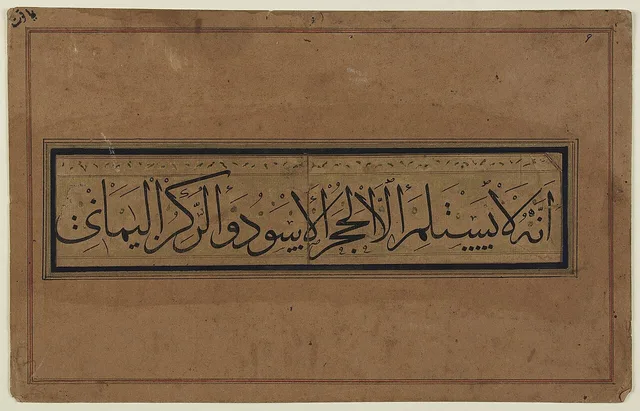
13th century · Library of Congress, Washington
Photo: Wikimedia Commons, public domain
The letter and its measure
The unit is the dot: the small rhomb the reed leaves when it is set down and drawn its own width. In thuluth the alif stands seven dots tall. Ottoman manuals describe how it is built: a starting dot that becomes its small hook, then two dots of chest, two of body and two of tail. Hashim al-Baghdadi's model book of 1961 sets the same seven dots beside it.
The ordinary pen is 2.5 to 4 mm wide. Written with a pen three times as broad, the script becomes jali thuluth, the size of panels and buildings. The round letters, such as 'ayn, fa, qaf, mim, ha and waw, keep their eyes open. Alif, kaf and lam carry the small hook at the head.
Vowel signs are written a third as wide as the letters' own pen. Small ornamental marks fill the gaps and tie a composition together. Two Ottoman forms show how far this can go: musalsal, where every letter is joined to the next, and mirror writing, where a phrase faces its own reflection.
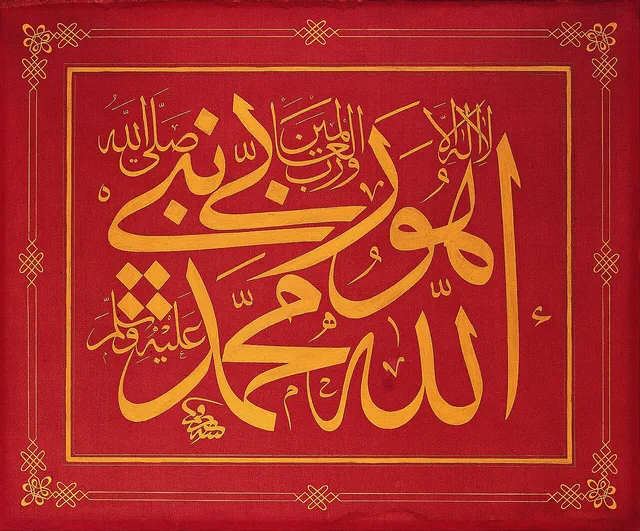
1809–1826 · Sakıp Sabancı Museum, Istanbul
Photo: Wikimedia Commons, public domain
Stone, glass and marble
Because it is slow to write, thuluth was never the hand of daily business. It was kept for words that had to stand out: chapter headings in the Qur'an, book titles, album pages and inscriptions. Under the Seljuks and the Ottomans it carried most building inscriptions until the eighteenth century, when jali ta'liq began to take its place.
In Mamluk Cairo it was written in gold and colour. A Qur'an from the madrasa of Uljay al-Yusufi, probably made for Sultan Hasan in the late 1350s, opens with the basmala in thuluth so large that a page holds only a few words. Enamelled glass lamps of the period carry the sultan's name in a broad band of it.
In Mughal Agra, the great gate of the Taj Mahal is framed by Qur'anic verses in black stone set into white marble. The chief calligrapher, Amanat Khan Shirazi, wrote the higher panels slightly larger, so that from the ground the lines look even.
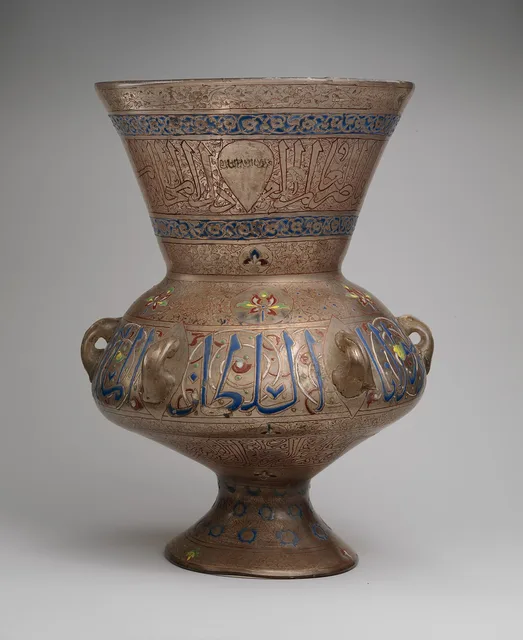
about 1340 · The Metropolitan Museum of Art, New York
Photo: Wikimedia Commons, CC0
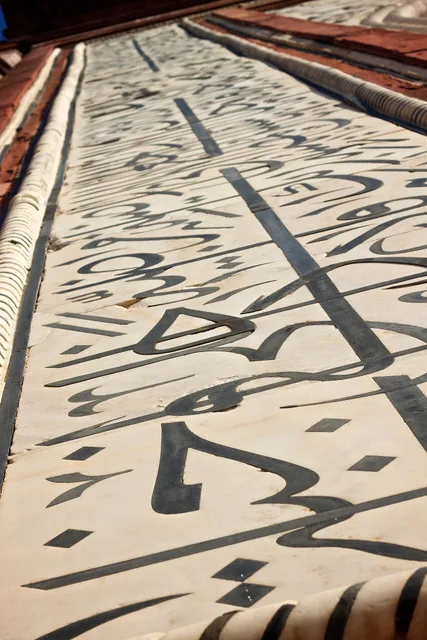
17th century · Taj Mahal, Agra
Photo: Edmund Gall, Wikimedia Commons (Taj Mahal calligraphy, India, 2013-03 (11551455483).jpg), CC BY-SA 2.0 (creativecommons.org/licenses/by-sa/2.0)
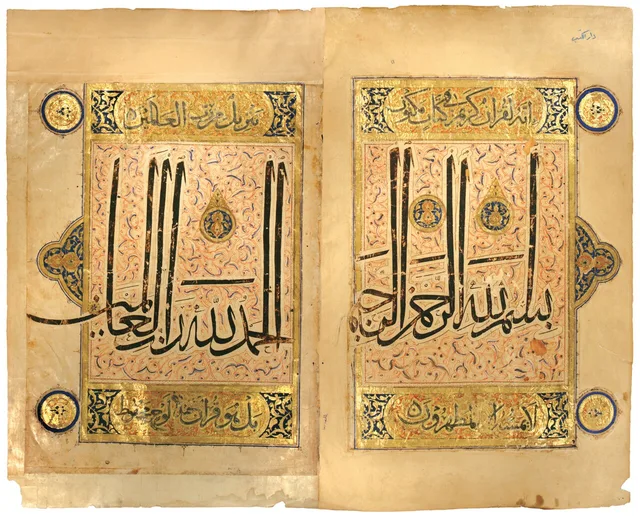
late 1350s · National Library of Egypt, Cairo (from the madrasa of Uljay al-Yusufi)
Photo: Wikimedia Commons, public domain
The Ottoman school
In Istanbul the script was reshaped more than once. Şeyh Hamdullah (1436–1520), teacher of Sultan Bayezid II, changed the forms and proportions of thuluth and naskh and the order of the line and the page. Ahmed Karahisari (about 1469–1556; some sources give 1566) went back to Yaqut instead. The TDV encyclopedia gives him the inscription of the Süleymaniye dome, rewritten under Sultan Abdülmecid by Abdülfettah Efendi, who kept its layout. His adopted son Hasan Çelebi (died 1594) wrote the mosque's inscriptions in stone and tile; English Wikipedia credits him with nearly all of its thuluth.
Hafız Osman (1642–1698) refined Hamdullah's line again. In jali, Mustafa Rakım (1757–1826) reached the proportion that later masters measured themselves against. Kazasker Mustafa İzzet (1801–1876) designed the eight great roundels of Hagia Sophia, hung during the restoration of 1847–1849. They are about 7.6 m across and carry the names of God, the Prophet, the first four caliphs, and Hasan and Husayn.
The model sheets of thuluth and naskh left by Mehmed Şevki Efendi (1829–1887) are still printed, and students still copy them.
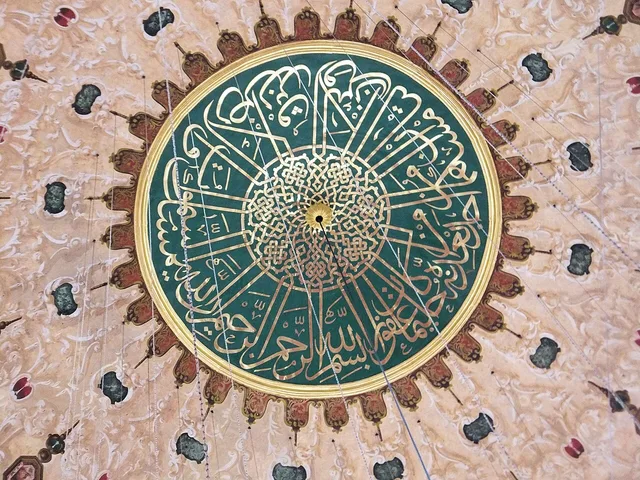
mosque built 1550–1557 · Süleymaniye Mosque, Istanbul
Photo: R Prazeres, Wikimedia Commons (Suleymaniye DSCF2145.jpg), CC BY-SA 4.0 (creativecommons.org/licenses/by-sa/4.0)
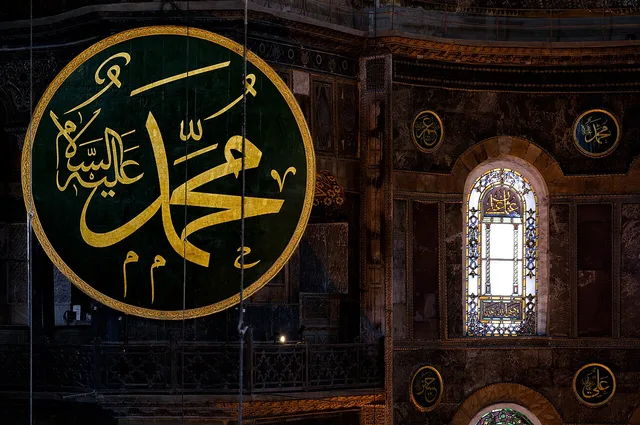
1847–1849 · Hagia Sophia, Istanbul
Photo: Laurens R. Krol, Wikimedia Commons (2017-09-01 Turkey, Istanbul DSC 3587 DxO 1.jpg), CC BY 4.0 (creativecommons.org/licenses/by/4.0)
How thuluth is learned
In the Ottoman tradition a student began with thuluth. The teacher wrote the model, the mashq, in front of him, and the first lesson was a short prayer: 'Lord, make it easy and not hard; Lord, let it end in good.' The student copied the model for a week. The teacher then rewrote the faulty letters under the student's lines, and gave a new model only when the old one was learned.
First come the single letters, from alif to ya. Then each letter joined to the others: ba with alif, ba with ba, and so on. Then whole compositions. A steady student needed three or four years. For the ijazah he copied a piece by an old master, chosen by his teacher; once his teacher approved it, he could sign his own work. Since the nineteenth century printed copybooks have helped: Hutut-i Osmaniye by Mehmed İzzet and Hafız Tahsin in Istanbul, and later Hashim al-Baghdadi's book in Baghdad.
If you are starting, write the alif many times before anything else and measure it against seven dots. Keep the eyes of the round letters open. When you study a finished piece, check that the uprights have the same width and the same lean, and that the small marks serve the words without crowding them.
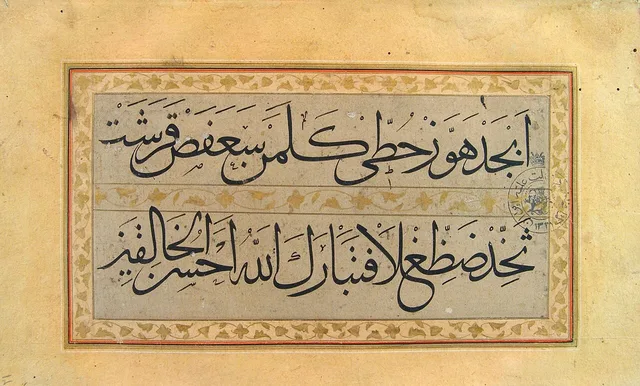
1593 · Golestan Palace Library, Tehran
Photo: Wikimedia Commons, public domain
Sources
- Muhittin Serin, "Sülüs", TDV İslâm Ansiklopedisi, vol. 38, Istanbul, 2010
- Muhittin Serin, "Meşk" (calligraphy section), TDV İslâm Ansiklopedisi, web edition
- Library of Congress, African and Middle Eastern Division, calligraphic fragment attributed to Yaqut al-Musta'simi (digital ID ascs.004)
- Hashim Muhammad al-Baghdadi, Qawa'id al-khatt al-'arabi, Baghdad, 1961
- Wikipedia (English), "Thuluth", "Ahmed Karahisari", "Süleymaniye Mosque", "Hagia Sophia", "Taj Mahal"
- Wikipedia (Turkish), "Kazasker Mustafa İzzet Efendi"
Try it now in this very script — الله نور
Open in the Studio →Written by the MASHQ studio · last updated 2026-10-05. Further reading, the standard references in English: Sheila S. Blair, Islamic Calligraphy (Edinburgh University Press, 2006) · Annemarie Schimmel, Calligraphy and Islamic Culture (New York University Press, 1984) · Yasin Hamid Safadi, Islamic Calligraphy (Thames and Hudson, 1978).
Keep exploring
From the store's journal: Styles guide: Kufic, Thuluth & Diwani