Hâfiz Osman
1642–1698 · Istanbul
The refiner. He edited Sheikh Hamdullah's letterforms with a jeweller's patience until Ottoman Naskh reached its final clarity — the Qur'an editions copied from his hand were printed for centuries and set the visual standard most Muslims still read today. He invented the fixed hilya layout, teaching sultans on Sundays and orphans on Wednesdays. 'Hâfiz Osman wrote it' became, simply, the highest compliment a page could receive.
Key works: the canonical hilya layout; Qur'ans that became the printed standard.
Achievements
- From about 1090/1679 developed his own style of thuluth and naskh, which replaced Şeyh Hamdullah's as the model for later calligraphers.
- Set out the hilye (the written description of the Prophet) as a single panel; this layout became standard. He also arranged the first hilye with a Turkish rendering.
- Wrote twenty-five Qur'ans from 1069/1659 on; the copy dated 1097/1686 was printed in 1881 by order of Abdülhamid II.
- Became calligraphy teacher of Sultan Mustafa II in 1106/1695 and had taught Ahmed III as a prince.
- About fifty of his pupils are known by name; he taught poor children on Sundays and well-off children on Wednesdays, without fee.
Taught by: Derviş Ali the Elder (Büyük Derviş Ali), Suyolcuzade Mustafa Eyyubi, Nefeszade Seyyid İsmail Efendi
Taught: Yedikuleli Seyyid Abdullah Efendi (Haşimizade Abdullah Efendi), Rodosizade Abdullah, Yusuf Rumi, İmam Derviş Ali, Derviş Mehmed Kevkeb, Kürtzade Bursalı İbrahim, Bursalı Mehmed, Sultan Mustafa II, Ahmed III
His work
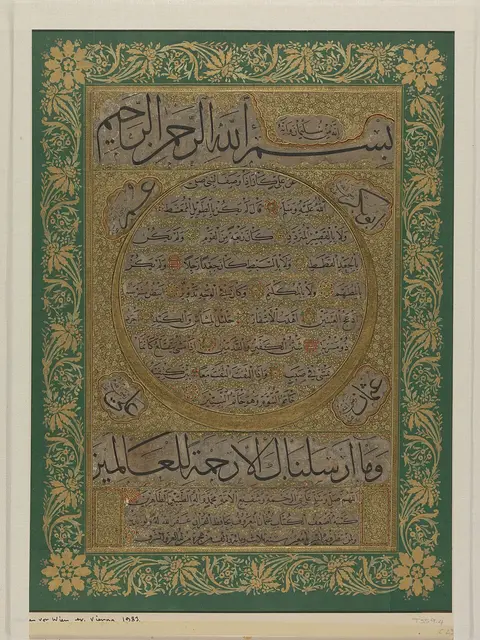
Istanbul, 1691–1692 · Chester Beatty Library, Dublin (T 559.4)
Photo: Wikimedia Commons, public domain
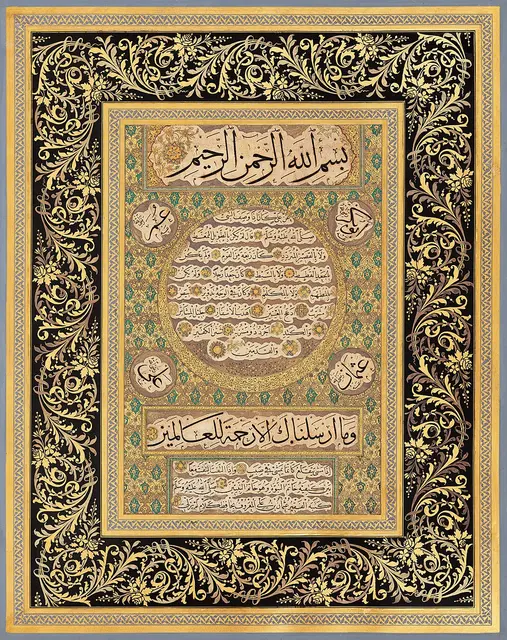
about 1670–1680 · Sadberk Hanım Museum, Istanbul
Photo: Wikimedia Commons, public domain
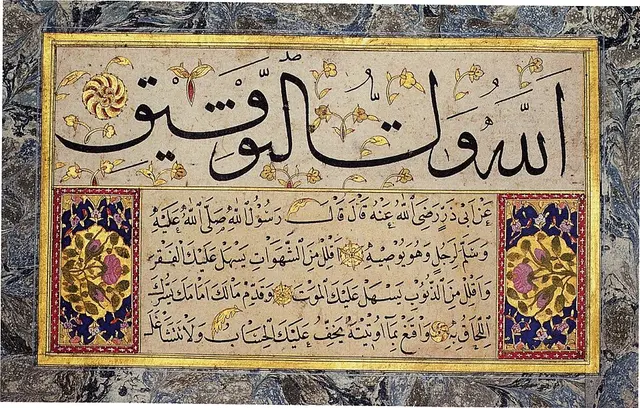
Istanbul, 1693–1694 · Museum für Islamische Kunst, Berlin (I. 1985.11.3)
Photo: Wikimedia Commons, public domain
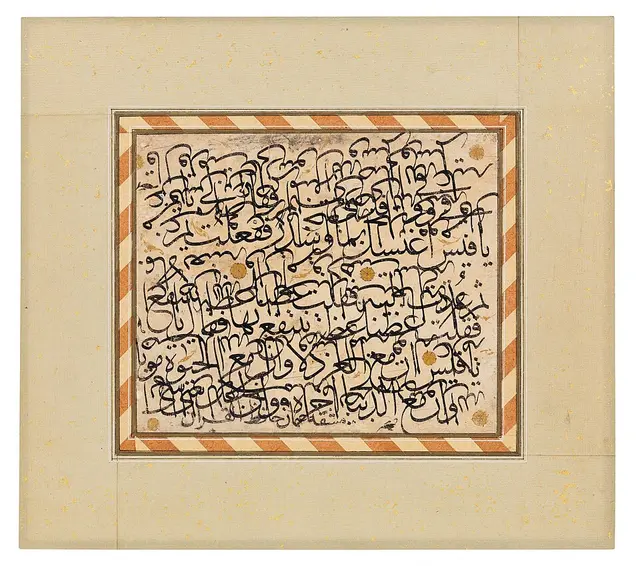
about 1680 · Sadberk Hanım Museum, Istanbul
Photo: Wikimedia Commons, public domain
Write in the tradition this hand shaped.
Write in this tradition now →Write in Naskh yourself, free: the Naskh calligraphy generator · your name in Arabic calligraphy
Living calligraphers you can buy from — signed originals on paper, from AED 550: Anwar Alhulwani (Thuluth) · Ahmed Alhawary (Jali Thuluth, Naskh) · Rasha Kasim (Kufi) — or every Naskh piece the store makes: Naskh collection.
Sources
- TDV İslâm Ansiklopedisi, 'HÂFIZ OSMAN' (M. U. Derman, 1997): dates, teachers, style, Qur'ans, hilye, students islamansiklopedisi.org.tr
- English Wikipedia: hilye layout, teaching, Mustafa II en.wikipedia.org
- Turkish Wikipedia: hilye, sultans taught tr.wikipedia.org
- Arabic Wikipedia: Arabic name, 25 mushafs, 1052-1111 AH ar.wikipedia.org
- Persian Wikipedia: life (with inconsistent hijri dates) fa.wikipedia.org
- Wikidata item wikidata.org
Written by the MASHQ studio · last updated 2026-10-05. Further reading, the standard references in English: Sheila S. Blair, Islamic Calligraphy (Edinburgh University Press, 2006) · Annemarie Schimmel, Calligraphy and Islamic Culture (New York University Press, 1984) · Yasin Hamid Safadi, Islamic Calligraphy (Thames and Hudson, 1978).