
Tawqi' and Riqa' — the chancery pair
Two of the classical six pens lived not in Qur'ans but in the state's paperwork. Tawqi' — 'the signing' — was the script of caliphal decrees: Thuluth's forms compressed and speeded up, with letters linking to each other in unexpected places so a line flows almost unbroken. Riqa' — its smaller sibling, script of notes and petitions — shrank the same logic further; it later inspired the name of the modern everyday Ruq'ah, though the two are different hands. Together they show calligraphy's practical spine: for every ceremonial script displayed on a wall, a working script moved the empire's letters, contracts and signatures. The beauty was not optional even in bureaucracy — a chancery hand WAS the state's face.
A script named after a ruling
In the early caliphate, petitions were read out to the ruler in open audience, and his decision was written on the petition itself. That short decision was called a tawqi'. At first caliphs wrote it in their own hand; later, secretaries drafted it by fixed rules, a practice known as tawqi' 'ala al-qisas, 'ruling on the petitions'. Harun al-Rashid handed this duty to his vizier Ja'far ibn Yahya al-Barmaki, and a special office for rulings appeared.
The script took the name of the act. The TDV İslâm Ansiklopedisi credits a secretary and poet named Yusuf, known as Laqwa, with drawing it out of Thuluth in the eighth century. Al-Fadl ibn Sahl (d. 202/818), vizier of the caliph al-Ma'mun, named it al-riyasi and ordered the diwan's decrees and letters to be written in it. The Arabic Wikipedia gives the founder's name as Yusuf al-Shajari.
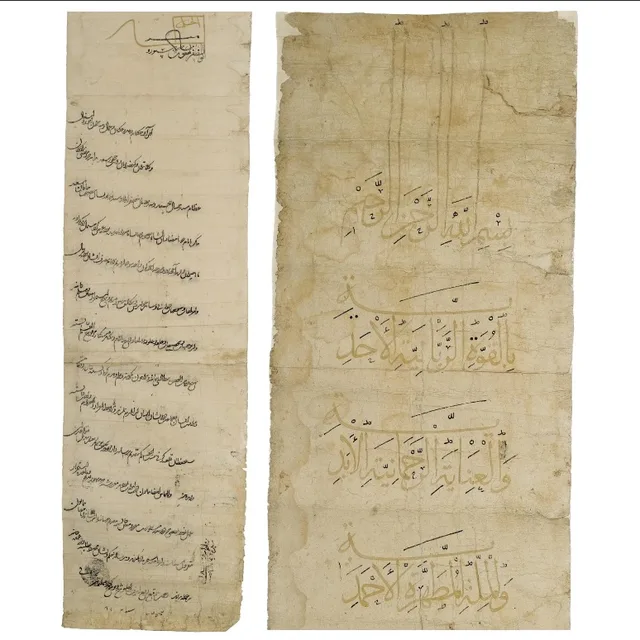
reign of Ya'qub, 883–896 AH (1478–1490) · Private collection (sold at Sotheby's, London, 2007)
Photo: Wikimedia Commons, public domain
From Ibn Muqla to Yaqut
Until the early tenth century, in the period writers call al-khatt al-mawzun, the 'weighed script', tawqi' was refined mainly inside the chancery, the Diwan al-Insha'. Then the vizier Ibn Muqla (d. 328/940) and his brother Abu 'Abdallah sorted the scripts and bound each to measured rules. That opened the age of al-khatt al-mansub, the 'proportioned script'. TDV says Ibn Muqla took particular care over tawqi'; the English Wikipedia calls him its developer, though the older sources place its birth a century before him.
Ibn al-Bawwab (d. 413/1022) refined it along with the other pens. Ibn al-Khazin (Abu'l-Fadl Ahmad al-Dinawari) set down its classical measures. Yaqut al-Musta'simi (d. 698/1298) and his school then fixed it as one of the six pens, and his followers carried it east. An album page in the Istanbul University Library pairs naskh by Muhammad-Qasim with tawqi' by Yahya al-Jamali, written in Shiraz and dated 746/1345–46.
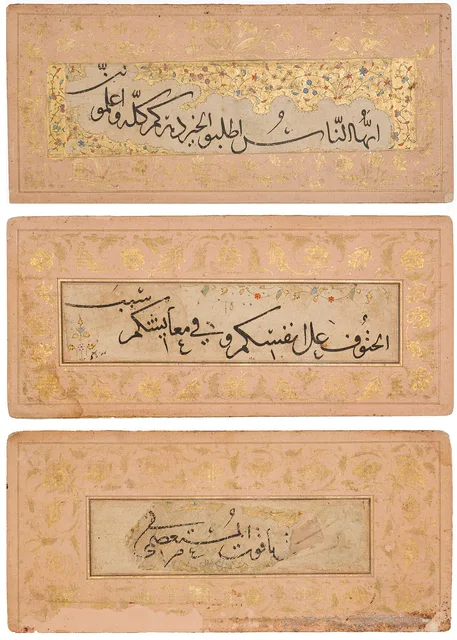
before 1298 · Khalili Collections, London
Photo: Wikimedia Commons, public domain
How to recognise tawqi'
Tawqi' is written with a nib as wide as Thuluth's, yet everything in it is smaller. The alif of Thuluth runs to about seven dots of its pen; the alif of tawqi' to five. Its bowls and descenders are shorter and its letters rounder.
Three habits give it away. Letters that normally stand apart lean in, touch and join, so whole words run as one movement. The line tends to climb toward its end. And the small eyes of 'ayn, fa', qaf and mim inside a word are left open, sometimes almost erased. The Mamluk secretary al-Qalqashandi, in Subh al-A'sha, lists shapes proper to tawqi' and rare in Thuluth, such as a ra' that curls upward and a waw bent up like a kaf.
A fourteenth-century Qur'an page in the Library of Congress shows the joining clearly: in one word an alif and a lam are tied by a small upturned loop. Scribes also signed their colophons in it: in a copy of al-Busiri's poem in the Walters Art Museum, Ridwan ibn Muhammad signed in gold tawqi' in 767/1366, though the text is in Thuluth and Naskh.
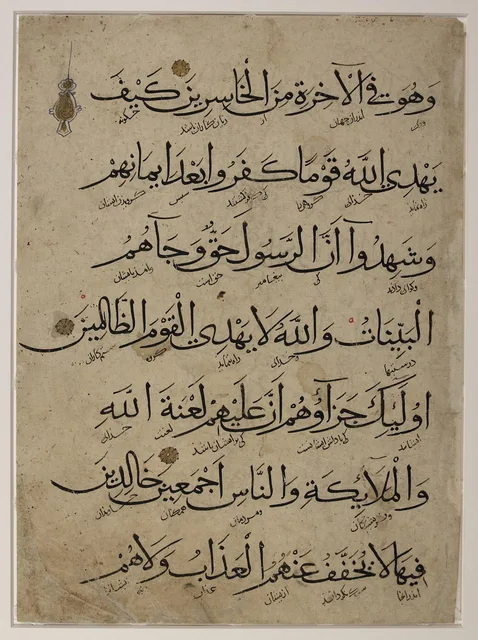
14th century · Library of Congress, Washington
Photo: Wikimedia Commons, public domain
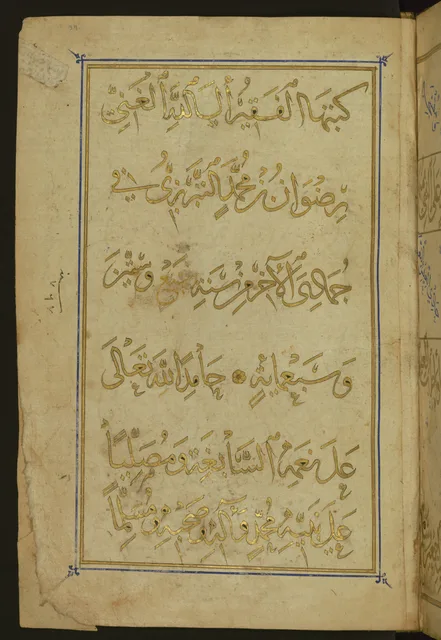
767 AH (1366) · Walters Art Museum, Baltimore (W.581)
Photo: Wikimedia Commons, public domain
Riqa': the pen of colophons and diplomas
Riqa' grew out of tawqi' and kept its rules. Its name means 'slips', the small, measured sheets used for letters and notes. Its nib is usually half that of tawqi', about the width of a naskh pen, and its alif measures five dots of its own pen, so the whole script is smaller, finer and rounder still. Letters that do not join in ordinary writing, such as alif, ra' and waw, reach out to the next letter. The eyes of 'ayn, qaf, mim and waw close up, and the knot of lam-alif disappears.
Riqa' became the working hand of the book. Scribes used it for colophons and for notes of collation, hearing (sama') and ownership. In a book written by Ibn Arghun of Shiraz in 918/1512, a line of gold riqa' names its dedicatee, the Ottoman sultan Selim I. Calligraphers wrote their diplomas in it, hence its other name, khatt al-ijaza. Ottoman courts used it for deeds and endowments until Diwani replaced it; in Iran, ta'liq did. Persian scribes also used it for translations between the lines: in 1838 Visal of Shiraz copied an Arabic prayer in black naskh with its Persian version in red riqa'.
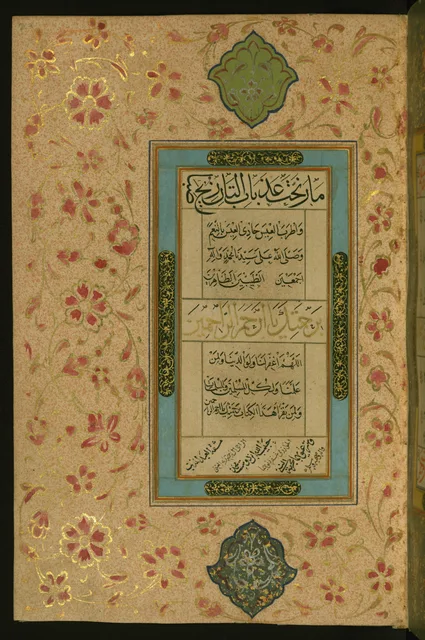
17th–18th century (11th–12th century AH) · Walters Art Museum, Baltimore
Photo: Wikimedia Commons, public domain
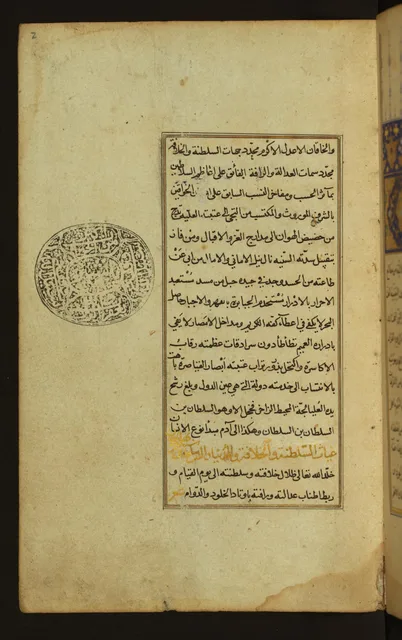
918 AH (1512); seal 1130 AH (1717) · Walters Art Museum, Baltimore (W.591)
Photo: Wikimedia Commons, public domain
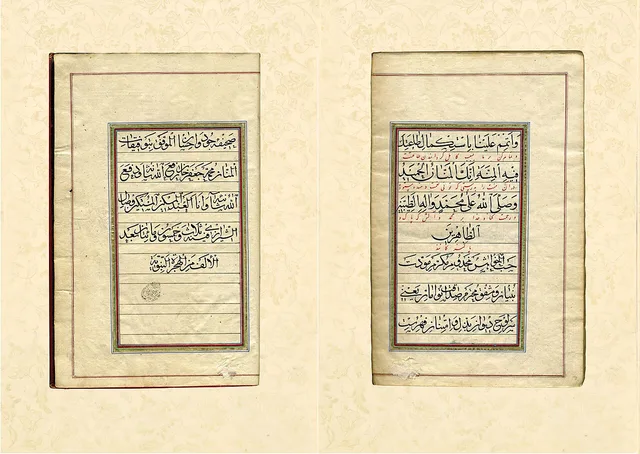
1838 · Museum of Decorative Arts, Isfahan
Photo: Wikimedia Commons, public domain
Where to find them, and what came after
Tawqi' served the Seljuk chanceries, and the Ottomans used it until Diwani appeared in the reign of Mehmed II. After that the Ottoman school kept it for small duties: sura headings and verse counts in a mushaf, and album pieces. Şeyh Hamdullah (d. 926/1520) wrote panels pairing one line of tawqi' with three lines of riqa'; one is in the Topkapı Palace Library (Emanet Hazinesi 2084).
Some Persian scribes liked to set the six pens side by side on a closing page. In 888/1483 Zayn al-'Abidin ibn Muhammad al-Shirazi finished a Qur'an in thirty parts for the Aq Qoyunlu ruler Ya'qub Beg. One of its colophon pages, now in the Chester Beatty Library, steps from muhaqqaq through naskh, thuluth and rayhan to a last line in tawqi'. The same ruler's decrees opened with large lines of gold tawqi'.
Modern Ruq'ah shares the name; TDV treats it as another hand with the traits of Diwani, while the English Wikipedia calls it riqa' simplified. Mümtaz Efendi (d. 1872) gave it rules in the Ottoman government offices, and Mehmed İzzet Efendi (d. 1903) the form most people learn today. Anyone who wants to read old books should still know tawqi' and riqa'. On a manuscript's last page the scribe's signature is very often in one of them. Look for the five-dot alif, the joined letters and the rising line.
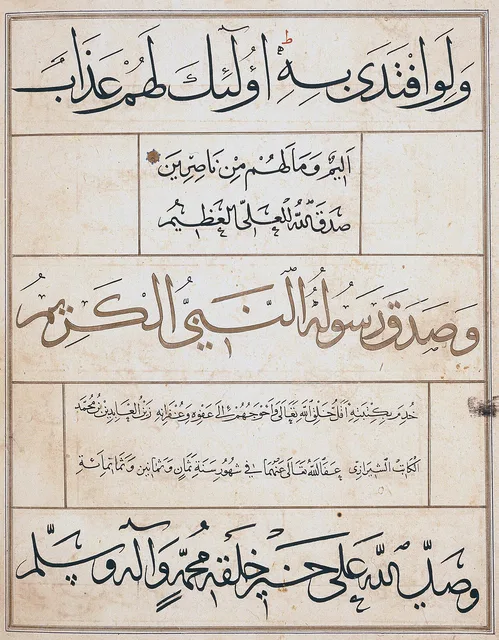
888 AH (1483) · Chester Beatty Library, Dublin (Is 1502, f.24b)
Photo: Wikimedia Commons, public domain
Sources
- Muhittin Serin, "Tevkî'" (the script), TDV İslâm Ansiklopedisi, vol. 41, 2012
- Erdoğan Merçil, "Tevkî'" (the document), TDV İslâm Ansiklopedisi, vol. 41, 2012
- Muhittin Serin, "Rikâ'" and "Rik'a", TDV İslâm Ansiklopedisi, vol. 35, 2008
- Wikipedia (English), "Tawqi" and "Reqā'"; Wikipedia (Arabic), "Khatt al-ijaza"
- Maryam Ekhtiari, "Jamāli Ṣufi, Pir Yaḥyā", Encyclopaedia Iranica, vol. XIV, 2008
- Walters Art Museum, catalogue records for MSS W.581 (colophon in gold tawqi') and W.591 (dedication in gold riqa')
- Library of Congress, Qur'anic verses in tawqi' script, 14th century
- Chester Beatty Library, Dublin, Qur'an copied by Zayn al-'Abidin ibn Muhammad al-Shirazi, Is 1502, f.24b
Try it now in this very script — وقّع الأمير
Open in the Studio →Written by the MASHQ studio · last updated 2026-10-05. Further reading, the standard references in English: Sheila S. Blair, Islamic Calligraphy (Edinburgh University Press, 2006) · Annemarie Schimmel, Calligraphy and Islamic Culture (New York University Press, 1984) · Yasin Hamid Safadi, Islamic Calligraphy (Thames and Hudson, 1978).
Keep exploring
From the store's journal: Styles guide: Kufic, Thuluth & Diwani