Muhaqqaq — the sultan of Qur'anic scripts
Before Ottoman taste settled on Naskh and Thuluth, the great Mamluk and Ilkhanid Qur'ans were written in Muhaqqaq — 'the meticulously produced'. It is a script of long horizontals: shallow, wide bowls, flattened descenders that sweep left like drawn blades, and tall straight alifs. On the large Qur'an pages of the fourteenth century — some half a metre tall, five lines to the page — its horizontal drive gives every line weight. One of the six classical pens, it was, with its small form rayhani, the script Yaqut al-Musta'simi and his pupils worked in most. It faded when smaller Qur'ans became the norm, but for grandeur per line, few scripts come near it.
One of the six pens
Muhaqqaq means "made exact" or "fully realised". The name is old: it already appears in Ibn al-Nadim's Fihrist, in the tenth century. In the classical list of the six pens it forms a pair with rayhani, its smaller form, as thuluth pairs with naskh and tawqi' with riqa'. Ibn Muqla set rules for the scripts of his day; Ibn al-Bawwab, who died in 1022, and later Yaqut al-Musta'simi gave muhaqqaq its classical shape.
The Turkish scholar Nihad Çetin writes that muhaqqaq keeps the natural forms of the letters, with few artistic liberties. Like thuluth it is a script of the large pens, but its bowls are flatter and wider. Letters stand upright, and a line runs far wider than it is tall. Where thuluth bends its descending strokes back up into a hook, muhaqqaq lets them finish straight and sharp, and a rounded descender may wrap under the next letter.
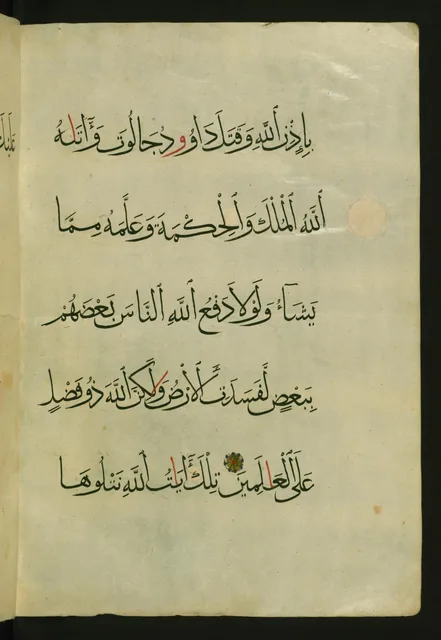
late 8th century AH / 14th century · Walters Art Museum, Baltimore
Photo: Wikimedia Commons, public domain
Yaqut's Baghdad
Baghdad led the art until the Mongols took the city in 1258. Yaqut, whose name ties him to the last Abbasid caliph al-Musta'sim, is remembered for cutting the reed at a slant instead of straight across, which made his line finer. A story says he sat in a minaret finishing his practice while the city was sacked. He died in 1298. Part 15 of a 30-part Qur'an copied in Baghdad in 681 (1282–83) and ascribed to him, now in the Khalili Collections, has five lines of muhaqqaq to the page, though the page is only 24.5 cm tall.
His pupils carried the script into the next century. One of them, Ahmad ibn al-Suhrawardi, copied a 30-part Qur'an in Baghdad between 1302 and 1308, illuminated by Muhammad ibn Aybak. No colophon names its patron, so it is known as the Anonymous Baghdad Qur'an. A single leaf of it in the Metropolitan Museum measures 51 by 37 cm.
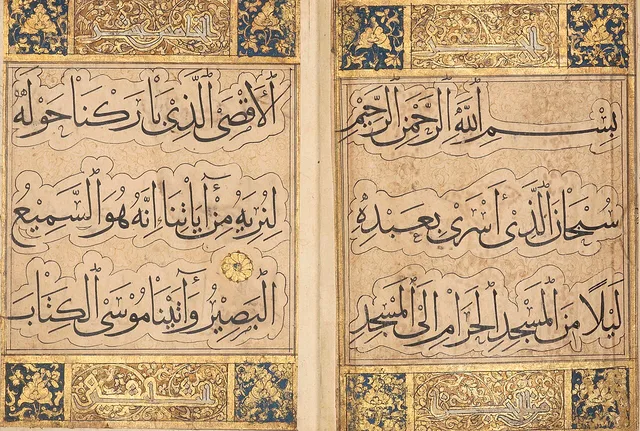
681 AH / 1282–83 · Khalili Collections, London (QUR 29)
Photo: Wikimedia Commons, public domain
The Ilkhanid Qur'ans
The Mongol Ilkhans, now Muslim, spent lavishly on the Qur'an. Sultan Uljaytu ordered a 30-part copy in Mosul between 1306 and 1311 from 'Ali ibn Muhammad al-Husayni, who probably illuminated it too. Its parts are now divided between the Chester Beatty Library in Dublin, the Topkapı Palace and the Museum of Turkish and Islamic Arts in Istanbul, and the Bayezid Library in Amasya. In these books muhaqqaq is written large, in gold outlined in black or in black outlined in gold, with only a few lines to the page.
The script travelled well beyond the capitals. A fourteenth-century leaf in the David Collection in Copenhagen, from Central Asia or Anatolia, shows the same long, level strokes and sharp endings, with smaller writing set between the lines.
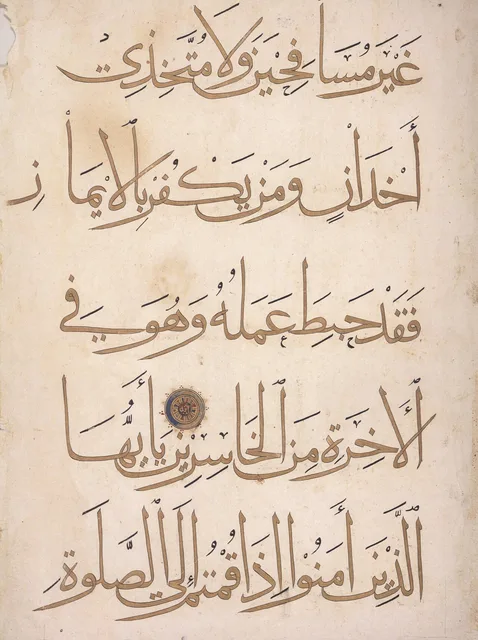
1306–1311 · Chester Beatty Library, Dublin
Photo: Wikimedia Commons, public domain
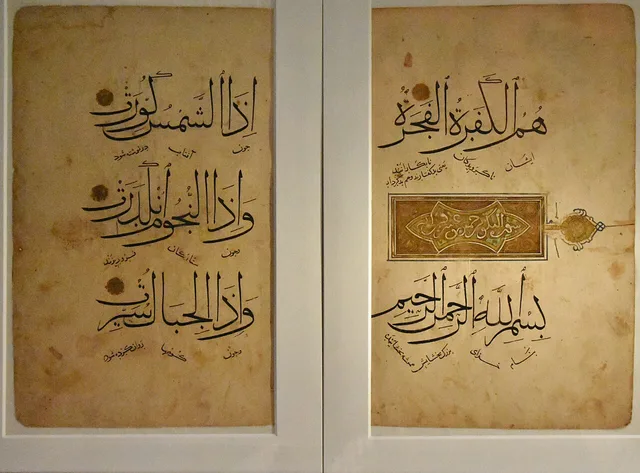
14th century · The David Collection, Copenhagen
Photo: Richard Mortel, Wikimedia Commons (Leaf from a copy of the Quran written in Muhaqqaq script, Central Asia or Anatolia, 14th century, The David Collection, Copenhagen (1) (35573615554).jpg), CC BY 2.0 (creativecommons.org/licenses/by/2.0)
Mamluk Cairo
In Egypt and Syria the Mamluk sultans and amirs gave very large Qur'ans to the mosques and madrasas they founded. In 1313 Shadhi ibn Muhammad ibn Ayyub copied one in gold muhaqqaq outlined in black; a folio is in the Freer Gallery in Washington. Sultan al-Ashraf Sha'ban, who reigned from 1363 to 1377, ordered a Qur'an for his madrasa, copied between 1372 and 1376 by 'Ali ibn Muhammad al-Mukattib al-Ashrafi in large muhaqqaq jali, with chapter headings in Kufic. It is now in the National Library of Egypt.
On the largest of these pages a few lines fill the whole text block, with wide spaces between the words and the vowel signs set clear above and below. The eye travels across the page more than down it, and the horizontals carry the reading.
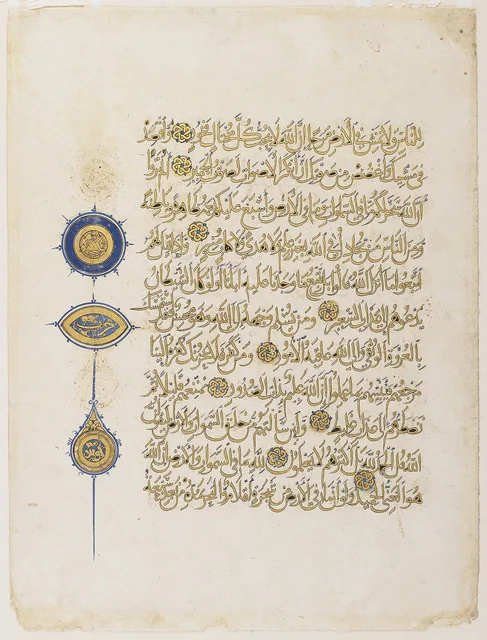
1313 · Freer Gallery of Art, Washington
Photo: Wikimedia Commons, public domain
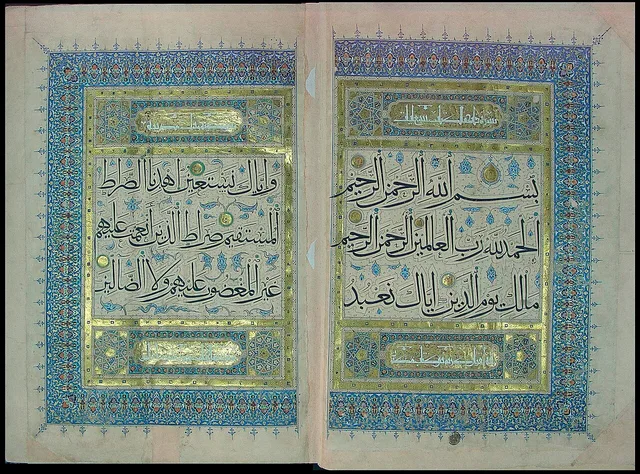
1372–1376 · National Library of Egypt (Dar al-Kutub), Cairo
Photo: Wikimedia Commons, public domain
The largest pages
The grandest of all is the Qur'an attributed to 'Umar Aqta' of Samarqand, made around 1400. Its pages measured about 177 cm by more than a metre, with seven lines of muhaqqaq on one side of each sheet. It has long been named after Timur's grandson Baysunghur, but Qatar Museums, which holds a page, thinks it more likely to have been made for Timur himself; the attribution is still debated.
The story goes that 'Umar, who had only one arm, first offered Timur a Qur'an small enough to fit in a ring, and when this did not please, made the largest one instead. A huge marble Qur'an stand in the courtyard of the Bibi Khanum mosque in Samarqand matches its size so closely that it was probably made for it. Single lines from this book, about a metre long, are now kept in museums as works on their own.
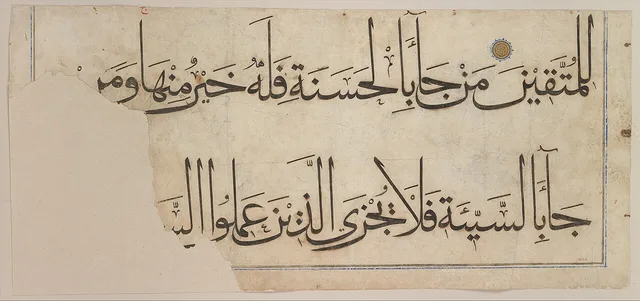
about 1400 (before 1405) · Metropolitan Museum of Art, New York (18.17.2)
Photo: Wikimedia Commons, CC0
Fading, and what to look for
The Ottomans preferred thuluth for display and naskh for books. Şeyh Hamdullah, who died in 1520, still refined muhaqqaq, and fifteenth-century Ottoman Qur'ans use it in lines of gold and blue. But naskh took over the Qur'an page, helped by Hafız Osman, who died in 1698. After 1700 one meets it mostly in a single line: the basmala that heads a hilya. Uğur Derman notes that Ottoman sources say little about how muhaqqaq and rayhani were taught, because both had fallen out of use.
To recognise it, set it beside thuluth. Look at the endings of ra, waw and nun: in muhaqqaq they run down and to the left and end in a point; in thuluth they turn up. Look at the bowls: shallow and wide. Look at the alifs: tall and straight. If you practise it, use your thuluth pen and let the line run long and level.
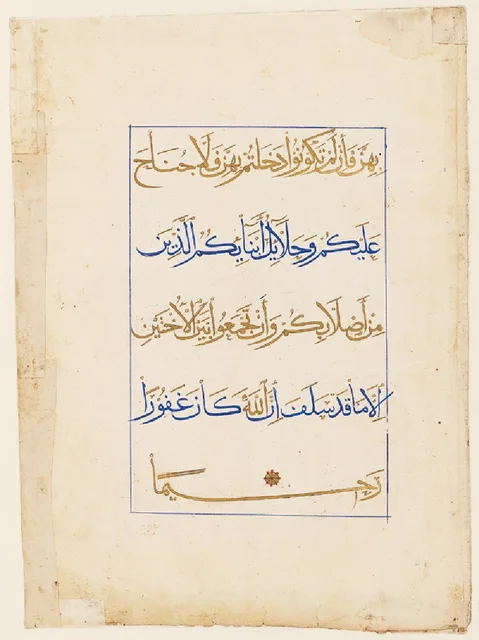
15th century · Ashmolean Museum, Oxford
Photo: Wikimedia Commons, public domain
Sources
- Nihad M. Çetin, "Aklâm-ı Sitte", TDV İslâm Ansiklopedisi, 1989
- M. Uğur Derman, "Hattat", TDV İslâm Ansiklopedisi, 1997
- Elisabeth Kvernen, "Muhaqqaq", Calligraphy Qalam (James Madison University)
- Wikipedia (English), "Muhaqqaq" and "Yaqut al-Musta'simi"
- Museum records: Khalili Collections QUR 29 (Part 15 of a 30-part Qur'an, Baghdad, 681 AH); Metropolitan Museum of Art 50.12 and 55.44 (Anonymous Baghdad Qur'an)
- Christie's, lot notes on a folio of the Baysunghur Qur'an, as reproduced by Frances W. Pritchett (Columbia University)
- Qatar Museums, "Folio from a monumental Qur'an" (MS.119.2007)
- Bonhams, Islamic and Indian Art, catalogue note on a muhaqqaq fragment from Uljaytu's Mosul Qur'an (sale 29724, lot 2)
- Smithsonian National Museum of Asian Art (Freer Gallery), record F1937.32, Folio from a Qur'an, Egypt, 1313
Try it now in this very script — الرحمن الرحيم
Open in the Studio →Written by the MASHQ studio · last updated 2026-10-05. Further reading, the standard references in English: Sheila S. Blair, Islamic Calligraphy (Edinburgh University Press, 2006) · Annemarie Schimmel, Calligraphy and Islamic Culture (New York University Press, 1984) · Yasin Hamid Safadi, Islamic Calligraphy (Thames and Hudson, 1978).
Keep exploring
From the store's journal: Styles guide: Kufic, Thuluth & Diwani