Sini — Arabic written with a Chinese brush
Islam reached China along the Silk Road, and Chinese Muslims — the Hui — needed to write Arabic with the tools they knew: the brush, not the reed. The result is Sini, Arabic calligraphy with the soul of Chinese brushwork. Strokes swell and taper dramatically, horizontals stretch wide, and whole phrases compose into balanced forms that echo Chinese characters. You find it on mosque plaques in Xi'an, on porcelain made for Muslim patrons, and in the round 'basmala on a plate' compositions the tradition loves. Sini proves a deep truth about this art: the letters are fixed, but the hand that writes them carries its whole culture — and the script absorbs it without losing a word.
China's Muslims and their Qur'ans
Under the Mongol Yuan dynasty (1279–1368) many Muslims from Iran and Central Asia settled in China, some of them officials wealthy enough to pay for Qur'ans and mosque inscriptions. Their descendants, today called the Hui, took up the Chinese language and way of life but kept Arabic for prayer and scripture. Under the Ming (1368–1644) and the Qing, contact with Central Asia thinned, and their writing grew more local.
The oldest dated Qur'an known from China is a single volume in the Khalili Collections: part 29 of a 30-part set, dated Muharram 804 (1401), at the Great Mosque of Khanbaliq, today's Beijing. Its colophon names the scribe and illuminator as Hajji Rashad ibn 'Ali al-Sini, "the Chinese". The collection places it in a type of manuscript with roots in eastern Iran. A Chinese Qur'an was normally a set of 30 slim volumes; a text page holds five to seven lines, and the opening spread of each volume only three.
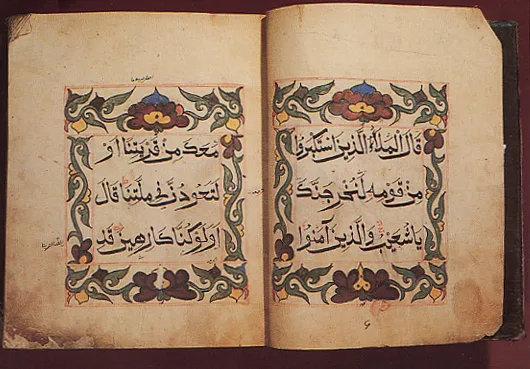
17th century · Tareq Rajab Museum, Kuwait
Photo: Wikimedia Commons, public domain
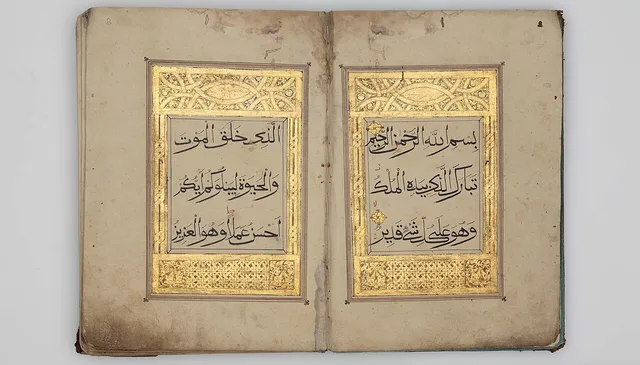
Muharram 804 / 1401 · Khalili Collections, London (QUR 974)
Photo: Khalili Collections, Wikimedia Commons (Khalili Collection Islamic Art qur 0974 fol 2b-3a.jpg), CC BY-SA 3.0 igo (creativecommons.org/licenses/by-sa/3.0/igo)
Brush and reed
Most Chinese Qur'ans are written in a script derived from muhaqqaq, often called Sini, "Chinese". The Asian Civilisations Museum in Singapore describes a 30-volume Qur'an of the early seventeenth century that combines standard Sini, derived from muhaqqaq, with square Kufic. Sini is also written with the soft Chinese brush in place of the reed, and the brush gives it thick horizontals and fine verticals.
Learn to see it in the endings. Ra, za and waw throw out long tails, and nun and sad at the end of a word sink below the line and run a long way left. The ba that opens a word, above all in the basmala, climbs in a curve. A closing mim breaks the pattern: it hangs straight down or coils, instead of lying along the line with the other tails. Small curls are frequent and corners are sharp. A text can run across, or down, like the paired couplets hung beside Chinese doors. Set a Chinese Qur'an beside an Egyptian or Iranian copy of the same century, and the difference shows first in these endings and in the weight of the horizontal strokes.
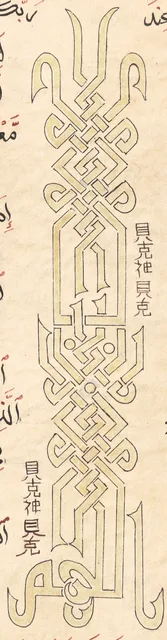
19th century · Khalili Collections, London
Photo: Khalili Collections, Wikimedia Commons (Allahumma, Chinese hajj scroll 1845.jpg), CC BY-SA 3.0 igo (creativecommons.org/licenses/by-sa/3.0/igo)
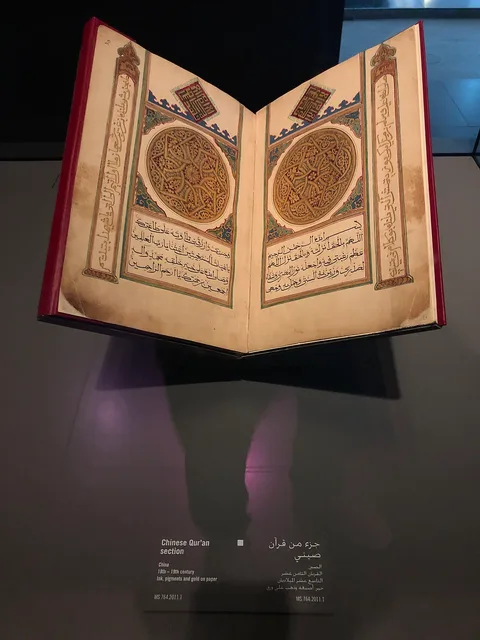
18th–19th century · Museum of Islamic Art, Doha
Photo: Davide Mauro, Wikimedia Commons (Chinese Qur'an.jpg), CC BY-SA 4.0 (creativecommons.org/licenses/by-sa/4.0)
On mosque walls
Chinese mosques are built like Chinese halls, with timber frames, tiled roofs and courtyards, so Arabic is often the clearest sign of what they are. The Great Mosque of Xi'an traces its founding to 742, under the Tang; most of what stands was built in 1392, under the Ming emperor Hongwu. It faces west, toward Mecca, rather than south like most Chinese buildings.
Its halls carry boards and plaques of Sini Arabic set among carved flowers and clouds, in brick, wood or gold on dark lacquer. Inscriptions are placed over doors and near the mihrab, often in a frame shaped like a cloud or a fan. At the same gate a Chinese name board and an Arabic phrase can hang one above the other, two writing systems sharing one entrance.
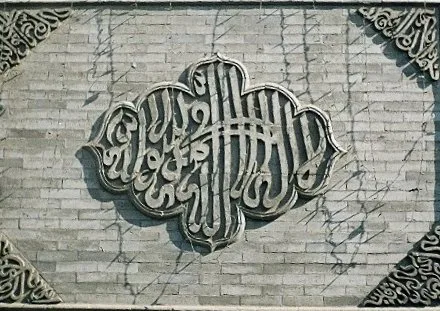
on a mosque largely built in 1392 · Great Mosque of Xi'an, China
Photo: Paul Louis, Wikimedia Commons (Arabic Plaque, Great Mosque, Xian.jpg), CC BY-SA 3.0 (creativecommons.org/licenses/by-sa/3.0)
Porcelain and bronze
Arabic reached the imperial kilns too. In the Zhengde reign (1506–1521) the potteries of Jingdezhen made blue-and-white pieces with Arabic and Persian words: brush rests, boxes, vases, and tablets such as the one in the British Museum with a Qur'anic passage. On these objects the letters are painted in cobalt under the glaze, inside a medallion or a lobed panel, and the composition follows the shape of the piece. On the British Museum tablet the verses sit inside a diamond, framed by flower scrolls painted in the same blue.
Later, in the Qing period, bronze incense burners and boxes carried short phrases such as al-hamdu lillah, set in a round field, as on the lid of an incense box now in the Adilnor Collection in Sweden. Here the words bend and stack to fill the circle, the same way a Chinese seal fills its square.
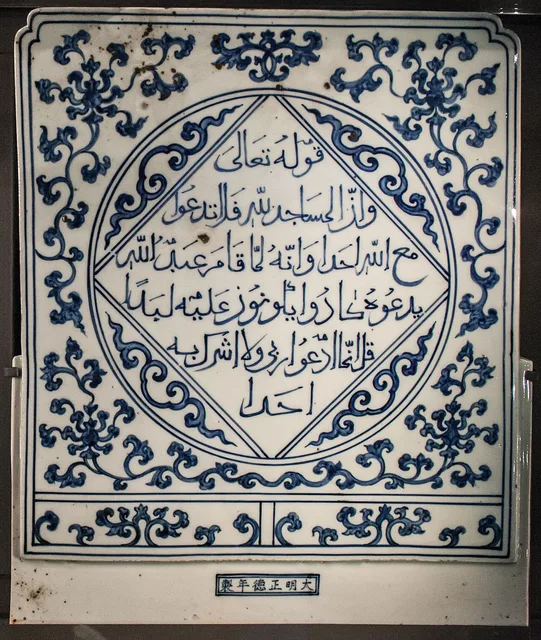
Ming dynasty, Zhengde period, 1506–1521 · British Museum, London
Photo: Wikimedia Commons, public domain
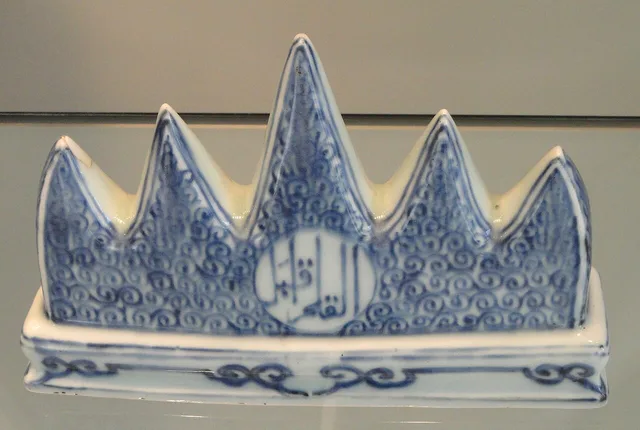
Zhengde period, 1506–1521 · Gardiner Museum, Toronto
Photo: Wikimedia Commons, CC0
Sini today, and how to begin
The tradition is still practised. Haji Noor Deen Mi Guangjiang, born in Shandong in 1963, became in 1997 the first Chinese Muslim to receive the Egyptian certificate of Arabic calligraphy, and he teaches at the Islamic College in Zhengzhou. Among the Hui of Xi'an, Sini is part of daily life: people take classes in it and hang it in homes, shops and restaurants. Works by living calligraphers are protected, so none are shown here.
To begin, take a soft round brush and thin ink, and choose a short phrase such as bismillah or al-hamdu lillah. Press down at the start of each horizontal and lift as you leave it, so the stroke swells and then tapers; keep the verticals fine. Then fit the words into a circle or a square, as on the incense box lid shown here, and check that every letter can still be read.
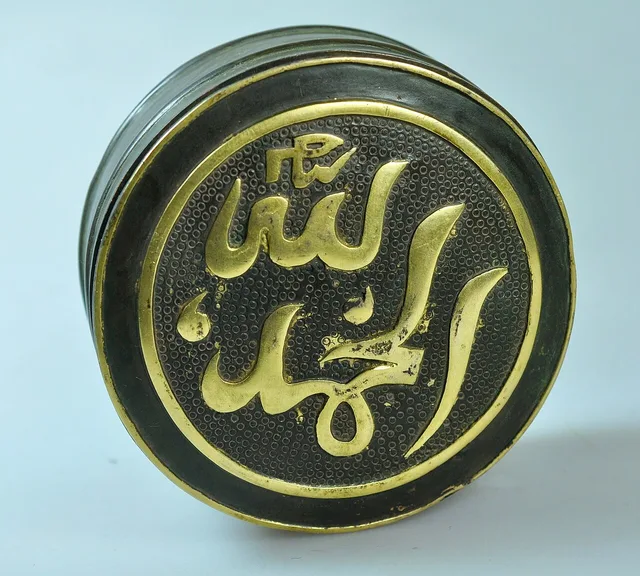
Qing dynasty, 19th century · Adilnor Collection, Sweden
Photo: Danieliness, Wikimedia Commons (Alhamdulillah in Sini Arabic.jpg), CC BY-SA 4.0 (creativecommons.org/licenses/by-sa/4.0)
Sources
- Khalili Collections, record of QUR 974, Part 29 of a 30-part Qur'an, Khanbaliq (Beijing), 1401
- Asian Civilisations Museum, Singapore, "A Chinese Qur'an in 30 volumes" (2012-00381), on Roots.gov.sg
- Wikipedia (English), "Sini (script)"
- Wikipedia (English), "Great Mosque of Xi'an"
- Wikipedia (English), "Noor Deen Mi Guangjiang"
- The Muslim 500, "Haji Mi Guang Jiang Noor Deen" (profile)
- Jill Caskey, Adam S. Cohen and Linda Safran, Art and Architecture of the Middle Ages (companion site), "Qur'an with Chinese clouds"
Try it now in this very script — الحمد لله
Open in the Studio →Written by the MASHQ studio · last updated 2026-10-05. Further reading, the standard references in English: Sheila S. Blair, Islamic Calligraphy (Edinburgh University Press, 2006) · Annemarie Schimmel, Calligraphy and Islamic Culture (New York University Press, 1984) · Yasin Hamid Safadi, Islamic Calligraphy (Thames and Hudson, 1978).
Keep exploring
From the store's journal: Calligraphy wall art for every room