Ijazah — the licence written in its own script
When a master judged a student ready, he wrote the certificate — the ijazah — granting the right to sign works and teach. The script of these certificates became a style of its own: Ottoman masters call it riqa', an offshoot of the chancery pen tawqi'; many Arabic manuals call it tawqi' itself. It blends Thuluth's stature with Naskh's speed — smaller and quicker than Thuluth, rounder and more joined than Naskh, with connections between normally unjoined letters that give it a flowing, signature-like character. Most licences in Thuluth and Naskh, the record of who licensed whom, are written in this hand. It is the script of authority in the literal sense: the words that made a calligrapher a calligrapher.
From the hadith scholars to the reed pen
Ijaza means permission. The word was first used by scholars of hadith: a teacher allowed a pupil to pass on what he had learned, by word or in writing. According to the TDV Encyclopaedia of Islam, the oldest known written licence was set down by Rabi' ibn Sulayman al-Muradi in July 879 (Dhu al-Qa'da 265), giving leave for a three-part copy of his teacher al-Shafi'i's Risala. The same form later served law, Qur'an reading, medicine, the Sufi orders and the crafts.
Scholars wrote such licences on the first or last page of a book. In January 1490, two years before Granada fell, its preacher al-Mawwaq wrote one for the last Nasrid sultan, Muhammad XII, in a manuscript now in the Escorial. Ottoman writers credit Zayn al-Din 'Abd al-Rahman ibn al-Sa'igh, who died in 1442, with starting the separate licence for calligraphers. The custom then held for centuries.
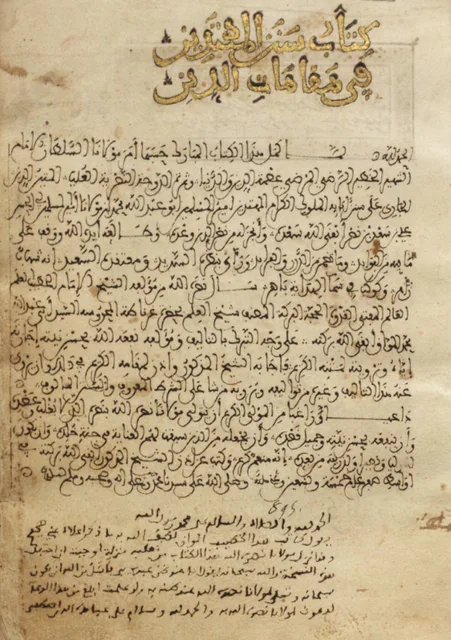
January 1490 · Real Biblioteca del Monasterio de El Escorial (Árabe 1527)
Photo: Wikimedia Commons, public domain
The pen of the licence
In the Ottoman account, the name khatt al-ijaza came from use: riqa' was the pen in which licences were customarily written. Riqa' grew out of tawqi', the chancery pen that the Abbasid vizier al-Fadl ibn Sahl, who died in 818, named al-riyasi and ordered for decrees and letters. Many Arabic manuals call the licence script tawqi' instead, and some explain that name by the master's signature on the licence. This classical riqa' is not the plain ruq'a of modern handwriting.
Riqa' is written with a pen about half as wide as that of tawqi', the width of a naskh pen. Its alif is five dots tall, against seven in thuluth. The letters are rounder. Alif, ra and waw, which usually stand apart, reach out to touch the next letter. Inside and at the end of a word, the eyes of 'ayn, qaf, mim and waw are half closed, and lam-alif loses its knot. Ibn Muqla gave it rules, and Ibn al-Khazin fixed its classical measures. Besides licences it served for colophons, readers' notes and endowment deeds.
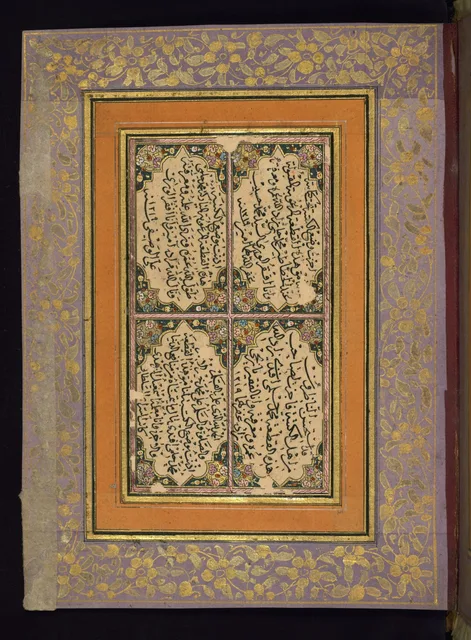
1804–1805 · Walters Art Museum, Baltimore
Photo: Wikimedia Commons, public domain
The long road to the licence
In Istanbul a pupil learned by meşk. Once a week the teacher wrote one model line, and the pupil copied it until it was right. Thuluth and naskh were taught together, and the first line was a prayer: rabbi yassir wa-la tu'assir, rabbi tammim bi-l-khayr, "Lord, make it easy, not hard; Lord, bring it to a good end". First came the single letters, the mufradat. Then came letters joined in pairs, and finally whole verses and poems, the murakkabat.
Under each model the master drew a small mark built from the letters of sa'y, "effort". If a letter failed, he wrote it again under the pupil's line and marked its measure with dots. A well-made passage he circled with his pen. When the alphabet was done he wrote "tammat al-huruf bi-'awn Allah al-malik al-ra'uf", the letters are complete by the help of God. A gifted pupil who came every week could finish the course in three to five years.
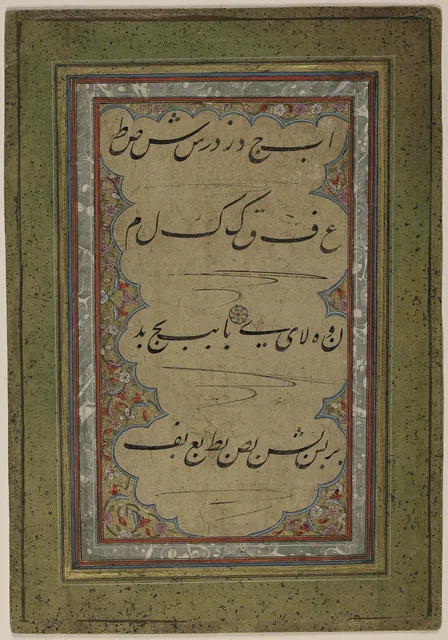
19th century · Library of Congress, Washington
Photo: Wikimedia Commons, public domain
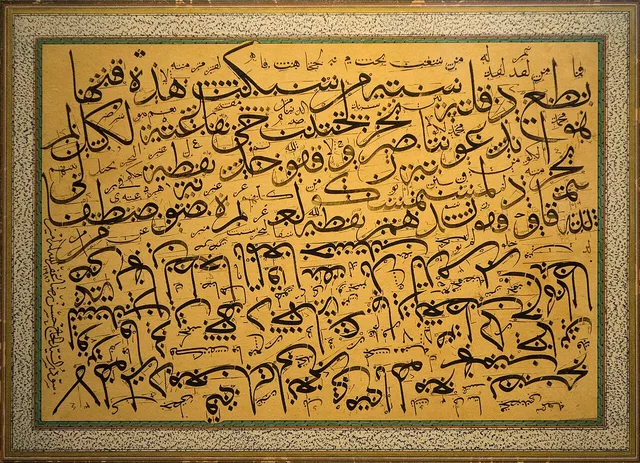
1880–81 · Sakıp Sabancı Museum, Istanbul
Photo: Dosseman, Wikimedia Commons (Istanbul Sakip Sabanci Museum Calligraphic exercise in Nesih and rıka script by Hasan Rıza, 1880-81 in 2014 8803.jpg), CC BY-SA 4.0 (creativecommons.org/licenses/by-sa/4.0)
The licence itself
For the final test the teacher chose a piece by an old master, and the pupil copied it closely. Many wrote a hilya, the description of the Prophet, for this purpose; some copied a juz' or a whole Qur'an in naskh. Under the approved piece the teacher wrote, in riqa', words to this effect: I have licensed the writer of this fine piece to put his signature under his work; may God lengthen his life and his knowledge. Then came his name and the date, often with the phrase ana mu'allimuhu, "I am his teacher".
From then on the new calligrapher could write katabahu, "he wrote it", under his work, so the licence was also called the ketebe. It was granted at a gathering, often in a mosque, before other masters, who added their own lines of approval below. Some licences from Edirne carry thirty or forty such endorsements. The pupil could also receive a pen-name at the ceremony: the second names of Isma'il Zühdi and Mustafa Rakım were given in this way.
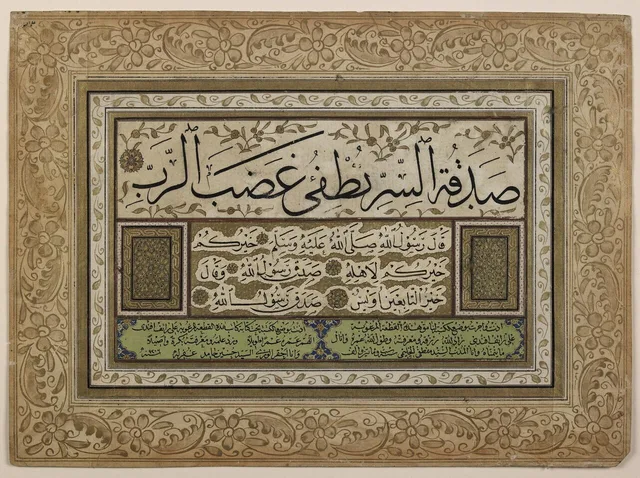
1791 · Library of Congress, Washington
Photo: Wikimedia Commons, public domain
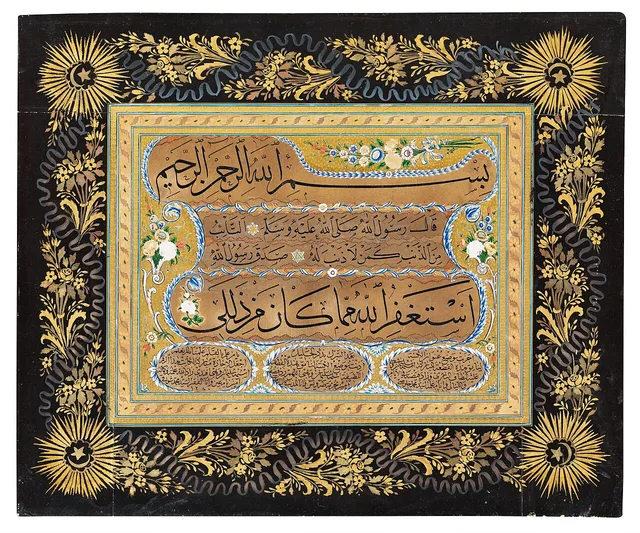
1863–1864 · Sadberk Hanım Museum, Istanbul
Photo: Wikimedia Commons, public domain
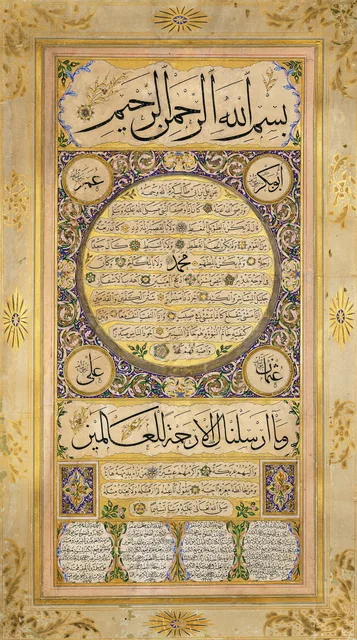
19th century · Khalili Collections, London
Photo: Khalili Collections, Wikimedia Commons (Khalili Collection Islamic Art cal-0255.jpg), CC BY-SA 3.0 igo (creativecommons.org/licenses/by-sa/3.0/igo)
Across the empire, and today
Licences in ta'liq followed the same path, with the permission written in small ta'liq. Mehmed Esad was born with his right side paralysed, and one leading master would not take him as a pupil. Another, Dedezade Mehmed Said, licensed him in 1754. The piece, now in the Topkapı Palace, records his name, his pen-name and his nickname Yesari, "the left-handed". Great masters kept the custom even late in life: Hacı Mehmed Nazif took a ta'liq licence from Sami Efendi at the age of sixty.
The system reached the far ends of the empire. Husein Rakim Islamović of Sarajevo (1839–1895) earned two licences in Istanbul in thuluth and naskh, from Mehmed Şevki and Yahya Hilmi, and two in ta'liq; they are kept in the Gazi Husrev-beg Library. The Ottoman school for calligraphers, the Medresetü'l-Hattatin, opened in 1914; the official diplomas it gave its graduates were always written in diwani, whatever script they had studied, and sealed by the teacher. The schools of Mehmed Şevki and Mustafa İzzet still teach today, and the licence is still the moment a pupil becomes a calligrapher.
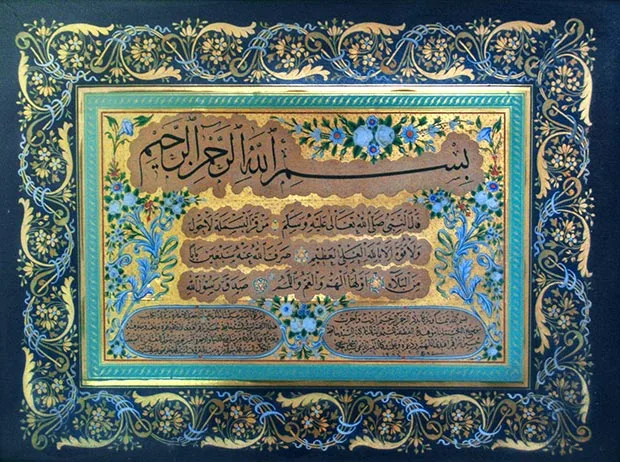
19th century · Museum of the Gazi Husrev-beg Library, Sarajevo
Photo: Wikimedia Commons, public domain
Sources
- M. Uğur Derman, "Hattat", TDV İslâm Ansiklopedisi, 1997
- Cemil Akpınar, "İcâzet", TDV İslâm Ansiklopedisi, 2000
- Muhittin Serin, "Rikâ'", TDV İslâm Ansiklopedisi, 2008
- Muhittin Serin, "Tevkî'", TDV İslâm Ansiklopedisi, 2012
- M. Uğur Derman, "Yesârî Mehmed Esad", TDV İslâm Ansiklopedisi, 2013
- Meliha Teparić, "Husein Rakim Islamović, 19th century Bosnian calligrapher", Islamic Arts Magazine
- Jan Ženka, "A Manuscript of the Last Sultan of al-Andalus and the Fate of the Royal Library of the Nasrid Sultans at the Alhambra", Journal of Islamic Manuscripts, 2018 (as cited in the Commons record of the Escorial licence)
- Wikipedia (Arabic), "خط الإجازة"
Try it now in this very script — أجزتُ له أن يكتب
Open in the Studio →Written by the MASHQ studio · last updated 2026-10-05. Further reading, the standard references in English: Sheila S. Blair, Islamic Calligraphy (Edinburgh University Press, 2006) · Annemarie Schimmel, Calligraphy and Islamic Culture (New York University Press, 1984) · Yasin Hamid Safadi, Islamic Calligraphy (Thames and Hudson, 1978).
Keep exploring
From the store's journal: The meaning behind popular phrases