Maghribi — the West's own hand
While the East refined Naskh and Thuluth, North Africa and Andalusia grew a script of their own. Its origin is debated: older books derive it straight from Kufic, while Umberto Bongianino traces it to the round book hands of ninth-century al-Andalus. It kept habits the East abandoned: deep, sweeping bowls that dive below the baseline, a single-dotted qaf and a fa dotted below, and a pointed reed that gives an even, unmodulated line. Qur'ans of Córdoba, Marrakesh and Fes are written in it, sometimes on dyed parchment. Morocco still writes it, and printed its own Qur'an in it in 2010 — a regional voice that never bowed to Ottoman fashion. Its rhythm is horizontal and generous, with descenders that curl like waves under the text.
Roots in Kairouan and Córdoba
Arabic writing reached North Africa with the conquests of the seventh century, and the first scribes of Ifriqiya and al-Andalus wrote angular hands. Kairouan, in today's Tunisia, became a centre of book-making. In 1020 Fatima, the nurse of the Zirid prince al-Mu'izz ibn Badis, gave the Great Mosque of the city a Qur'an on parchment, made by the scribe and gilder 'Ali ibn Ahmad al-Warraq. Its leaves measure 44.5 by 30 cm, with five lines each. Most of them are in the museum at Raqqada; others are in Tunis, Copenhagen, New York and Doha.
How the round western hand grew out of this world is debated. Many books, following the French scholar Octave Houdas, derive Maghribi straight from Kufic; François Déroche suggested an early chancery hand instead. Umberto Bongianino, who studied more than two hundred dated manuscripts of the tenth to twelfth centuries, calls the Kufic theory misleading. In his reading the round hand grew in the late ninth century out of the plain book hands of al-Andalus, much as naskh grew out of Abbasid book hands in the East, and it became a mark of Andalusi identity. An early sign of the split is a ninth-century treatise on alphabets, known from an eighteenth-century copy of an exemplar dated 1022, which sets "the Maghribi pen, that is, the Andalusi" beside Kufic.
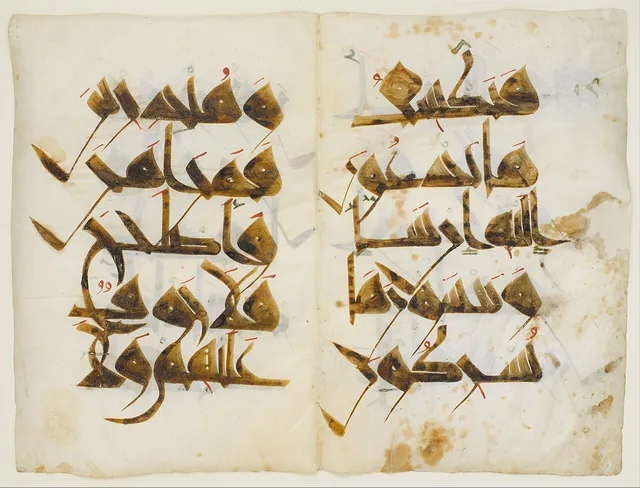
about 1019–20 · Metropolitan Museum of Art, New York
Photo: Wikimedia Commons, CC0
The dynasties that shaped it
The Almoravids carried Andalusi taste across the Maghreb. The minbar they gave the Qarawiyyin Mosque in Fes in 1144 bears a curved display script now called Maghribi thuluth. Bongianino dates its rise to the late eleventh century and traces it to eastern models reworked in Norman Sicily, in Tunis and in the Almoravid lands. The Almohads made it a dynastic emblem, written in gold on books, coins and textiles. Copies of the works of Ibn Tumart, the movement's founder, were made for the court: one was written for the caliph Ya'qub al-Mansur in 1193–94, and others open with pages of gold Maghribi thuluth and lavish lapis blue.
Under the Marinids of Fes (1244–1465) the script reached its settled form; Ibn Khaldun noted how much it owed to Andalusi scribes who had moved to the city. Its monumental face can still be read on the walls of the Bou Inania madrasa, built for Sultan Abu Inan Faris between 1350 and 1355. There carved stucco names the sultan, above a band of letters cut from glazed tile.
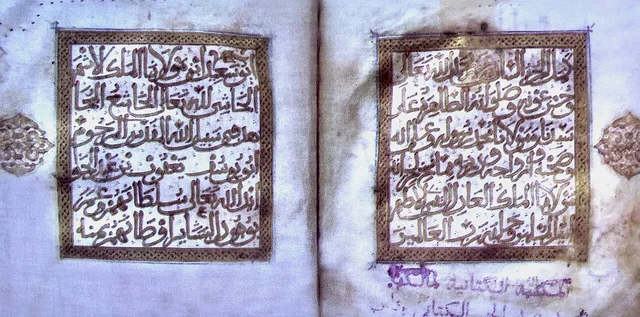
1258–1286 · National Library of the Kingdom of Morocco, Rabat
Photo: Wikimedia Commons, public domain
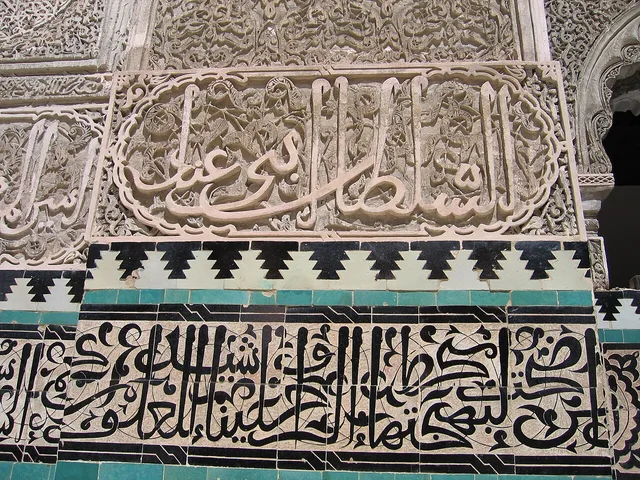
1350–1355 · Bou Inania madrasa, Fes
Photo: Wikimedia Commons, public domain
One script, several hands
Moroccan scholars usually count five varieties. Mabsut is the plain book hand of Qur'ans and texts. Mujawhar is a quicker, joined hand that the court used for decrees and letters. Maghribi thuluth serves titles and walls. Musnad, also called zimami, is the slanting hand of notaries and contracts. Maghribi Kufic lived on in ornament and on coins.
The French scholar Octave Houdas proposed a regional division in 1886: Qayrawani, Andalusi, Fasi and Sudani. The Sudani hands, thicker and darker, were written across the Sahel, from Timbuktu to Kano and Bornu, and copies of the Qur'an in them were still being made in northern Nigeria in the nineteenth century. In Fes, Muhammad ibn al-Qasim al-Qandusi, active between 1828 and 1861, developed a flamboyant personal hand that still carries his name.
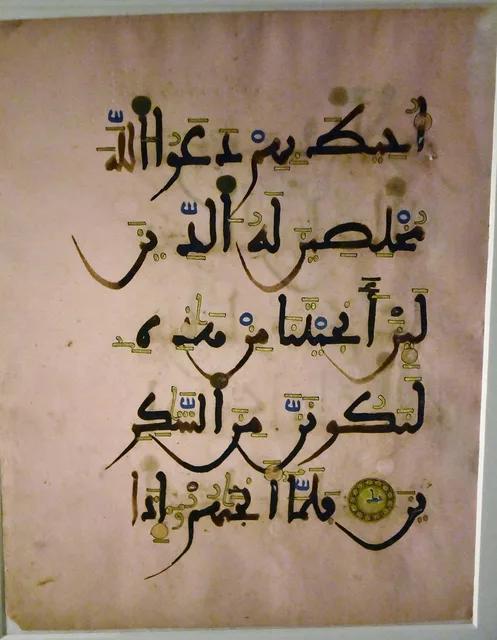
14th century · The David Collection, Copenhagen
Photo: Prof. Mortel, Wikimedia Commons (Copy of the Quran written in MAghribi scrip in Spain or Morocco, 14th cent., the Pink Quran, The David Collection, Copenhagen (1) (36409262125).jpg), CC BY 2.0 (creativecommons.org/licenses/by/2.0)
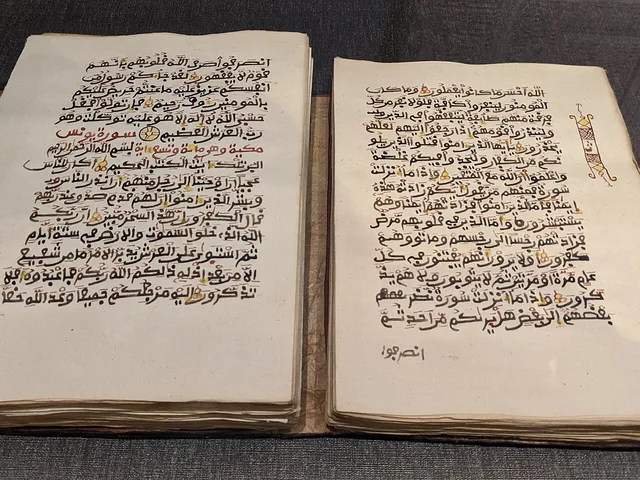
about 1830–1880 · Northern Nigeria; Museum of Fine Arts, Boston
Photo: Qubbat3924, Wikimedia Commons (Quran 19th century Nigeria, Maghribi style, Boston Museum of Fine Arts.jpg), CC BY-SA 4.0 (creativecommons.org/licenses/by-sa/4.0)
How to recognise it
Start with two letters. In Maghribi the fa has one dot below (ڢ) and the qaf one dot above (ڧ); eastern scripts put the fa's dot above and give the qaf two. Next look at sad and dad: their loops sit straight on the stroke, without the small tooth an eastern scribe puts before them. Alif and lam often finish their tall stems with a small knot, and a final alif is drawn downward, from its top.
Then look at the line. The scribe used a reed cut to a point, not a broad nib, so the stroke keeps nearly the same thickness everywhere. Final curves of nun, sin and lam open wide and swing well below the line. In Qur'ans the text is in dark ink and the signs are in colour: red, green, yellow or blue dots, as in a twelfth-century volume from the Maghreb now in the Walters Art Museum.
If you try it, use a fine, pointed pen and write slowly. Keep the bodies of the letters low and let the descending curves take the space.
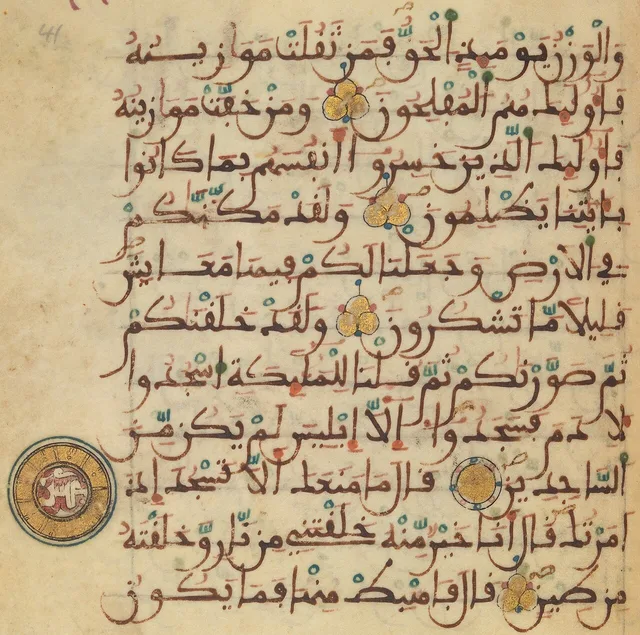
about 1300 · Metropolitan Museum of Art, New York
Photo: Wikimedia Commons, public domain
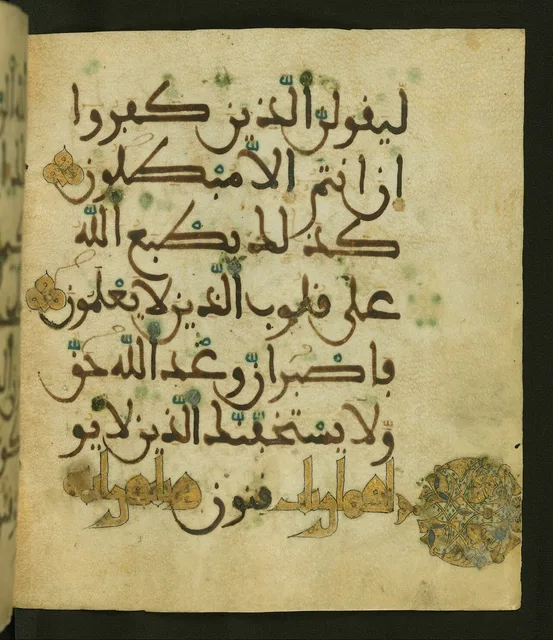
12th century · Walters Art Museum, Baltimore (W.556)
Photo: Wikimedia Commons, CC0
A living script
Maghribi entered print in 1864, when Muhammad al-Tayyib al-Rudani brought lithography to Morocco, and mujawhar became the usual text hand of lithographed books. Under the French protectorate Latin letters spread through the schools, and the Moroccan nationalist movement worked to keep the old hand. In 1949 Muhammad ibn al-Husayn al-Susi and Antonio García Jaén published five teaching booklets, Ta'lim al-khatt al-maghribi.
Today the script is studied and rewarded again. In 2007 Omar Afa and Muhammad al-Maghraoui published a history of it; in 2008 Morocco's Ministry of Islamic Affairs founded the Mohammed VI Prize for the art of Maghribi script; and in 2010 the kingdom issued its own printed Qur'an, in the Warsh reading and in Maghribi letters. In Tunisia, President Kais Saied drew wide attention in 2020 by writing official letters in it by hand.
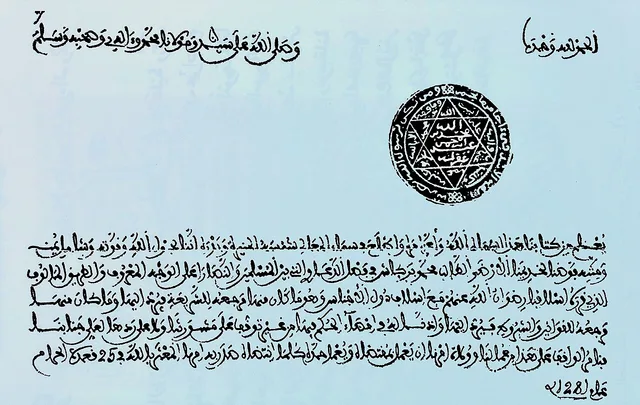
20 April 1865 · Morocco; published in Afa and al-Maghraoui, al-Khatt al-Maghribi
Photo: Wikimedia Commons, public domain
Sources
- Umberto Bongianino, The Manuscript Tradition of the Islamic West: Maghribi Round Scripts and Andalusi Identity, Edinburgh University Press, 2022
- Umberto Bongianino, "The power of curves: the rise of Maghribi thuluth (fifth–sixth/eleventh–twelfth centuries)", Journal of Material Cultures in the Muslim World, 2023
- Wikipedia (English), "Maghrebi script"
- Wikipedia (Arabic), "خط مغربي"
- Wikipedia (English), "Kairouani calligraphy"
- Walters Art Museum, Baltimore, record of manuscript W.556 (Qur'an, Maghreb, 12th century)
- Anouk Cohen, "Seeing and Hearing the Book: A Moroccan Edition of the Quran", Gradhiva, 2017
- Wikipedia (English), "Bou Inania Madrasa"
- Umberto Bongianino, The Manuscript Tradition of the Islamic West: Maghribī Round Scripts and Andalusī Identity (DPhil thesis), University of Oxford, 2017
Try it now in this very script — بسم الله الرحمن الرحيم
Open in the Studio →Written by the MASHQ studio · last updated 2026-10-05. Further reading, the standard references in English: Sheila S. Blair, Islamic Calligraphy (Edinburgh University Press, 2006) · Annemarie Schimmel, Calligraphy and Islamic Culture (New York University Press, 1984) · Yasin Hamid Safadi, Islamic Calligraphy (Thames and Hudson, 1978).
Keep exploring
From the store's journal: Styles guide: Kufic, Thuluth & Diwani