Hurufiyya — the letter enters the gallery
In the mid-twentieth century, Arab artists asked a bold question: what if the letter left the page and entered painting? The Hurufiyya movement — from harf, letter — answered across the region: Madiha Umar exhibiting letter-abstractions in Washington in the 1940s, Shakir Hassan Al Said in Baghdad making the letter a mystical field, Dia al-Azzawi, Rachid Koraïchi and others turning script into pure composition. Hurufiyya freed the letter from legibility: a ح could be a wave, an eye, a country. Every time you split a word into glyphs in this studio and twist one into ornament, you are working in their lineage.
A name with two histories
The word had an older life. In the late fourteenth century Fazlallah Astarabadi (about 1340–1394) founded Hurufism, a mystical doctrine that read the 28 letters of Arabic and the 32 of Persian as signs of the divine, written in the human face. Timur's son Miran Shah had him executed at Alinja, near Nakhchivan, in 1394. Many Hurufi manuscripts survive because Bektashi lodges kept them.
The twentieth-century movement took the name, not the doctrine. Painters, critics and collectors used it for art that takes the Arabic letter as its material, whether or not the words can be read.
Long before them, calligraphers had made letters into pictures: a lion from a prayer to 'Ali, a phrase written beside its mirror image. Such older works are the only pictures on this page. The artists of the movement died recently or are still alive, and their works are under copyright, so none is shown here.
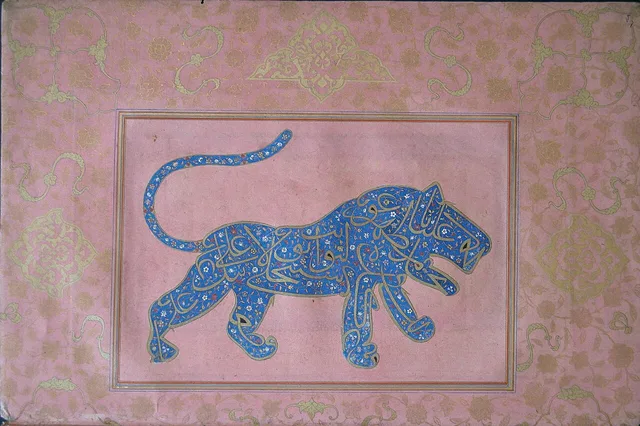
early 16th century · Istanbul University Library
Photo: Wikimedia Commons, public domain
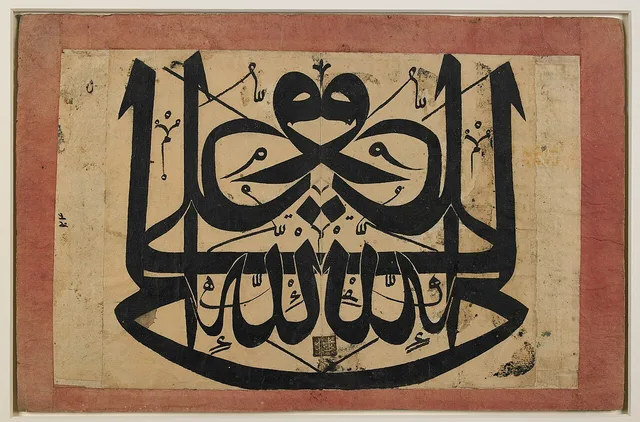
about 1720–1730 · Library of Congress, Washington
Photo: Wikimedia Commons, public domain
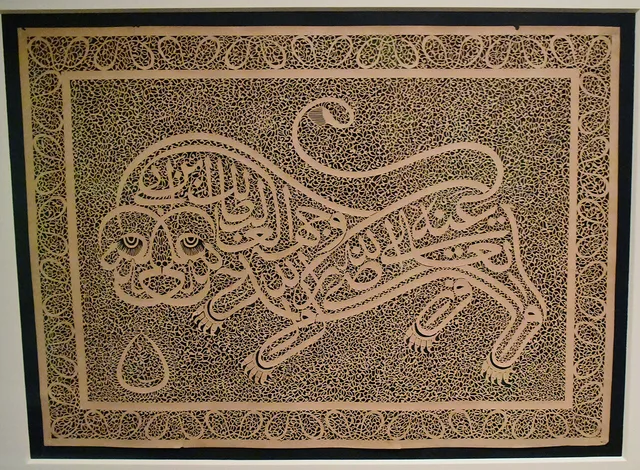
1280 AH / 1863–64 · The David Collection, Copenhagen
Photo: Richard Mortel, Wikimedia Commons (Calligraphy from Tukey, 1863-64, The David Collection, Copenhagen (35601784193).jpg), CC BY 2.0 (creativecommons.org/licenses/by/2.0)
Washington and Baghdad
Madiha Omar (1908–2005), born in Aleppo and trained in Istanbul, London and Washington, is usually named first. In 1949 she showed paintings built from Arabic letters in Washington. Sources differ on the place: English Wikipedia names the Georgetown Public Library and counts 22 paintings, while an Arabic article by Mohsen al-Dhahabi names the periodic exhibition of the Corcoran Gallery. They also differ on whether her essay on Arabic calligraphy as a source for abstract art appeared in 1949 or 1950.
In Baghdad, according to Shakir Hassan Al Said, the painter Jamil Hamoudi (1924–2003) had been bringing written words into his paintings since 1947, so the question of who came first has no single answer. In 1951 Shakir Hassan Al Said and Jawad Salim founded the Baghdad Modern Art Group. Its watchword, istilham al-turath, seeking inspiration from heritage, opened the way to the letter.
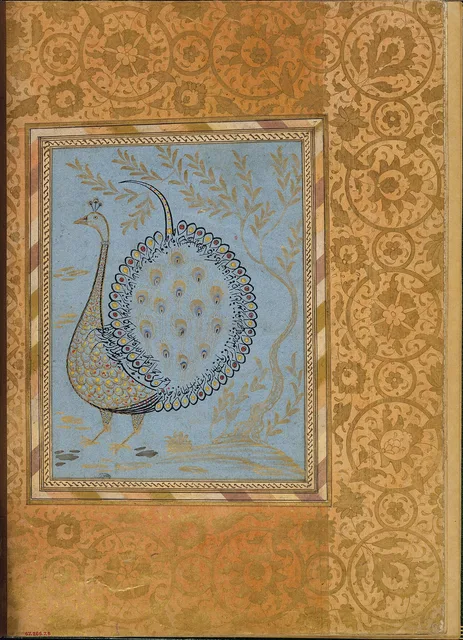
about 1600 · The Metropolitan Museum of Art, New York (Bellini Album)
Photo: Wikimedia Commons, CC0
Shakir Hassan Al Said and the One Dimension
Shakir Hassan Al Said (1925–2004), born in Samawah, wrote the Baghdad group's manifesto and read it at its first exhibition in 1951; it is counted as the first art manifesto published in Iraq. He was a writer as much as a painter, and his books on Iraqi art and on the aesthetics of Arabic calligraphy appeared in Arabic from 1969 into the 1990s.
In 1971 he founded the One Dimension group, al-Bu'd al-Wahid, and wrote its manifesto. For him the letter was a sign that points beyond the flat surface, and the one dimension stood for the eternal. His thinking drew on Sufism. Among his works are Window to the Word (1966) and Wall Strip no. 4 (1992), now in the Jordan National Gallery; others are at Mathaf in Doha, the Guggenheim, the Sharjah Art Museum and Darat al Funun in Amman.
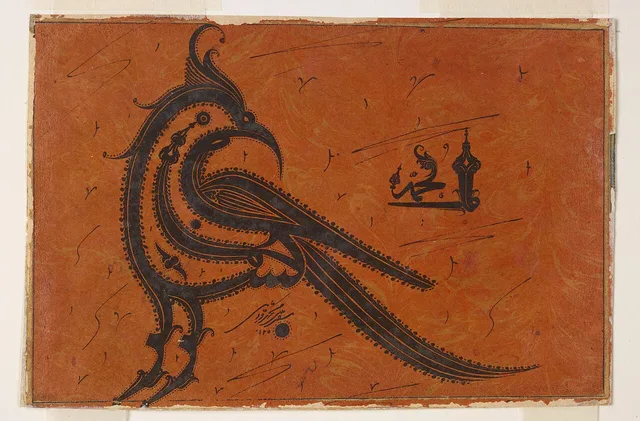
1250 AH / 1834–35 · Qajar Iran; present collection not recorded
Photo: Wikimedia Commons, public domain
Khartoum, Tehran and beyond
In Sudan, Ibrahim El-Salahi (born 1930) grew up in Omdurman, where his father kept a Qur'anic school. He studied fine art at Gordon Memorial College in Khartoum from 1949 and went to the Slade School in London on a scholarship in 1954. With Ahmed Shibrain (1931–2017) and Kamala Ishag he is counted in the Khartoum School, formed in 1960, whose painters simplified Arabic script into abstract forms. In 2013 his retrospective came to Tate Modern, the first major show of his work in Britain.
In Iran a parallel current, the Saqqakhaneh school, drew on popular religious images, talismans and Persian script. Hossein Zenderoudi (born 1937) won a prize at the Paris Biennale, Parviz Tanavoli (born 1937) carried letters into sculpture, and Faramarz Pilaram (1937 or 1938–1983) shared their circle. Nasser Assar (1928–2011) took up the letter outside the group.
Across the Arab world others followed, Dia al-Azzawi in Iraq and Rachid Koraïchi in Algeria among them, each with a different relation to the classical letter. Some kept the words readable; others kept only the movement of the pen.
Naming the movement
The Lebanese writer Charbel Dagher gave the movement a book-length study, al-Hurufiyya al-'arabiyya: fann wa-huwiyya (Arabic Hurufiyya: Art and Identity), published in Beirut in 1990; some catalogues give 1991. An English translation, supported by the Barjeel Art Foundation, appeared in 2016.
Museums followed. Venetia Porter's exhibition Word into Art: Artists of the Modern Middle East opened at the British Museum on 18 May 2006 and travelled to Dubai in 2008. The Barjeel Art Foundation's Hurufiyya: Art and Identity was shown at the Bibliotheca Alexandrina from 30 November 2016 to 28 January 2017.
Scholars still disagree about the word. The art historian Sandra Dagher has called Hurufiyya the most important movement in twentieth-century Arab art, while the Cambridge Companion to Modern Arab Culture describes it as neither a movement nor a school.
For a learner: the letter comes first
The older pictures on this page show that the freedom is not new. Ottoman, Persian and Indian calligraphers wrote birds, lions, elephants and ships from sacred words, and kept the letters correct while they did. The hoopoe in Berlin is a basmala; every stroke in it is still a letter.
El-Salahi learned the letter at his father's Qur'anic school before he ever painted it. That is the order to follow. Learn the letter in one script, with its measure in dots, until your hand knows it. Then take one letter, a ح or a ن, and change one thing at a time: its size, its weight, its direction, its place on the page.
When you look at a hurufi work, check whether its words can be read and which script its shapes come from. The answers place the work between calligraphy and painting, which is where the movement chose to stand.
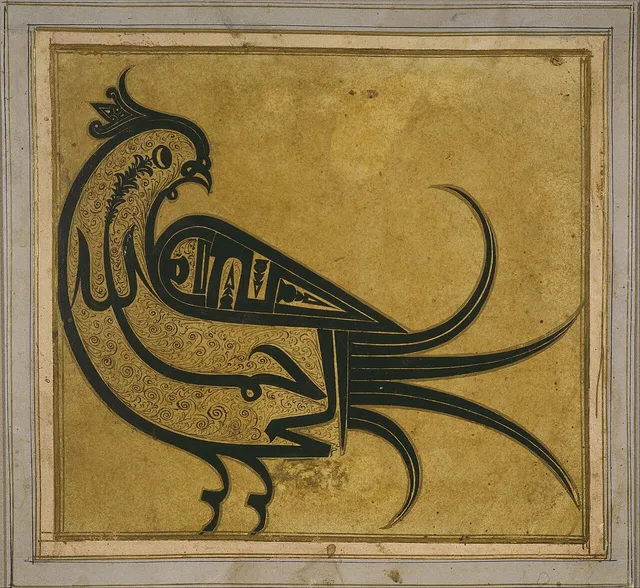
17th century · Museum of Islamic Art, Pergamonmuseum, Berlin
Photo: Wikimedia Commons, public domain
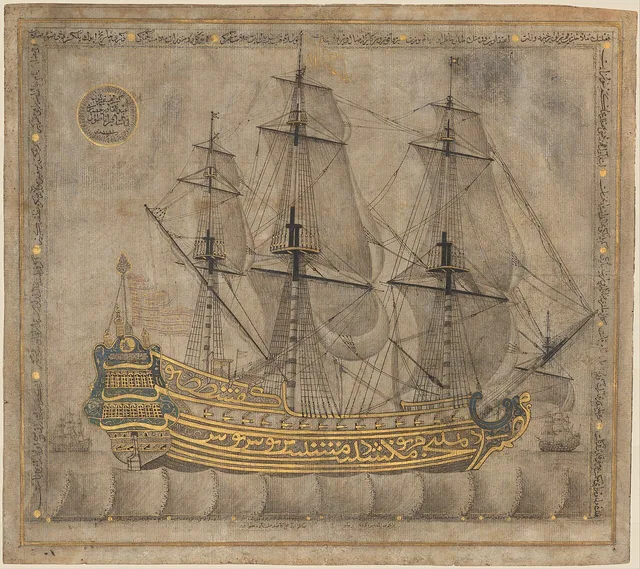
1766–1767 · Metropolitan Museum of Art, New York
Photo: Wikimedia Commons, CC0
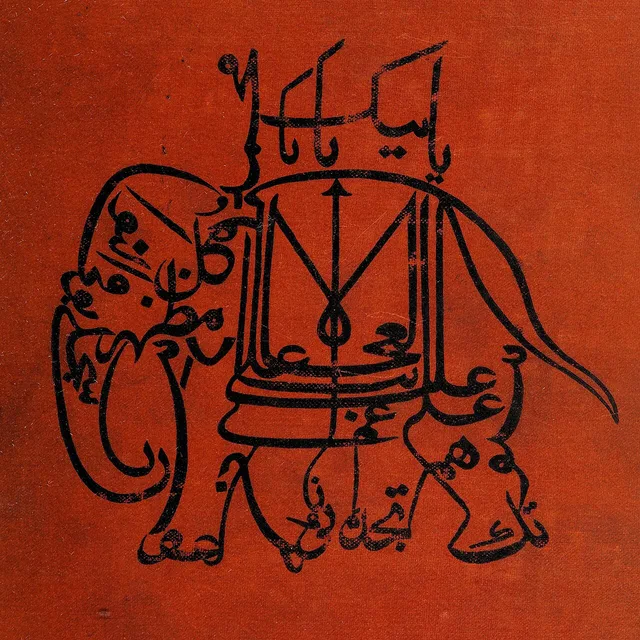
published 1891 · Printed by Macmillan, London, 1891 (Wellcome Library copy)
Photo: Wikimedia Commons, public domain
The movement's own works are still under copyright, so this page shows older works in which the letter had already become a picture.
Sources
- Wikipedia (English), "Hurufiyya movement", "Madiha Omar", "Shakir Hassan Al Said", "Ibrahim El-Salahi" and "Hurufism"
- Hamid Algar, "Horufism", Encyclopaedia Iranica
- Tate, "Khartoum School", Art Terms; and press release "Ibrahim El-Salahi: A Visionary Modernist", 2013
- Charbel Dagher, al-Hurufiyya al-'arabiyya: fann wa-huwiyya, Beirut, 1990 (some catalogues: 1991); English edition Arabic Hurufiyya: Art & Identity, Skira and Barjeel Art Foundation, 2016
- Venetia Porter, Word into Art: Artists of the Modern Middle East, British Museum Press, 2006
- Mohsen al-Dhahabi, "al-Hurufiyyun al-'arab: al-riyada wa-l-huwiyya", Diwan al-Arab, 2007
- Hamid Keshmirshekan, "Saqqā-ḵāna ii. School of art", Encyclopaedia Iranica, 2009 (read via web.archive.org)
- Bibliotheca Alexandrina, "Hurufiyya: Art and Identity Exhibition", events page, 2016
Try it now in this very script — ح
Open in the Studio →Written by the MASHQ studio · last updated 2026-10-05. Further reading, the standard references in English: Sheila S. Blair, Islamic Calligraphy (Edinburgh University Press, 2006) · Annemarie Schimmel, Calligraphy and Islamic Culture (New York University Press, 1984) · Yasin Hamid Safadi, Islamic Calligraphy (Thames and Hudson, 1978).
Keep exploring
From the store's journal: Calligraphy wall art for every room