
Yaqut al-Musta'simi
d. 1298 · Baghdad
Slave, then secretary to the last Abbasid caliph, then the bridge between eras. He recut the pen's nib at an angle — a small blade-stroke that gave every script new fire — and distilled the six classical scripts (al-aqlam al-sitta) that all Ottoman and Persian masters would study. Legend says he kept practising in a minaret while the Mongols sacked Baghdad in 1258: the city fell, the six scripts survived.
Legacy: the six scripts canon; the slanted nib cut.
Achievements
- Chose six scripts, thuluth, naskh, rayhan, muhaqqaq, tawqi and riqa, and refined them; they gradually displaced all other styles except Kufic (Encyclopaedia Iranica).
- Cut the reed nib at a slant instead of straight across.
- Was given the title qiblat al-kuttab.
- Survived the Mongol sack of Baghdad in 1258 and then served the Ilkhanid minister Ata-Malik Juvayni.
- Dated Qur'ans in his name survive from 681 AH (1282–83) to 1289, in Dublin, London, Istanbul, Tehran and Paris.
Taught by: Safi al-Din Abd al-Mu'min al-Urmawi
Taught: Ahmad ibn al-Suhrawardi, Arghun al-Kamili, Mubarakshah ibn Qutb, Abdallah al-Sayrafi, Pir Yahya al-Sufi (Yahya al-Jamali al-Sufi), Sayyid Haydar, Sons and nephew of Ata-Malik Juvayni
His work
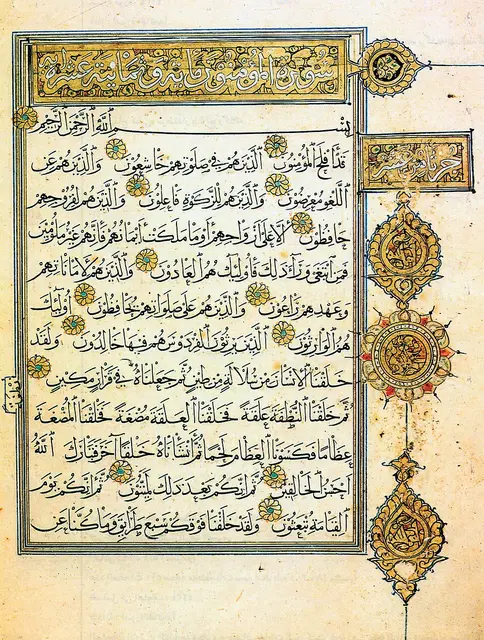
Baghdad, 1286 · Islamic Museum, Tehran (ms. 4277)
Photo: Wikimedia Commons, public domain
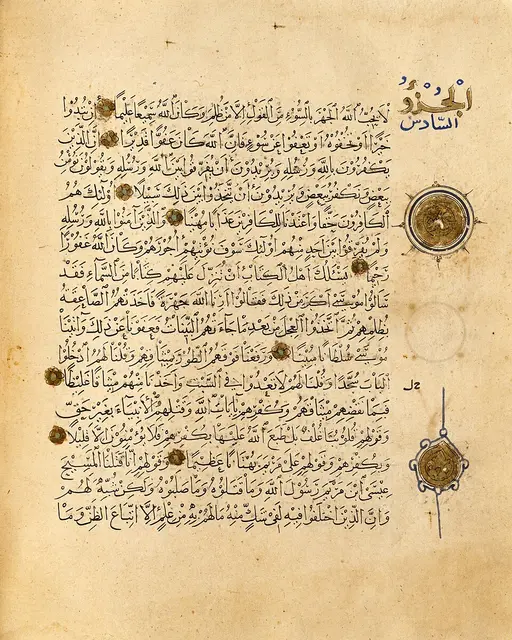
Baghdad, 1289 · Bibliothèque nationale de France (Arabe 6716)
Photo: Wikimedia Commons, public domain
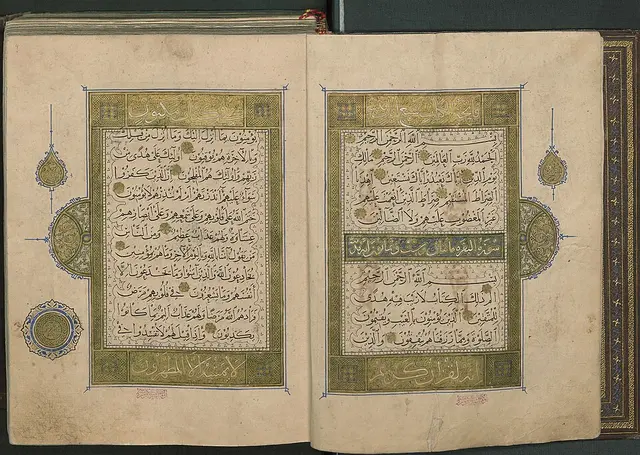
Baghdad, 1286–1287 · Turkish and Islamic Arts Museum, Istanbul (507)
Photo: Wikimedia Commons, public domain
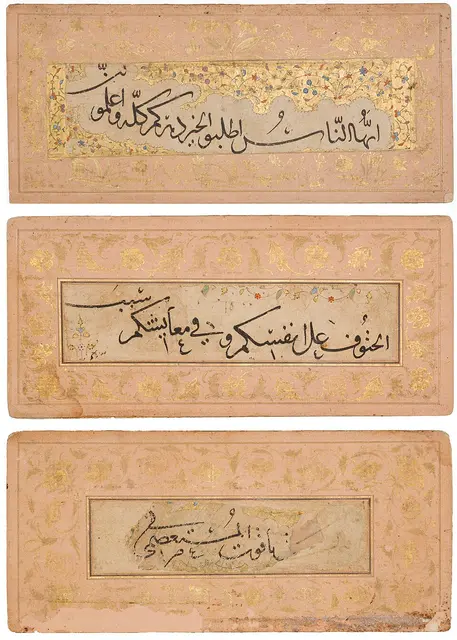
before 1298 · Khalili Collections, London
Photo: Wikimedia Commons, public domain
Write in the tradition this hand shaped.
Write in this tradition now →Write in Thuluth yourself, free: the Thuluth calligraphy generator · your name in Arabic calligraphy
Living calligraphers you can buy from — signed originals on paper, from AED 550: Anwar Alhulwani (Thuluth) · Ahmed Alhawary (Jali Thuluth, Naskh) · Rasha Kasim (Kufi) — or every Thuluth piece the store makes: Thuluth collection.
Sources
- identity wikidata.org
- origin, service of al-Musta'sim, 1258 minaret story, oblique nib, qiblat al-kuttab, students Suhrawardi and Yahya al-Sufi, Shuhda claim en.wikipedia.org
- Arabic name, Rumi origin, death 696 (or 686), quotation from al-Nujum al-zahira ar.wikipedia.org
- teacher Safi al-Din Urmavi and Juvayni's sons (Iqbal Ashtiani), list of seven pupils, death 698 fa.wikipedia.org
- d. 696/1296-97 or 698/1298-99; selected six scripts iranicaonline.org
- Yaqut d. 1297 or 1299, credited with canonising the proportions of the six scripts iranicaonline.org
- said born Amasya early 13th c., slave of al-Musta'sim, service of Juvayni after 1258, died Baghdad 1298, many false attributions khalilicollections.org
- Part 15 Qur'an, 681/1282-3, Baghdad, muhaqqaq khalilicollections.org
- Qur'an dated Sha'ban 681 in Oman craftsofiraq.uvic.ca
Written by the MASHQ studio · last updated 2026-10-05. Further reading, the standard references in English: Sheila S. Blair, Islamic Calligraphy (Edinburgh University Press, 2006) · Annemarie Schimmel, Calligraphy and Islamic Culture (New York University Press, 1984) · Yasin Hamid Safadi, Islamic Calligraphy (Thames and Hudson, 1978).