
Ibn al-Wahid (Sharaf al-Din Muhammad ibn Sharif)
1249–1311 · Damascus & Cairo
Sharaf al-Din Muhammad ibn Sharif ibn Yusuf, known as Ibn al-Wahid, was born in Damascus in 647 AH (1249). He studied hadith and Arabic there, then travelled to Baalbek, the Hijaz and Iraq to perfect his writing, and in Iraq he met Yaqut al-Musta'simi. He worked in the chancery in Syria and Egypt and became known for copying and decorating Qur'ans. His best-known work is the seven-volume Qur'an commissioned by Rukn al-Din Baybars al-Jashnakir, later Sultan Baybars II, written in gold thuluth in Cairo in 704–705 AH (1304–06) and now in the British Library. He also wrote a commentary on Ibn al-Bawwab's poem on calligraphy. In his last years he lived as a Sufi at the khanqah of Sa'id al-Su'ada in Cairo, and he died at the Mansuri hospital there in 711 AH (1311).
Achievements
- Wrote the seven-volume Qur'an of Rukn al-Din Baybars al-Jashnakir (later Sultan Baybars II) in gold thuluth, Cairo, 704–705 AH (1304–06); now British Library Add MS 22406–22412.
- Wrote a commentary on Ibn al-Bawwab's poem on calligraphy (the Ra'iyya); a manuscript is in Dar al-Kutub, Cairo, and it was printed in Tunis in 1967.
- Served in the chancery (diwan al-insha') in Syria and Egypt.
- Taught many students and had a manner of writing named after him that others copied (ar Wikipedia).
- Wrote Nisf al-'aysh for the Mamluk sultan al-Ashraf Khalil.
Taught by: Yaqut al-Musta'simi
His work
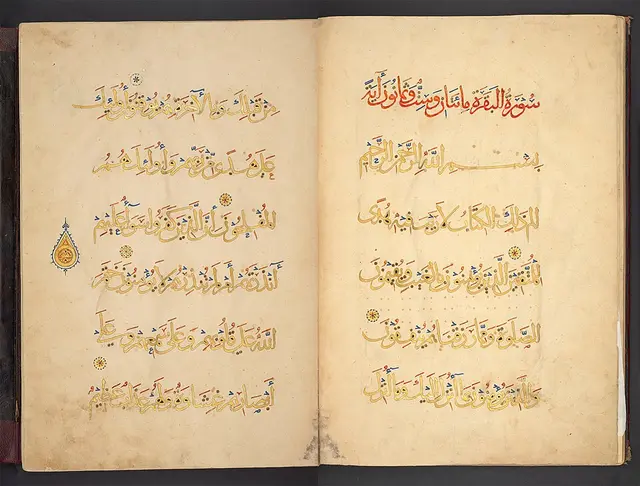
1304–1306 · British Library, London (Add MS 22406)
Photo: Wikimedia Commons, public domain
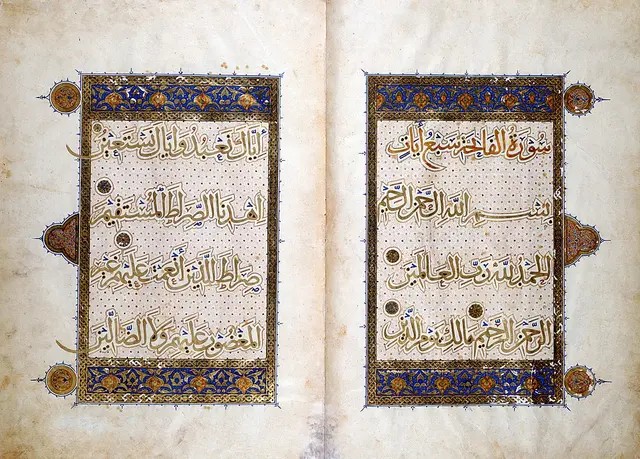
1304–1306 · British Library, London (Add MS 22406)
Photo: Wikimedia Commons, public domain
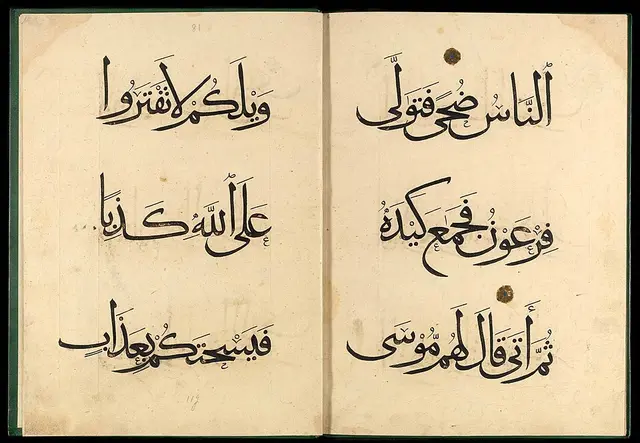
about 1306–1310 · Chester Beatty Library, Dublin
Photo: Wikimedia Commons, public domain
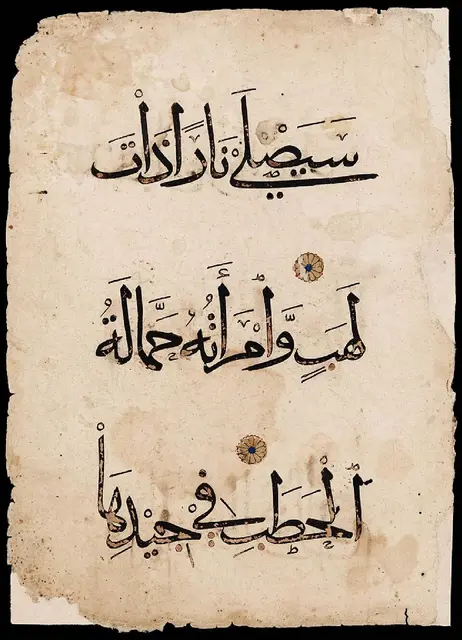
about 1306–1311 · Museum of Fine Arts, Boston
Photo: Wikimedia Commons, public domain
Write in the tradition this hand shaped.
Write in this tradition now →Living calligraphers you can buy from — signed originals on paper, from AED 550: Anwar Alhulwani (Thuluth) · Ahmed Alhawary (Jali Thuluth, Naskh) · Rasha Kasim (Kufi) — or every Thuluth piece the store makes: Thuluth collection.
Sources
- identity, 1249–1311, Damascus–Cairo wikidata.org
- main biography (after al-Mawsu'a al-'Arabiyya and al-Dhahabi): 647–711 AH, Damascus, travels, met Yaqut, chancery, Baybars Qur'an, commentary on Ibn al-Bawwab, khanqah Sa'id al-Su'ada, death at al-Bimaristan al-Mansuri ar.wikipedia.org
- his commentary on the Ra'iyya, printed Tunis 1967; death in Cairo 711/1311 ar.wikipedia.org
- Add MS 22406: vol. 1 of the seven-volume Qur'an of Rukn al-Din Baybars; illuminators named; volume shelfmarks 22406–22412 searcharchives.bl.uk
- Commons record (BL image): copied by Muhammad ibn al-Wahid, gold thuluth, Cairo 1304–06 commons.wikimedia.org
- commentaries of Ibn al-Basis and Ibn al-Wahid on Ibn al-Bawwab's Ode (D. James) craftsofiraq.uvic.ca
Written by the MASHQ studio · last updated 2026-10-05. Further reading, the standard references in English: Sheila S. Blair, Islamic Calligraphy (Edinburgh University Press, 2006) · Annemarie Schimmel, Calligraphy and Islamic Culture (New York University Press, 1984) · Yasin Hamid Safadi, Islamic Calligraphy (Thames and Hudson, 1978).