Abdallah al-Sayrafi
d. 1345 · Tabriz
Abdallah ibn Mahmud al-Sayrafi was the son of Khwaja Mahmud Sarraf of Tabriz and appears to have spent his whole life in that city. He trained in the six scripts of the Baghdad school of Yaqut al-Musta'simi. Encyclopaedia Iranica names Sayyid Haydar, a pupil of Yaqut, as his principal teacher, while Arabic and Persian sources count him among Yaqut's own pupils. He copied Qur'ans but was best known for designing architectural inscriptions. With his pupil Hajji Muhammad Bandgir he wrote the inscriptions of a Tabriz building put up in 741–743 AH (1340–43), afterwards called 'the building of the master and the pupil'. Surviving work includes a muhaqqaq Qur'an in the Chester Beatty Library, a naskh Qur'an dated 720 AH (1324) in the shrine library at Mashhad, and a 1324 page in the Iraq Museum. He died after 746 AH (1345–46) and is said to be buried in the Charandab cemetery in Tabriz.
Achievements
- Designed the inscriptions of a Tabriz building of 741–743 AH (1340–43), written with his pupil and later called 'the building of the master and the pupil' (Encyclopaedia Iranica).
- Designed the calligraphy of the Dimashqiya madrasa in Tabriz, now lost (Encyclopaedia Iranica).
- Signed Part 30 of a Qur'an in naskh in 1328, now in the Chester Beatty Library.
- A naskh Qur'an dated 720 AH (1324) is in the shrine library at Mashhad; a 1324 specimen in thuluth, naskh and riqa' is in the Iraq Museum.
- Dust Muhammad traced the Khurasani naskh tradition back to him (Encyclopaedia Iranica).
- Arabic and Persian sources trace a line from him through Khayr al-Din al-Mar'ashi to Hamdullah of Amasya.
Taught by: Sayyid Haydar, Yaqut al-Musta'simi
Taught: Hajji Muhammad Bandgir, Khayr al-Din al-Mar'ashi
His work
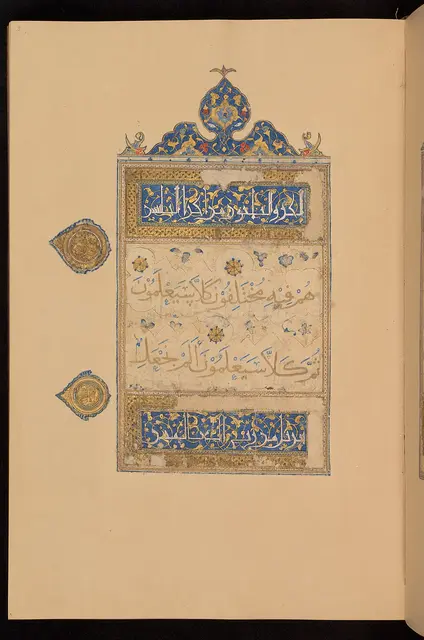
1328 · Chester Beatty Library, Dublin
Photo: Wikimedia Commons, public domain
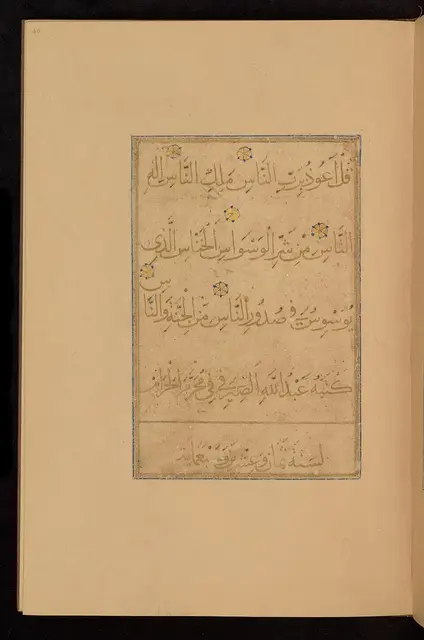
1328 · Chester Beatty Library, Dublin
Photo: Wikimedia Commons, public domain
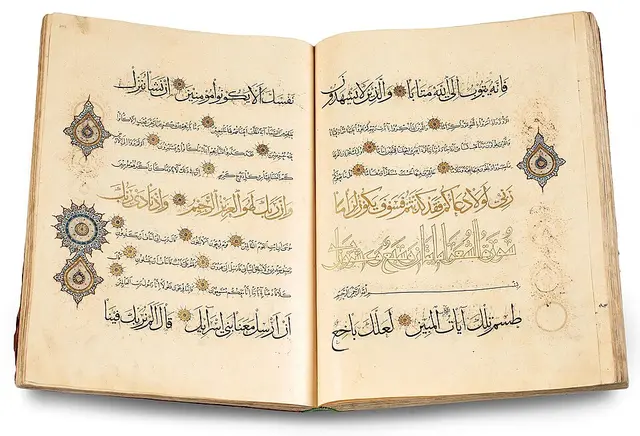
first half of the 14th century · Turkish and Islamic Arts Museum, Istanbul
Photo: Wikimedia Commons, public domain
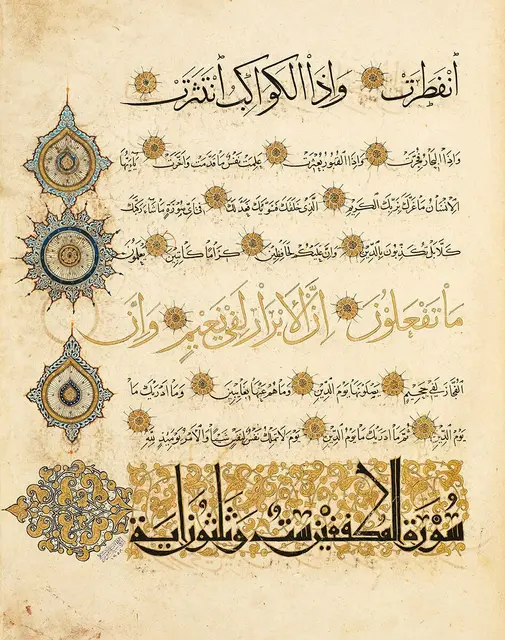
first half of the 14th century · Turkish and Islamic Arts Museum, Istanbul
Photo: Wikimedia Commons, public domain
Write in the tradition this hand shaped.
Write in this tradition now →Living calligraphers you can buy from — signed originals on paper, from AED 550: Anwar Alhulwani (Thuluth) · Ahmed Alhawary (Jali Thuluth, Naskh) · Rasha Kasim (Kufi) — or every Naskh piece the store makes: Naskh collection.
Sources
- identity wikidata.org
- main source: Tabriz, father, d. after 746/1345-46, Charandab burial, teacher Sayyid Haydar, works, inscriptions, pupil Hajji Muhammad Bandgir, Dust Muhammad iranicaonline.org
- Arabic name, dates 742/747, pupil of Yaqut, Khayr al-Din al-Mar'ashi and Hamdullah line, Ustad-Shagird mosque ar.wikipedia.org
- same facts in Persian (Fazaeli, Atlas-e khatt) fa.wikipedia.org
Written by the MASHQ studio · last updated 2026-10-05. Further reading, the standard references in English: Sheila S. Blair, Islamic Calligraphy (Edinburgh University Press, 2006) · Annemarie Schimmel, Calligraphy and Islamic Culture (New York University Press, 1984) · Yasin Hamid Safadi, Islamic Calligraphy (Thames and Hudson, 1978).