Ahmad ibn al-Suhrawardi
1256–1340 · Baghdad
Ahmad ibn al-Suhrawardi was born in Baghdad in 1256 into a family that traced its roots to Suhraward in north-west Iran; he signed himself Ahmad son of Yahya son of Muhammad. The Reed College anthology names Ibn Habib and Safi al-Din al-Urmawi as his teachers, and some biographers count him among the pupils of Yaqut al-Musta'simi. He wrote naskh and thuluth but is known above all for large muhaqqaq. Between 701 and 707 AH (1302–08) he copied a thirty-part Qur'an, now called the Anonymous Baghdad Qur'an, illuminated by Muhammad ibn Aybak; parts of it are in the National Museum of Iran and the Metropolitan Museum of Art. He is said to have copied the Qur'an 33 times and to have designed inscriptions for buildings in Baghdad. His dated works run from 692 AH (1292) to 730 AH (1329). Most sources place his death in 1340; some give 1320–21.
Achievements
- Copied a thirty-part Qur'an in muhaqqaq between 701 and 707 AH (1302–08), illuminated by Muhammad ibn Aybak, known as the Anonymous Baghdad Qur'an.
- Is said to have copied the Qur'an 33 times.
- Designed inscriptions for buildings in Baghdad.
- Copied a single-volume Qur'an in 701 AH (1301–02), now Chester Beatty Library 1467, and another dated Shawwal 718 AH (1318), now in Istanbul.
- His dated works run from 692 AH (1292) to 730 AH (1329).
Taught by: Yaqut al-Musta'simi, Ibn Habib, Safi al-Din al-Urmawi
His work
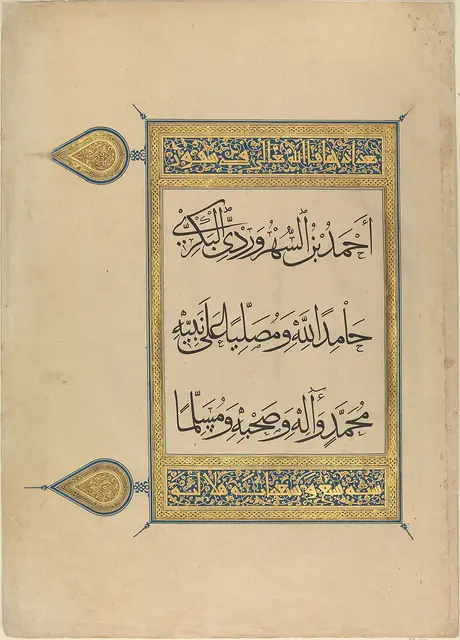
1307–1308 · Metropolitan Museum of Art, New York
Photo: Wikimedia Commons, CC0
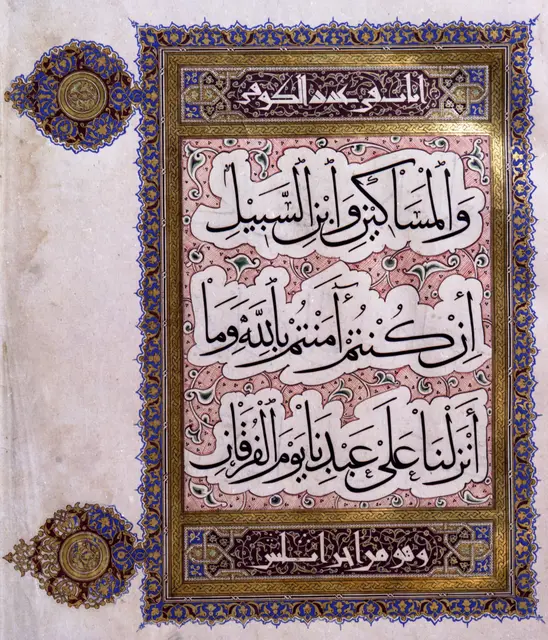
about 1305–1307 · National Museum of Iran, Tehran
Photo: Wikimedia Commons, public domain
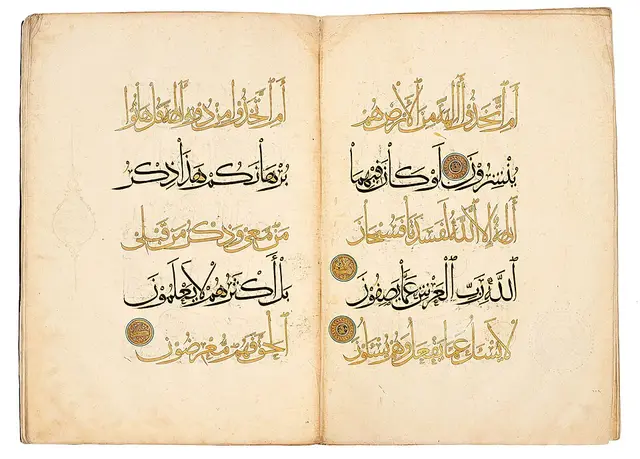
1307–1308 · Turkish and Islamic Arts Museum, Istanbul
Photo: Wikimedia Commons, public domain
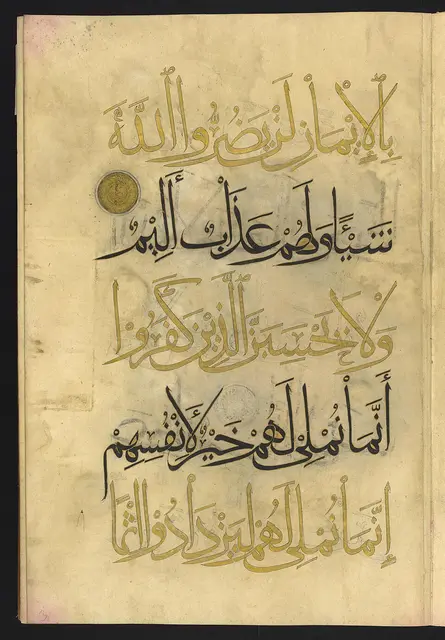
1307 · Saxon State and University Library, Dresden
Photo: Wikimedia Commons, public domain
Write in the tradition this hand shaped.
Write in this tradition now →Living calligraphers you can buy from — signed originals on paper, from AED 550: Anwar Alhulwani (Thuluth) · Ahmed Alhawary (Jali Thuluth, Naskh) · Rasha Kasim (Kufi) — or every Naskh piece the store makes: Naskh collection.
Sources
- identity wikidata.org
- 1256–1340, Baghdad, likely grandson of Shihab al-Din Umar al-Suhrawardi, pupil of Yaqut, 33 Qur'ans, two 30-volume Qur'ans, Baghdad inscriptions en.wikipedia.org
- 654–741 AH, signature lineage, works list incl. 718 Qur'an and 728 Nahj al-Balagha fa.wikipedia.org
- born Baghdad 1256, lineage, teachers Ibn Habib and Safi al-Din Ormavi, Mohaqqaq Qur'an 701–706, dated works 692/1292 to 730/1329, d. 1340, buried Baghdad reed.edu
- Met 50.12, calligrapher Ahmad ibn al-Suhrawardi al-Bakri, died 1320/21, 706 AH/1306–7 metmuseum.org
- Met 55.44, calligrapher Ahmad ibn al-Suhrawardi al-Bakri, dated 707 AH/1307–8 metmuseum.org
- (after D. James) Anonymous Baghdad Qur'an 1302–08 with Muhammad ibn Aybak, CBL 1467 (701), TIEM 486 (718), death 1320–21, 33 Qur'ans, Baghdad inscriptions craftsofiraq.uvic.ca
Written by the MASHQ studio · last updated 2026-10-05. Further reading, the standard references in English: Sheila S. Blair, Islamic Calligraphy (Edinburgh University Press, 2006) · Annemarie Schimmel, Calligraphy and Islamic Culture (New York University Press, 1984) · Yasin Hamid Safadi, Islamic Calligraphy (Thames and Hudson, 1978).