Diwani — the sultan's secret hand
Diwani was born in the Ottoman chancery — the diwan — in the fifteenth century: decrees of Mehmed II are already written in it. Who gave it its rules is disputed; Arabic accounts name Ibrahim Munif, the TDV encyclopedia scribes such as Matrakçı Nasuh and Taci Bey. It was a state secret: its dense, undulating lines, packed with no room between words, made royal decrees hard to forge and harder to tamper with. Letters ride each other in waves and nothing is ruled — the script breathes. Its ornate cousin, Diwani Jali, fills every void with dots and small marks until the text becomes a golden thicket. It remains the script of ceremony: wedding invitations, royal correspondence, and names written like decrees.
Where it came from
The name means 'of the divan', because the hand was written only there. The Ottomans also called it hatt-ı çep, and its scribes çepnüvis. Some reports say the clerks swore never to write it outside the council. Its letter shapes show where it grew from: ta'liq, a Persian chancery hand of the eleventh and twelfth centuries, reworked by Turkish scribes.
Fifteenth-century manuals on writing do not name it, yet documents from the reign of Mehmed II (1451–1481) are written in it. Those early lines are plain; later ones are far more worked. Who gave it its rules is disputed. Arabic accounts, Arabic Wikipedia among them, name Ibrahim Munif and place him under Mehmed II. The TDV encyclopedia of Islam names instead Matrakçı Nasuh and Bali Yusuf in Istanbul and Taci Bey in Amasya. Taci's son Cafer Çelebi, chancellor (nişancı) to Bayezid II and Selim I, reformed both the tughra and the Diwani hand. The sixteenth-century historian Âlî lists an Ibrahim Münshi among those who wrote it well in Iran.
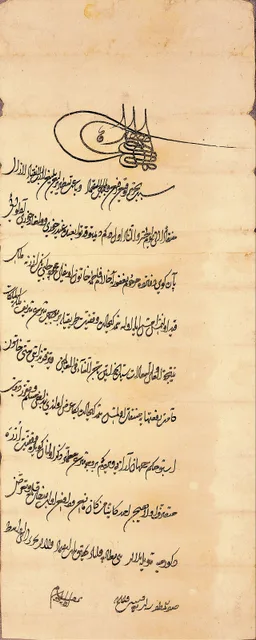
1459 · Sakıp Sabancı Museum, Istanbul
Photo: Wikimedia Commons, public domain
A hand for decrees
Almost everything the imperial council issued was written in Diwani: decrees (ferman), warrants of privilege (berat), letters patent, appointments, endowment deeds and court records. The sultan's tughra stood at the head. Below it the text ran in long lines that rise to a point at the left end, and each line closes with a mark drawn from top to bottom.
Letters and words were packed so close that nothing could be slipped between them. A faster, freer form, divani kırması, filled the registers of outgoing orders. It joins more letters and leaves some half written, so reading it takes practice.
The hand matured from the sixteenth to the eighteenth century and reached its full proportions in the nineteenth, in the offices of the imperial council and the Sublime Porte. It was used until 1928, when Turkey changed its alphabet. Scribes did not sign official documents, so little is known about the early masters.
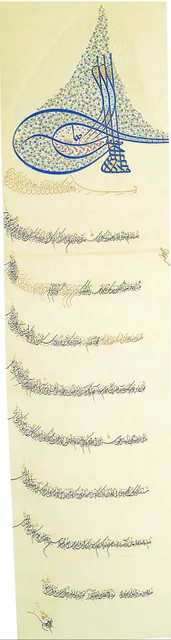
1575 · Sakıp Sabancı Museum, Istanbul
Photo: Wikimedia Commons, public domain
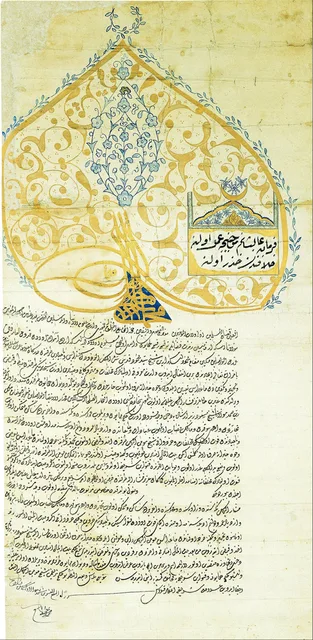
1659 · Sakıp Sabancı Museum, Istanbul
Photo: Wikimedia Commons, public domain
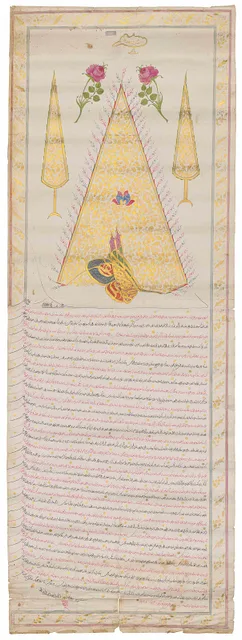
25 July 1827 · Private collection (sold at Christie's)
Photo: Wikimedia Commons, public domain
Reading its letters
Unlike other scripts, Diwani letters stand up and lean to the left, and their level strokes slope too, from right to left. The bowls of ح, س, ص, ع, ق, ك, ل, م, ن and ى are drawn back towards the right. Alif, dal, ra and waw, which join nothing after them in other hands, here join the next letter. Words sit without gaps, and towards the end of a line they lift away from it. Taken together, says the TDV encyclopedia, these features give the hand its air of grandeur.
In Mahdi al-Sayyid Mahmud's model book of Diwani, the alif is six dots tall, with a thin line after the third dot. That line marks the halfway point, and it is part of the measure.
The researcher Naji Zayn al-Din held that Diwani's ornament came from Chinese writing through the Turks of Transoxiana. The TDV encyclopedia rejects this: plain Diwani, it says, has no ornament at all. The dots and small marks belong to its jali form.
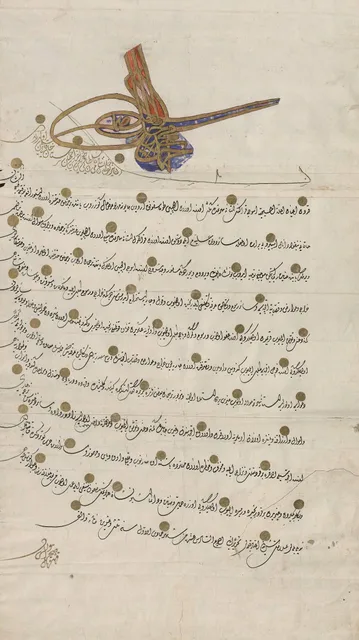
1711 · National Archives of Sweden, Stockholm
Photo: Wikimedia Commons, public domain
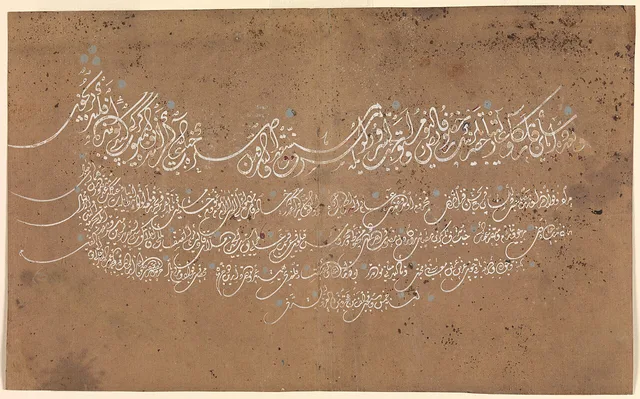
1664–65 · The Metropolitan Museum of Art, New York
Photo: Wikimedia Commons, CC0
Diwani Jali, and the road to Cairo
Diwani Jali is the same hand made into a single shape: the whole text is set as one block, and its gaps are filled with dots and small marks. The two are so close, the TDV encyclopedia notes, that a calligrapher who writes one can easily write the other.
The encyclopedia's list of the last great writers of both runs from Mümtaz Efendi (died 1871) through Mehmed Şefik, Mehmed İzzet and Sami Efendi to Kamil Akdik, İsmail Hakkı Altunbezer, Halim Özyazıcı and Hamit Aytaç (died 1982). The works of the most recent of them are still under copyright, so none are shown here.
From Istanbul the hand went to Cairo. King Fuad opened the School for Improving Arabic Script there in 1922, and Diwani was taught there from the start. Mustafa Ghazlan Bey (died 1938) wrote it so finely that in Egypt it is sometimes called al-khatt al-Ghazlani. It is written today across the Arab world, though not in Iran, Afghanistan or Pakistan.
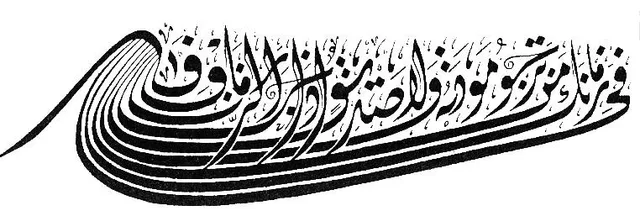
1826 · Istanbul (reproduced in G. Mandel, Das arabische Alphabet, 2004)
Photo: Wikimedia Commons, public domain
Before you write it
Learn to read it first. Take a decree whose text is published and follow the letters slowly, watching for alif, dal, ra and waw joined to the letter after them. Reading teaches the eye where each letter begins before the hand has to find it.
When you write, make the six-dot alif your yardstick and give every word the same lean. Practise long lines that climb at the end, and close each line with its downward stroke. Leave the jali form until the plain hand is steady: its ornament hides faults and does not mend them. In Ottoman times Diwani, jali Diwani and the tughra were taught mostly in the council's own offices, so copy from documents as well as from copybooks.
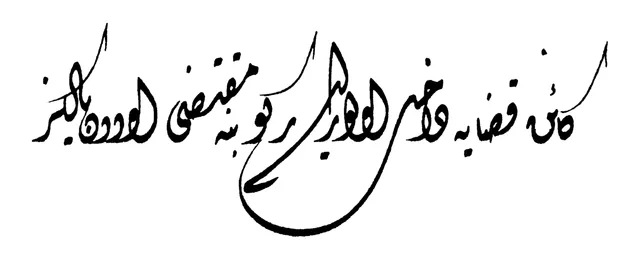
1892 · Hutut-i Osmaniye, printed in Istanbul
Photo: Wikimedia Commons, public domain
Sources
- Ali Alparslan, "Dîvânî", TDV İslâm Ansiklopedisi, vol. 9, Istanbul, 1994
- Muhittin Serin, "Meşk" (calligraphy section), TDV İslâm Ansiklopedisi, web edition
- Mahdi al-Sayyid Mahmud, al-Khatt al-diwani, model sheets (no date)
- Wikipedia (English), "Diwani"
- Wikipedia (Arabic), "Madrasat tahsin al-khutut" (the School for Improving Arabic Script, Cairo)
- The Metropolitan Museum of Art, "Page of Calligraphy", 1986.216.1, collection record
Try it now in this very script — عز من قنع
Open in the Studio →Written by the MASHQ studio · last updated 2026-10-05. Further reading, the standard references in English: Sheila S. Blair, Islamic Calligraphy (Edinburgh University Press, 2006) · Annemarie Schimmel, Calligraphy and Islamic Culture (New York University Press, 1984) · Yasin Hamid Safadi, Islamic Calligraphy (Thames and Hudson, 1978).
Keep exploring
From the store's journal: Styles guide: Kufic, Thuluth & Diwani