Ruq'ah — the people's script
Ruq'ah is the youngest classical script, standardised in nineteenth-century Istanbul so that clerks across the Ottoman empire would write one clear, fast hand. Short strokes, clipped curves, no ornament: a script designed to be finished, not admired — and precisely because of that, it became the everyday handwriting of most of the Arab world, the Maghreb aside. Shop signs, school notebooks, kitchen notes: very often Ruq'ah. In this studio it signs the name: the Arabic of the Mashq wordmark is set in Aref Ruqaa, a typographic homage to the hand of daily life.
Two scripts, one name
Ruq'ah means a scrap of paper or parchment. Centuries before the Ottomans, riqa' was also the name of one of the six classical pens: a small, quick relative of tawqi', used for letters, notes in the margins of books and colophons. Calligraphers wrote their diplomas in it, so it was also called the ijazah hand. Its alif was five dots of its own pen. The TDV encyclopedia traces it to the eighth century, when the secretary and poet Yusuf Laqwa drew a new style from thuluth that became the pen of tawqi'; riqa' came from that, and Ibn Muqla gave both their order.
The Ottoman ruq'ah shares that name and little else. Arabic Wikipedia gives two views of where it came from: that it grew out of naskh and thuluth, or that it was drawn from Diwani and from siyaqat, the accountants' hand. The TDV encyclopedia of Islam describes it as Diwani with everything slow taken out.
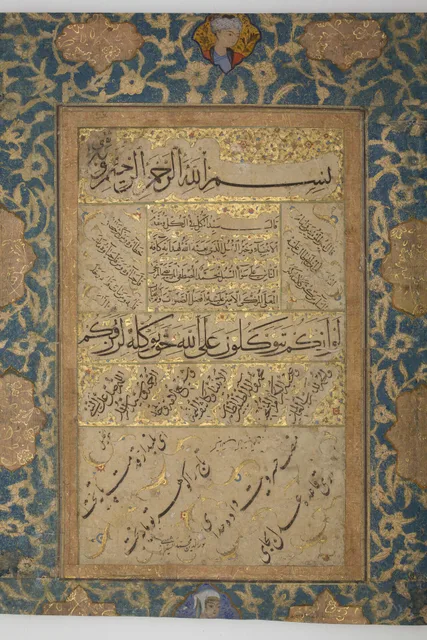
1692 · Khalili Collections, London
Photo: Khalili Collections, Wikimedia Commons (Khalili Collection Islamic Art cal 0225.2.jpg), CC BY-SA 3.0 IGO
From the offices of the Sublime Porte
No one knows exactly when it appeared. One historian places an early form in the Dulkadir principality of south-eastern Anatolia after the middle of the fifteenth century. It is certain in the imperial council from the second half of the eighteenth. By the nineteenth it was the hand of daily life, of letters, and of the government offices of the Porte.
Mümtaz Efendi then gave the clerks' hand fixed rules. The TDV encyclopedia dates his death to 1872 in one article and 1871 in another, and Arabic Wikipedia sets his rules in 1280 AH / 1863. After him Mehmed İzzet Efendi, calligraphy teacher at the Galatasaray imperial school, studied the hands of the statesmen Âli Pasha, Fuad Pasha and Cevdet Pasha and drew a new, clearer style. Its letters were better proportioned and less squat, and in time the clerks' older style was forgotten. Not everyone welcomed it: the TDV encyclopedia records that Sami Efendi and others who kept to the Porte's hand disliked it, because it had lost the speed that was the point of ruq'ah.
Mehmed İzzet was born in 1841 and, by the TDV encyclopedia, died on 18 January 1903; some give 1904. English Wikipedia credits a different man, Kazasker Mustafa İzzet (1801–1876), so the two names are easily confused. İzzet printed his models, with Hafız Tahsin, in Hutut-i Osmaniye (Istanbul, editions of 1296, 1306 and 1309 AH), and printing let one teacher's models reach many schools.
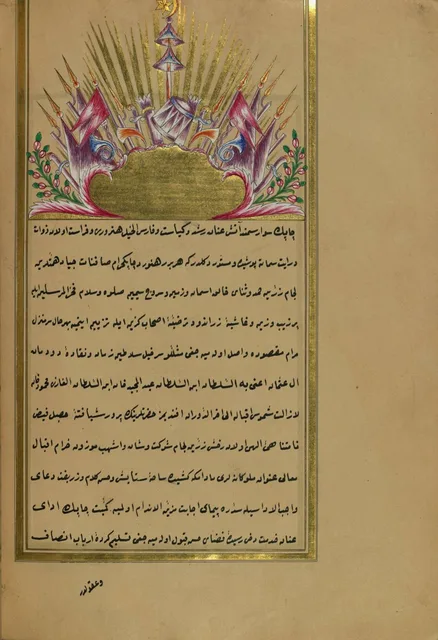
1854–1855 · Walters Art Museum, Baltimore
Photo: Wikimedia Commons, public domain
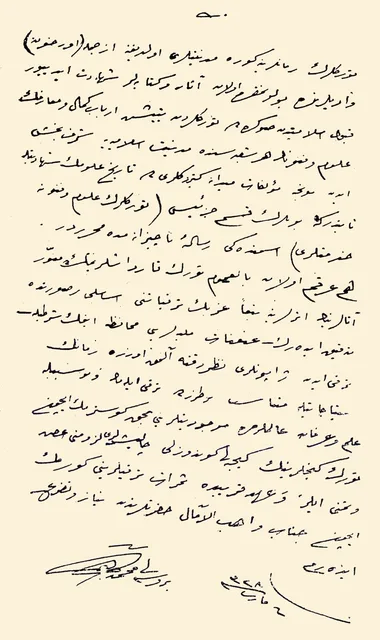
1913 · Reproduced in TDV İslâm Ansiklopedisi
Photo: Wikimedia Commons, public domain
How ruq'ah is built
Set it beside Diwani and you see what was removed. The tall letters were shortened. The hooks and flourishes went. The leftward lean became straight and sharp. The eyes of fa, qaf, mim and waw closed, and the teeth of sin became a plain line. Arabic Wikipedia adds that the fa and qaf keep their eyes open in the middle of a word.
Dots are half the size of the pen's full dot. Two dots become one short dash, and three become a small arch. Words carry no vowel signs and sit on the line, and only a few shapes go below it: the bowls of jim, ha, kha, 'ayn and ghayn written alone, and the tail of a final mim.
In Hashim al-Baghdadi's model book the ruq'ah alif is three dots tall, and the dot itself is a short, steep stroke. The script can be written small and fast without losing its shape, which is why it fits a crowded page.

1892 · Hutut-i Osmaniye, printed in Istanbul
Photo: Wikimedia Commons, public domain
The hand of the Arab world
İzzet's ruq'ah reached the Arab world through his pupils: the TDV encyclopedia names Abd al-Razzaq Awad and Najib Hawawini, who came from Egypt to study with him in Istanbul. When schools began to teach it, copybooks followed. In Cairo the School for Improving Arabic Script, opened under King Fuad in 1922, kept the Ottoman teaching alive; its first teacher was Abdulaziz al-Rifa'i.
Letters show the hand at work: Gibran Khalil Gibran writing to May Ziadeh in 1915, the Egyptian scholar Ahmad Taymur Pasha in 1924, and Ali bin al-Hussein, former king of the Hejaz, writing from Amman in 1931. Newspaper titles are still often lettered in large ruq'ah. Everyday handwriting across the Arab East is usually a mix of naskh and ruq'ah; in the Maghreb ruq'ah is less used.
Like Diwani before it, ruq'ah also has a broken, hurried form, known in the Ottoman offices as rik'a kırması, in which some common words take shorthand shapes.
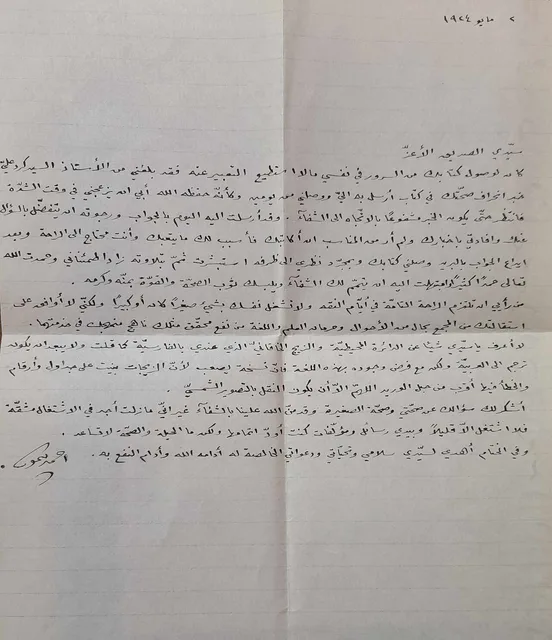
2 May 1924 · Private collection
Photo: Wikimedia Commons, public domain
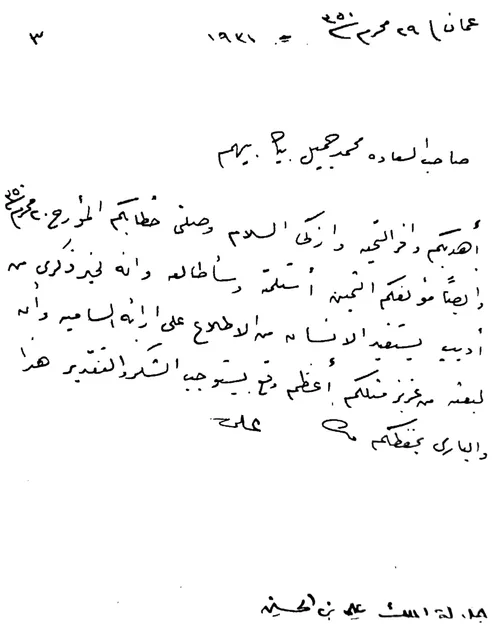
15 June 1931 · Private collection (written in Amman)
Photo: Wikimedia Commons, public domain
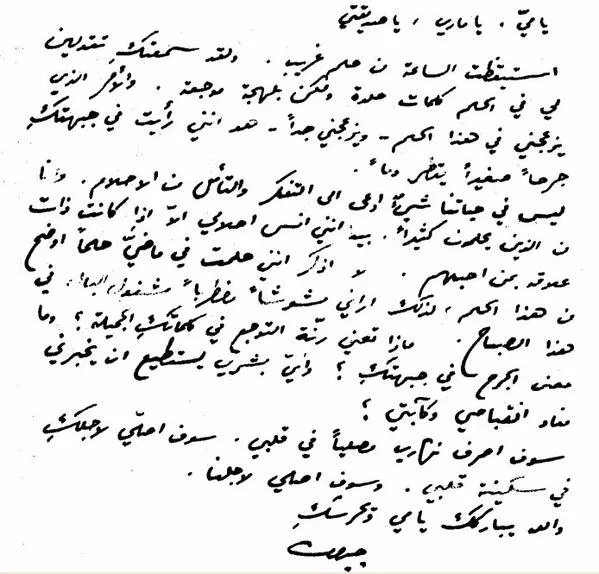
1915 · Published facsimile
Photo: Wikimedia Commons, public domain
How to start
Ruq'ah is a sensible first script for anyone who wants a better everyday hand, because the gain shows in every note you write. Start with the alif at three dots and the short strokes of ba and dal.
Write on a ruled line and keep every letter on it, except the few that go below. Practise the joined dots, the dash for two and the arch for three, until you write them without thinking. Leave out the vowel marks, as the script expects. Then copy a short letter in a good hand, line by line, and compare.
Speed comes last. The aim is a fast ruq'ah that keeps its proportions; a fast one that loses them is only a scrawl.
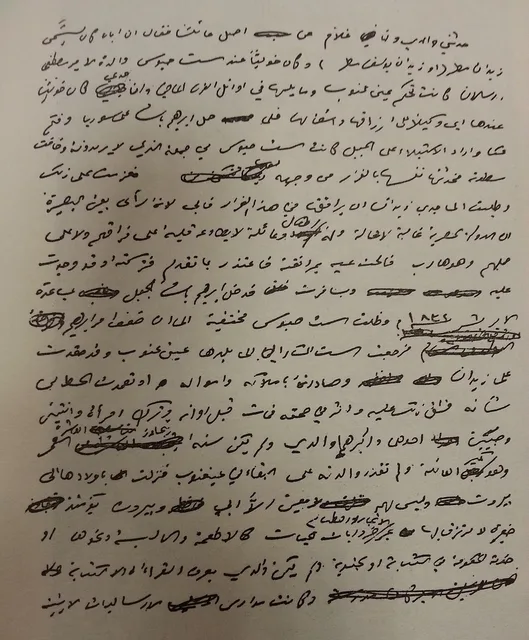
before 1914 · Reproduced in Jurji Zaydan: Rijalun fi rajul (1970)
Photo: Wikimedia Commons, public domain
Sources
- Muhittin Serin, "Rik'a" (the Ottoman script) and "Rikā'" (one of the six pens), TDV İslâm Ansiklopedisi, vol. 35, Istanbul, 2008
- Ali Alparslan, "Dîvânî", TDV İslâm Ansiklopedisi, vol. 9, Istanbul, 1994
- Muhittin Serin, "Meşk" (calligraphy section), TDV İslâm Ansiklopedisi, web edition
- Hashim Muhammad al-Baghdadi, Qawa'id al-khatt al-'arabi, Baghdad, 1961
- Wikipedia (Arabic), "Khatt al-ruq'a" and "Madrasat tahsin al-khutut"
- Wikipedia (English), "Ruqʿah script"
- Walters Art Museum, manuscript W.661, Tayyarzade Ahmed Ata, Book on Horses, collection record
Try it now in this very script — أهلاً وسهلاً
Open in the Studio →Written by the MASHQ studio · last updated 2026-10-05. Further reading, the standard references in English: Sheila S. Blair, Islamic Calligraphy (Edinburgh University Press, 2006) · Annemarie Schimmel, Calligraphy and Islamic Culture (New York University Press, 1984) · Yasin Hamid Safadi, Islamic Calligraphy (Thames and Hudson, 1978).
Keep exploring
From the store's journal: Personalised Arabic name gifts