Ahmed Şemseddin Karahisari
d. 1556 · Afyonkarahisar & Istanbul
Ahmed Şemseddin Karahisari was born in Afyonkarahisar before 1470 and moved to Istanbul early in the reign of Bayezid II, where he stayed for the rest of his life. In his colophons he names the Persian calligrapher Esedullah Kirmani as his teacher. Unlike most Ottoman calligraphers of his time, he did not follow Şeyh Hamdullah; he gave the older manner of Yaqut al-Musta'simi a new reading and became known as 'Yaqut of Rum'. He was admired for chained and mirrored compositions in jali thuluth and muhaqqaq. A palace payroll of 1545 lists him among the court scribes. His best-known work is the large Qur'an of Süleyman I in the Topkapı Palace, attributed to him by style and its endowment note, and he wrote the dome inscription of the Süleymaniye Mosque. He died in Istanbul in 963/1556, at about ninety. His school gave way to Hamdullah's within a century.
Achievements
- Revived the manner of Yaqut al-Musta'simi in a new form and was called 'Yaqut of Rum' and 'sun of calligraphy' (şemsü'l-hat).
- Composed chained (müselsel) and mirrored compositions in jali thuluth and muhaqqaq, including a widely copied chained basmala.
- The large Qur'an of Süleyman I (Topkapı, Hırka-i Saadet 5; 300 leaves, 61.5 x 42.5 cm) is attributed to him by style and its endowment record.
- Wrote the dome inscription of the Süleymaniye Mosque (later rewritten in the same composition under Abdülmecid).
- Listed in the 1545 palace payroll among the court scribes, at 14 akçe a day.
- Outlined gold letters in black ink and black letters in gold.
Taught by: Esedullah Kirmani
Taught: Hasan Çelebi (Karahisari's adopted son; Hasan b. Abdullah, Hasan Halife), Derviş Mehmed, Kâtib, Muhyiddin Halife
His work
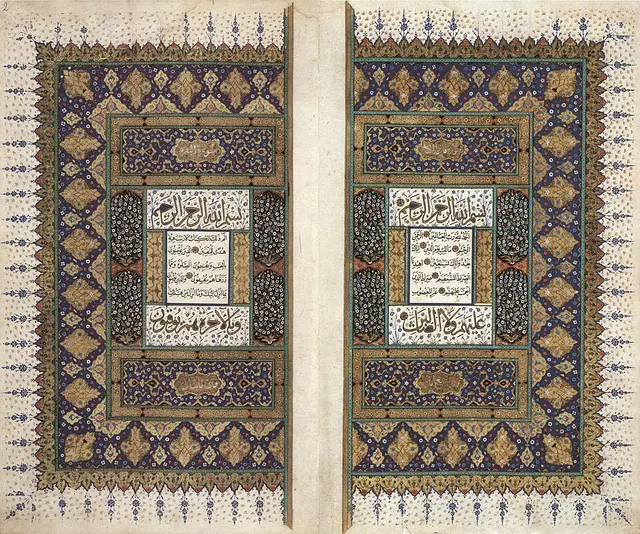
1546–1547 · Topkapı Palace Library, Istanbul
Photo: Wikimedia Commons, public domain
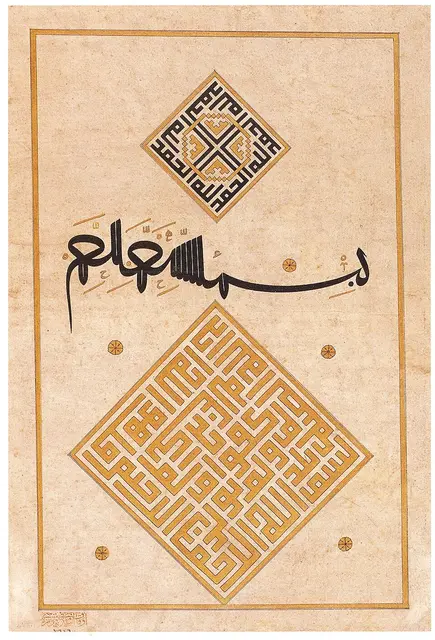
about 1550 · Turkish and Islamic Arts Museum, Istanbul
Photo: Wikimedia Commons, public domain
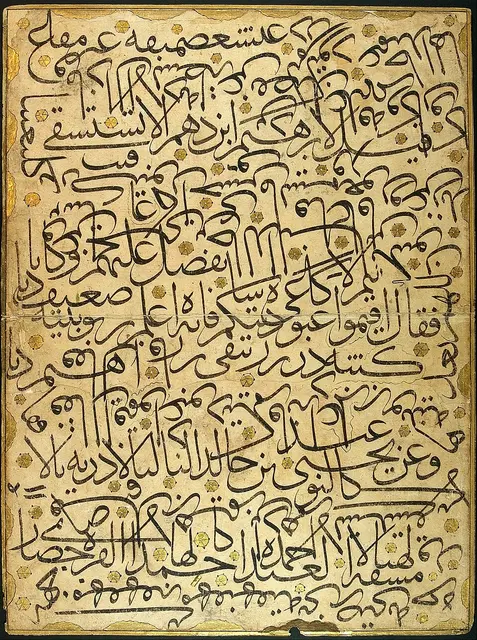
16th century · Sakıp Sabancı Museum, Istanbul
Photo: Wikimedia Commons, public domain
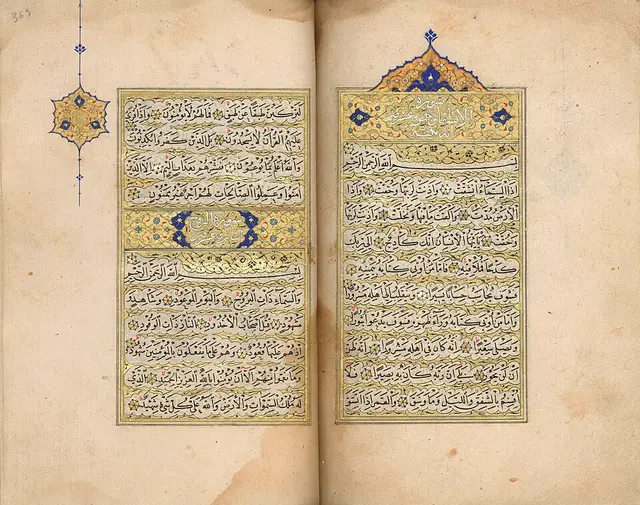
about 1550–1560 · Khalili Collections, London
Photo: Wikimedia Commons, public domain
Write in the tradition this hand shaped.
Write in this tradition now →Living calligraphers you can buy from — signed originals on paper, from AED 550: Anwar Alhulwani (Thuluth) · Ahmed Alhawary (Jali Thuluth, Naskh) · Rasha Kasim (Kufi) — or every Thuluth piece the store makes: Thuluth collection.
Sources
- TDV İslâm Ansiklopedisi, 'KARAHİSÂRÎ, Ahmed Şemseddin' (M. Serin, 2001): life, teacher question, payroll, works, students islamansiklopedisi.org.tr
- English Wikipedia: overview, Hasan Çelebi en.wikipedia.org
- Turkish Wikipedia: 'Yakut-ı Rum', Süleymaniye and Piyale Pasha inscriptions tr.wikipedia.org
- Arabic Wikipedia: Arabic name, 873-963 AH ar.wikipedia.org
- Persian Wikipedia (translation of en-wiki) fa.wikipedia.org
- Wikidata item wikidata.org
Written by the MASHQ studio · last updated 2026-10-05. Further reading, the standard references in English: Sheila S. Blair, Islamic Calligraphy (Edinburgh University Press, 2006) · Annemarie Schimmel, Calligraphy and Islamic Culture (New York University Press, 1984) · Yasin Hamid Safadi, Islamic Calligraphy (Thames and Hudson, 1978).