Malik Daylami (Malek Deylami)
1518–1562 · Deylam & Qazvin
Malik Daylami was born in 924 AH (1518) in the village of Deylam, in the Filvagush district of Qazvin, into a known family. His father, Shahra Amir, taught him thuluth, naskh and the six scripts; in 944 AH (1537), when Rustam Ali and Hafiz Babajan were in Qazvin, he learned nastaliq from them, and he refined it by copying the work of Mir Ali Heravi. He also studied logic, mathematics and philosophy with Jamal al-Din Mahmud Shirazi. The art-loving prince Sultan Ibrahim Mirza put him in charge of his library, and in 964 AH (1557) Malik went with the prince to Mashhad. He began the calligraphy of the prince's famous Haft Awrang of Jami, which other scribes completed. Shah Tahmasp then summoned him to Qazvin to write the inscriptions of his new palace and kept him at court. He also wrote poetry and knew music. Among his pupils was Mir Imad, the greatest nastaliq writer of the next generation. He died in Qazvin on 19 August 1562.
Achievements
- Learned nastaliq from Rustam Ali and Hafiz Babajan in Qazvin in 944 AH (1537) and studied Mir Ali Heravi's works closely.
- Ran the library of the Safavid prince Sultan Ibrahim Mirza and taught there; went with him to Mashhad in 964 AH (1557).
- Was called back by Shah Tahmasp to write the inscriptions of the new royal palace at Qazvin.
- Began the calligraphy of Ibrahim Mirza's Haft Awrang of Jami, now in the Freer Gallery, which others finished (Persian and English Wikipedia).
- Taught Mir Imad, who founded a new school of Persian nastaliq.
Taught by: Shahra Amir, his father, Rustam Ali, Hafiz Babajan, Jamal al-Din Mahmud Shirazi
Taught: Mir Imad al-Hasani, Muhammad Husayn Tabrizi, Shah Muhammad Mashhadi, Qutb al-Din Yazdi, Mir Muhammad Sadr al-Din Qazvini, Isa, Prince Sultan Ibrahim Mirza
His work
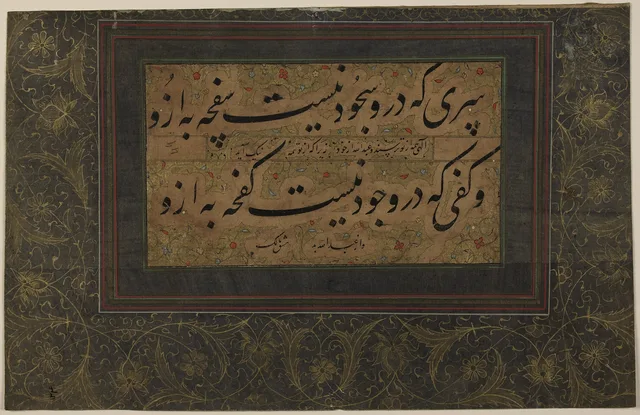
c. 1550 · Library of Congress, Washington (World Digital Library 159)
Photo: Wikimedia Commons, public domain
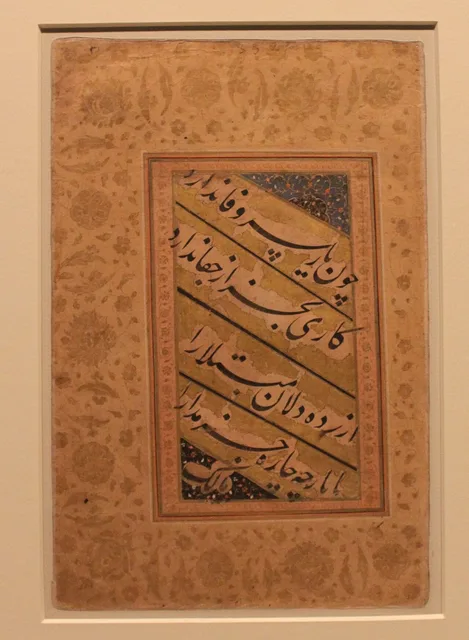
mid-16th century · Musée du Louvre, Paris (MAO 1201)
Photo: Faqscl (photograph), Wikimedia Commons (Quatrain en persan ; page d’album - Iran - milieu du 16è siècle et fin 16e-début du 17e siècle - Louvre - MAO 1201 Recto.jpg), CC BY-SA 4.0 (creativecommons.org/licenses/by-sa/4.0)
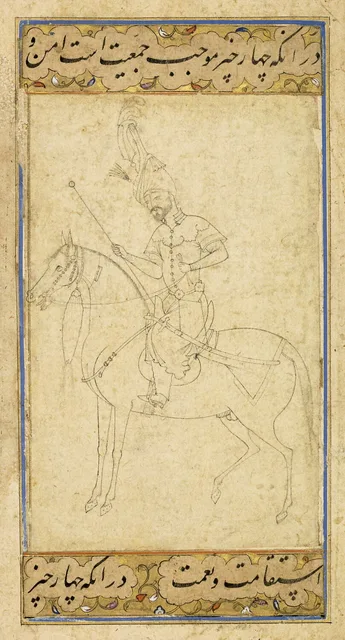
1525-1550 · Musée du Louvre, Paris (OA 7138 verso)
Photo: Wikimedia Commons, public domain
Three works are shown; his album pieces in Edinburgh, Istanbul and Paris (BnF) have no open photographs on Commons.
Write in the tradition this hand shaped.
Write in this tradition now →Living calligraphers you can buy from — signed originals on paper, from AED 550: Anwar Alhulwani (Thuluth) · Ahmed Alhawary (Jali Thuluth, Naskh) · Rasha Kasim (Kufi) — or every Nastaliq piece the store makes: Nastaliq collection.
Sources
- TDV İslâm Ansiklopedisi (Muhittin Serin): birth, teachers, career, death date, collections, students islamansiklopedisi.org.tr
- Persian Wikipedia (after Bayani pp. 598-609): Haft Awrang, students, works fa.wikipedia.org
- English Wikipedia: biography, students en.wikipedia.org
- World Digital Library 159 (Library of Congress): Munajat fragment signed 'mashq-i Malik' wdl.org
- Louvre OA 7138 verso: calligrapher Malik Daylami collections.louvre.fr
Written by the MASHQ studio · last updated 2026-10-05. Further reading, the standard references in English: Sheila S. Blair, Islamic Calligraphy (Edinburgh University Press, 2006) · Annemarie Schimmel, Calligraphy and Islamic Culture (New York University Press, 1984) · Yasin Hamid Safadi, Islamic Calligraphy (Thames and Hudson, 1978).