Shah Mahmud Nishapuri (Zarrin Qalam)
1495–1564 · Nishapur & Mashhad
Shah Mahmud Nishapuri, known as Zarrin Qalam ('Golden Pen'), was born in Nishapur around 1495. He learned calligraphy from his maternal uncle Abdi Nishapuri and later from Sultan Muhammad Khandan. His earliest dated work is from 1517, and he became one of the leading scribes at the Tabriz court of Shah Tahmasp. In Tabriz he copied a book of Hadith with Jami's Persian translations in 1528, now in the Metropolitan Museum, and in 1538 he finished a Qur'an written entirely in nastaliq, now in the Topkapi Palace Library. He also wrote parts of the Khamsa of Nizami made for the shah. In the 1550s he moved to Mashhad, where in 1556 he copied a section of the Haft Awrang made for Prince Ibrahim Mirza. The Met gives his death as 972 AH (1564-65) in Mashhad; Reed College records a work dated 1574.
Achievements
- Known by the title Zarrin Qalam, "Golden Pen".
- Leading scribe at the court of Shah Tahmasp in Tabriz.
- Finished a complete Qur'an in nastaliq on 12 June 1538 (Topkapi Palace Library, H.S. 25).
- Wrote parts of the Khamsa of Nizami made for Shah Tahmasp, with a colophon dated 1539 (British Library, Or. 2265).
- Copied the Subhat al-abrar of Ibrahim Mirza's Haft Awrang in Mashhad, dated 1556 (Freer Gallery of Art).
Taught by: Abdi Nishapuri, Sultan Muhammad Khandan
Taught: Salim Nishapuri, Hajj Muhammad Tabrizi, Muhammad Husayn Bakharzi, Sultan Mahmud Torbati, Qutb al-Din Yazdi
His work
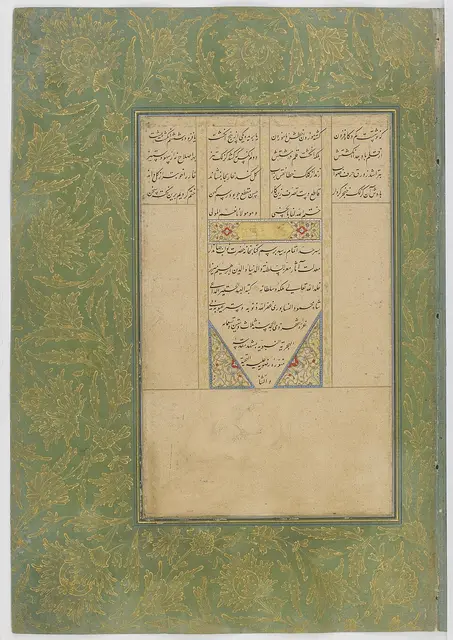
1556 · Freer Gallery of Art, Washington
Photo: Wikimedia Commons, public domain
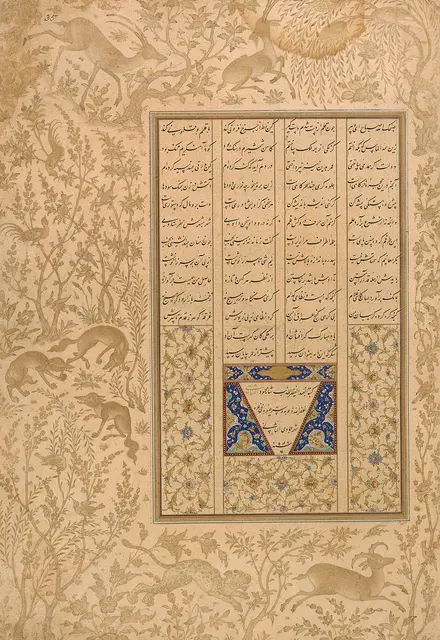
1539 · British Library, London
Photo: Wikimedia Commons, public domain
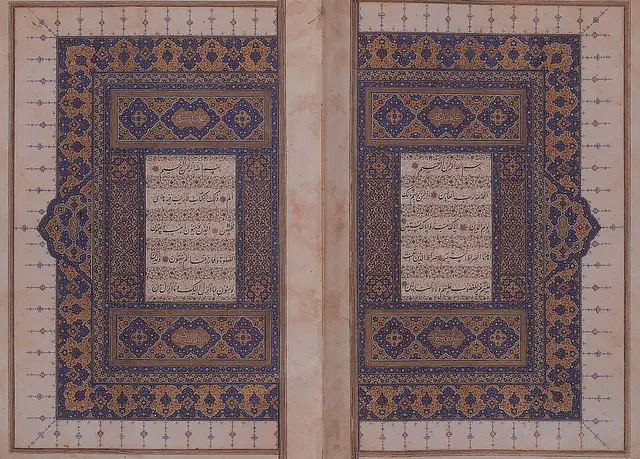
1538 · Topkapı Palace Library, Istanbul
Photo: Wikimedia Commons, public domain
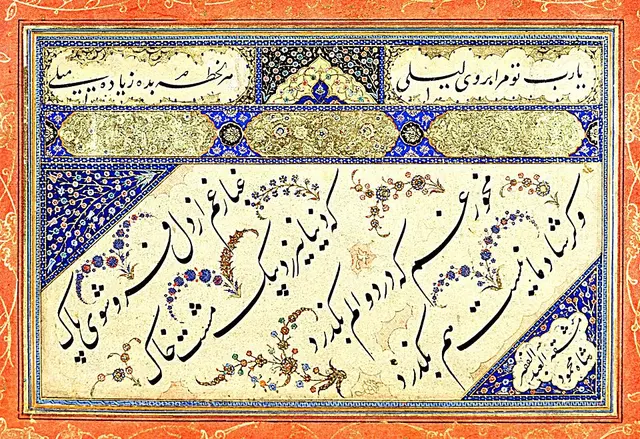
16th century · Istanbul University Library
Photo: Wikimedia Commons, public domain
Write in the tradition this hand shaped.
Write in this tradition now →Living calligraphers you can buy from — signed originals on paper, from AED 550: Anwar Alhulwani (Thuluth) · Ahmed Alhawary (Jali Thuluth, Naskh) · Rasha Kasim (Kufi) — or every Nastaliq piece the store makes: Nastaliq collection.
Sources
- Reed College anthology: birth, teachers, students, first nastaliq Qur'an, last dated work 1574 reed.edu
- Metropolitan Museum record of the 1528 Hadith manuscript (read via search-result summary; direct fetch returned HTTP 429): service to 1557, death 972/1564-65 in Mashhad metmuseum.org
- en.wikipedia: Haft Awrang section and date, Chaldiran anecdote flagged as later tradition en.wikipedia.org
- fa.wikipedia: unmarried, twenty years in Mashhad, burial near Sultan Ali fa.wikipedia.org
- Wikidata wikidata.org
Written by the MASHQ studio · last updated 2026-10-05. Further reading, the standard references in English: Sheila S. Blair, Islamic Calligraphy (Edinburgh University Press, 2006) · Annemarie Schimmel, Calligraphy and Islamic Culture (New York University Press, 1984) · Yasin Hamid Safadi, Islamic Calligraphy (Thames and Hudson, 1978).