Jafar Tabrizi (Ja'far Baysunghuri)
Tabriz
Ja'far ibn Ali of Tabriz, also called Ja'far Baysunghuri and Qiblat al-kuttab, was the leading calligrapher of the Timurid court at Herat in the first half of the fifteenth century. According to Dust Muhammad, he learned the six classical scripts from Shams al-Din Qattabi and nastaliq from 'Abdallah, son of Mir Ali Tabrizi, whom tradition credits with inventing the script. He moved from Tabriz to Herat, served Shah Rukh, and ran the library-workshop of Prince Baysunghur, overseeing some forty calligraphers. A report he wrote to the prince around 1429 survives in the Topkapı Palace and lists the books then in progress and the artists on each. His signed manuscripts run from 1412 to 1433 and include the Baysunghur Shahnameh of 1430, a Gulistan of Sa'di of 1427 now in Dublin, and a Khamsa of Nizami in New York. Scholars such as Simon Rettig see in his nastaliq the first classical form of the script, and the Safavid master Shah Mahmud Nishapuri called him its 'second inventor'. His students Azhar and Shaykh Mahmud carried his style forward to Sultan Ali Mashhadi.
Achievements
- Head of the library-workshop (kitabkhana) of the Timurid prince Baysunghur in Herat, in charge of about forty calligraphers.
- His progress report to Baysunghur (c. 1429, Topkapı H. 2153) is a rare record of how a royal book workshop worked.
- Copied the Baysunghur Shahnameh of 1430 (Golestan Palace) and many other signed manuscripts between 1412 and 1433.
- Gave nastaliq what later writers took as its first classical form; Shah Mahmud Nishapuri called him the 'second inventor' of the script.
- Also mastered the six scripts, especially thuluth, naskh and muhaqqaq.
Taught by: Shams al-Din Qattabi, Mir Ali Tabrizi
Taught: Mawlana Azhar Tabrizi, Shaykh Mahmud Zarin-qalam, 'Abdallah Tabbakh
His work
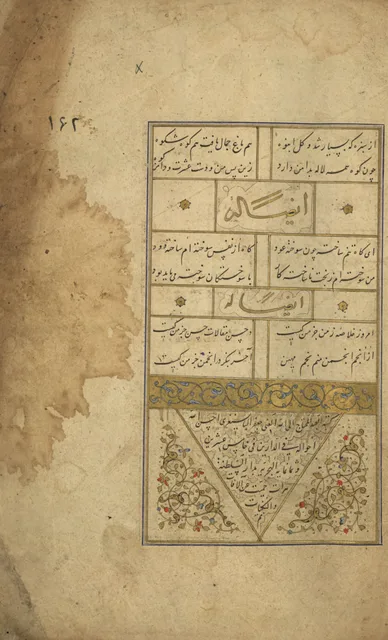
Herat, 1422 (825 AH) · Library of the Islamic Consultative Assembly, Tehran (No. 4017)
Photo: Wikimedia Commons, public domain
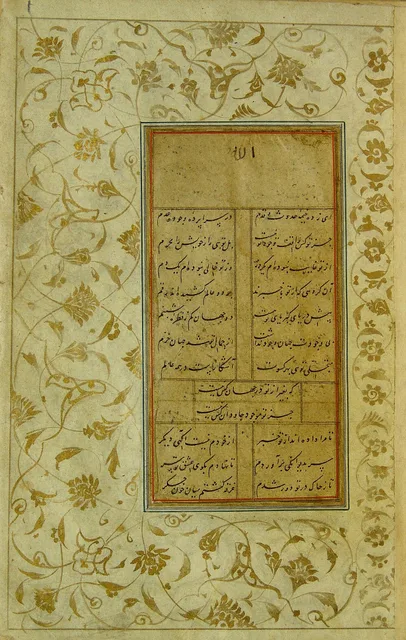
first half of the 15th century · Astan Quds Razavi Library, Mashhad (No. 10579)
Photo: Wikimedia Commons, public domain
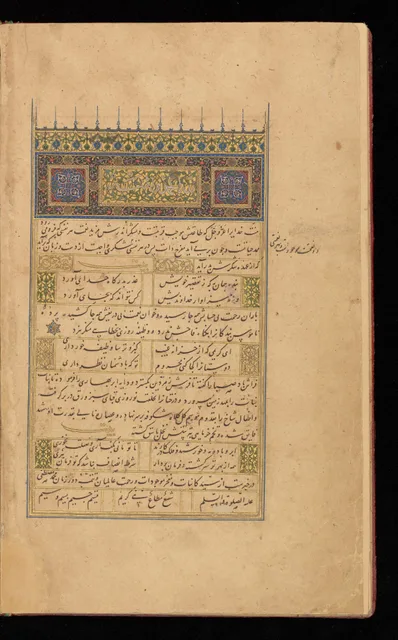
Herat, 1427 (830 AH) · Chester Beatty Library, Dublin (Per 119)
Photo: Wikimedia Commons, public domain
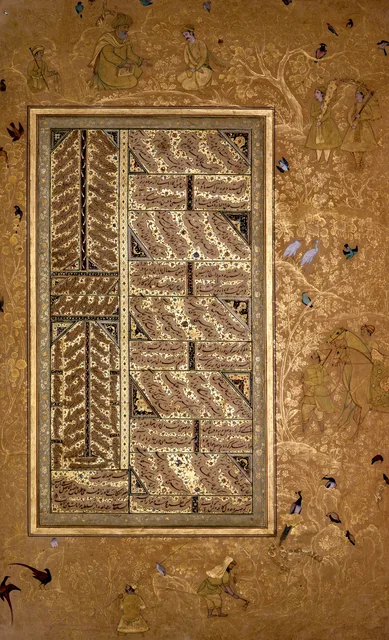
calligraphy early 15th century · Golestan Palace Library, Tehran (Golshan Album)
Photo: Wikimedia Commons, public domain
Write in the tradition this hand shaped.
Write in this tradition now →Living calligraphers you can buy from — signed originals on paper, from AED 550: Anwar Alhulwani (Thuluth) · Ahmed Alhawary (Jali Thuluth, Naskh) · Rasha Kasim (Kufi) — or every Nastaliq piece the store makes: Nastaliq collection.
Sources
- fl. 1412–1433, teachers per Dust Muhammad, Baysunghur kitabkhana, 1429 report, dated manuscripts, students, Rettig and Nishapuri on the second inventor en.wikipedia.org
- Qiblat al-kuttab, nastaliq and six scripts, Azhar's praise ar.wikipedia.org
- Persian page fa.wikipedia.org
- Reed College: Divan of Hasan Dehlavi and Golshan-e Raz pages (Commons sources) reed.edu
- Chester Beatty Library Per 119, Gulistan 1427 viewer.cbl.ie
Written by the MASHQ studio · last updated 2026-10-05. Further reading, the standard references in English: Sheila S. Blair, Islamic Calligraphy (Edinburgh University Press, 2006) · Annemarie Schimmel, Calligraphy and Islamic Culture (New York University Press, 1984) · Yasin Hamid Safadi, Islamic Calligraphy (Thames and Hudson, 1978).