Dust Muhammad Haravi
Kushvan & Qazvin
Dust Muhammad, son of Sulayman, came from Kushvan (also written Gavashan), a village near Herat. He learned calligraphy from Qasim Shadishah, and his first known signed pages were written in Herat in 1511–12. He was still working in Herat in the 1530s, when he copied a Qur'an in naskh with sura headings in riqa. By about 1540 he had joined the court of Shah Tahmasp I and signed himself 'the royal scribe'. He taught calligraphy to the shah's sister Sultanum and worked for the shah's brother Bahram Mirza, for whom he gathered scattered pages of earlier and living masters into one album, finished in 1544. His preface to that album traces the masters of ta'liq and nastaliq and the history of painting, and art historians still rely on it. Sam Mirza notes that he also wrote poetry under the pen name Kahi. Older books mix him up with the painter Dust Muhammad who went to India; the research of Chahryar Adle, accepted by David Roxburgh, separates the two. His last dated work is from 1564, and he probably died soon after in Qazvin.
Achievements
- His earliest known signed work was copied in Herat in 917 AH / 1511–12 and is in the National Library of Russia (Dorn 147).
- Served Shah Tahmasp I as 'royal scribe' (al-katib al-shahi); later sources say he was the only artist the shah kept in his own service.
- Assembled the Bahram Mirza Album for the prince Bahram Mirza and finished it in 951 AH / 1544 (Topkapı Palace Library, H. 2154).
- Wrote the album's long preface, one of the main early written sources on the history of Persian calligraphy and painting.
- Copied a Qur'an in naskh in Herat around 1538–40, and a Majalis al-'ushshaq dated 972 AH / 1564, his last known work.
Taught by: Qasim Shadishah
Taught: Sultanum, sister of Shah Tahmasp
His work
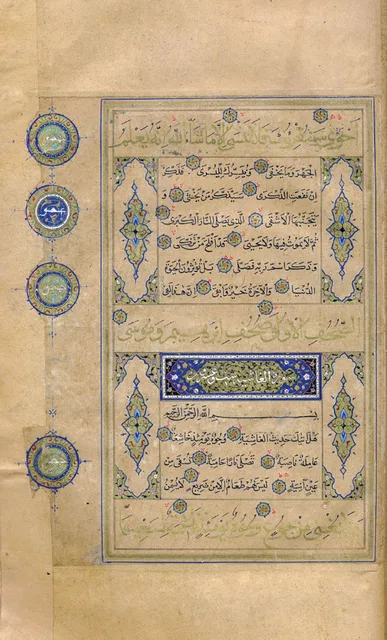
Herat, 1539–40 (946 AH) · Library of the Islamic Consultative Assembly, Tehran
Photo: Wikimedia Commons, public domain
Only two pages of his own writing are on Wikimedia Commons; the many paintings filed under his name there are by the painter Dust Muhammad, a different man.
Write in the tradition this hand shaped.
Write in this tradition now →Living calligraphers you can buy from — signed originals on paper, from AED 550: Anwar Alhulwani (Thuluth) · Ahmed Alhawary (Jali Thuluth, Naskh) · Rasha Kasim (Kufi) — or every Nastaliq piece the store makes: Nastaliq collection.
Sources
- teacher Qasim Shadishah, Bahram Mirza Album preface, Sultanum, pen name Kahi, distinction from the painter en.wikipedia.org
- fl. 917–972 AH, Kushvan/Gavashan, signed works Dorn 147, H. 2156, Qur'an 944, al-katib al-shahi 947, album 951, Majalis al-ushshaq 972, death probably Qazvin (Adle, Roxburgh) fa.wikipedia.org
- Arabic page (describes him as a painter; conflated with Dust Muhammad the painter) ar.wikipedia.org
- Qur'an page in naskh, Herat 946/1539–40, Majlis Library, Tehran (source: Brill) commons.wikimedia.org
Written by the MASHQ studio · last updated 2026-10-05. Further reading, the standard references in English: Sheila S. Blair, Islamic Calligraphy (Edinburgh University Press, 2006) · Annemarie Schimmel, Calligraphy and Islamic Culture (New York University Press, 1984) · Yasin Hamid Safadi, Islamic Calligraphy (Thames and Hudson, 1978).