Mahmud Celâleddin Efendi
1750–1829 · Dagestan & Istanbul
Mahmud Celâleddin was born in Dagestan in the Caucasus, probably around 1750, and came to Istanbul with his father, a Naqshbandi shaykh. According to TDV, the leading masters of the day reportedly refused to take him as a pupil because of his headstrong manner, so he trained himself on the works of Şeyh Hamdullah and Hâfız Osman until he reached master level. Early pieces are signed Mahmûdü'l-Mevdûd. He wrote Qur'ans, prayer books, albums, hilyes and panels, and made careful imitations of older masters. His jali thuluth, judged stiff beside Mustafa Rakım's, still had a following at court under Sultan Abdülmecid, whose teacher Mehmed Tâhir was Celâleddin's pupil. The marble jali thuluth of the Mihrişah Valide Sultan tomb in Eyüp (1793) is his. He died in Beylerbeyi in 1829; his wife Esmâ İbret was also a calligrapher.
Achievements
- Reached master level largely by himself, studying the works of Şeyh Hamdullah and Hâfız Osman.
- Wrote the marble jali thuluth inscriptions of the Mihrişah Valide Sultan tomb in Eyüp (1793).
- His jali thuluth manner was followed at court under Sultan Abdülmecid, whose teacher Mehmed Tâhir was his pupil.
- Left Qur'ans, prayer books, albums, hilyes and panels, some in the Topkapı Palace Library.
- A signed piece in diwani shows he also wrote the chancery script.
Taught: Mehmed Tâhir Efendi, Esmâ İbret Hanım
His work
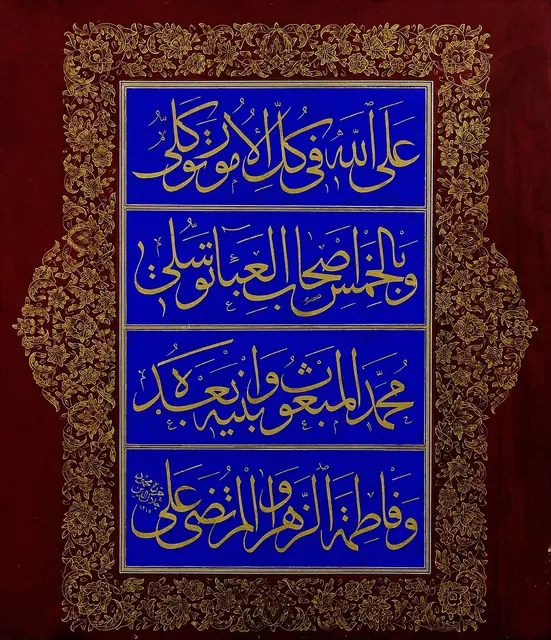
about 1800 · Sakıp Sabancı Museum, Istanbul
Photo: Wikimedia Commons, public domain
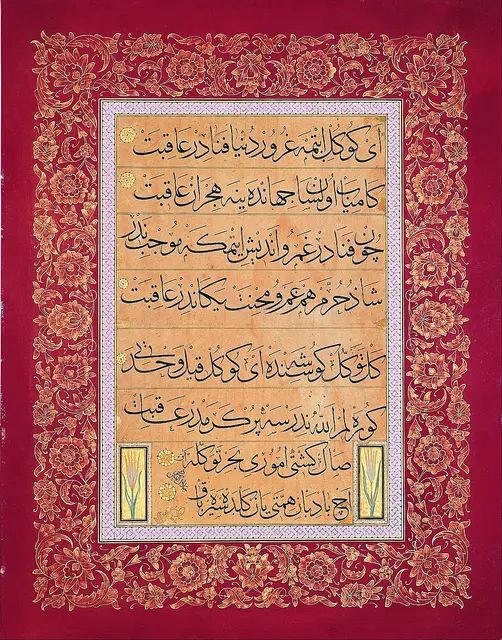
late 18th century · Sakıp Sabancı Museum, Istanbul
Photo: Wikimedia Commons, public domain
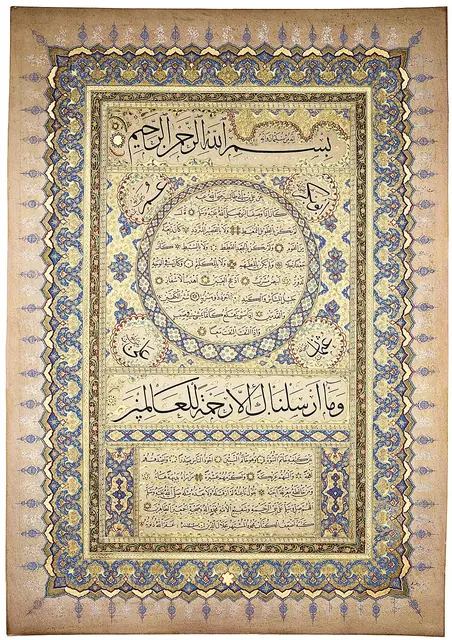
1787–1788 · sold at Sotheby's, London, 2018
Photo: Wikimedia Commons, public domain
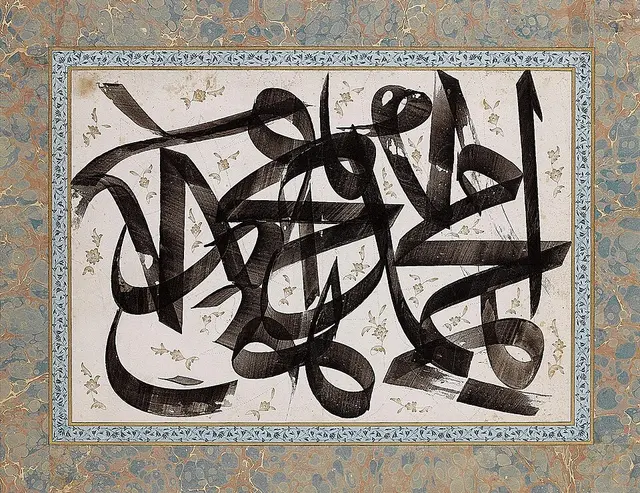
early 19th century · Sadberk Hanım Museum, Istanbul
Photo: Wikimedia Commons, public domain
Write in the tradition this hand shaped.
Write in this tradition now →Living calligraphers you can buy from — signed originals on paper, from AED 550: Anwar Alhulwani (Thuluth) · Ahmed Alhawary (Jali Thuluth, Naskh) · Rasha Kasim (Kufi) — or every Thuluth piece the store makes: Thuluth collection.
Sources
- TDV İslâm Ansiklopedisi, 'MAHMUD CELÂLEDDİN EFENDİ': birth estimate, self-taught training, signature, works, Mihrişah tomb, death 1245/1829 islamansiklopedisi.org.tr
- English Wikipedia: life, wife Esmâ İbret, burial en.wikipedia.org
- Turkish Wikipedia tr.wikipedia.org
- Arabic Wikipedia: Arabic name form, Dagestani (Avar) origin ar.wikipedia.org
- Khalili record of the eight-hadith panel (via Commons) commons.wikimedia.org
- Wikidata item wikidata.org
Written by the MASHQ studio · last updated 2026-10-05. Further reading, the standard references in English: Sheila S. Blair, Islamic Calligraphy (Edinburgh University Press, 2006) · Annemarie Schimmel, Calligraphy and Islamic Culture (New York University Press, 1984) · Yasin Hamid Safadi, Islamic Calligraphy (Thames and Hudson, 1978).