
Esmâ İbret Hanım
1780–1830 · Istanbul
Esmâ İbret Hanım was born in Istanbul in 1194 AH (1780), the only child of Ahmed Ağa, an official of the palace guard. As a girl she copied the thuluth and naskh of Mahmud Celâleddin Efendi, and she later studied with him; English Wikipedia also names Zühdi and İbrahim Şefik among her teachers. Celâleddin is said to have doubted at first that a girl could write so well. In 1209 AH (1794–95) she received her ijaza after writing a hilye, which was presented to Selim III and his mother Mihrişah Sultan. The sultan added the name İbret to hers and granted her money and a daily allowance from the customs. She then married her teacher, who was much older. She kept to the classical manner of Hafız Osman. Many of her pieces are unsigned, which makes attribution hard. Hilyes in the Topkapı Palace and the Museum of Turkish and Islamic Arts and a Dalaʾil al-khayrat in Istanbul University Library are known. Her death date is uncertain; she was buried beside her husband at the Murad Buhari lodge.
Achievements
- Received her ijaza from Mahmud Celâleddin Efendi in 1209 AH (1794–95), while still a teenager.
- Wrote a hilye that was presented to Sultan Selim III and his mother Mihrişah Sultan; the sultan added 'İbret' ('an example to learn from') to her name.
- Was granted 500 kuruş and a daily allowance from the customs revenue (40 akçe in Turkish sources; English Wikipedia says 500 akçe).
- Copied a Dalaʾil al-khayrat dated 1213 AH (1798–99), now in Istanbul University Library (A. 5566).
- Hilyes by her are in the Topkapı Palace Museum and the Museum of Turkish and Islamic Arts; other pieces in the Ekrem Hakkı Ayverdi collection.
Taught by: Mahmud Celâleddin Efendi, Zühdi, İbrahim Şefik
Her work
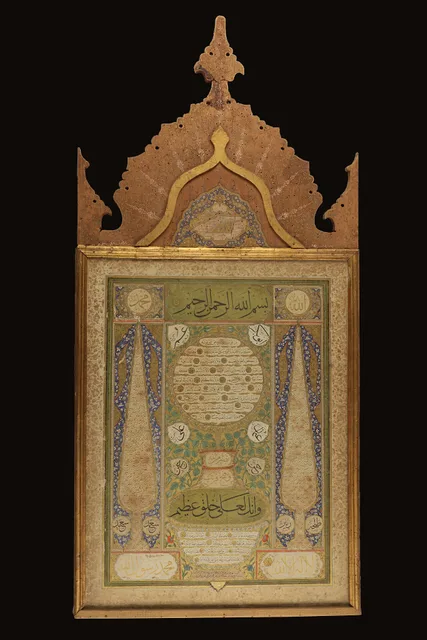
1794–95 (1209 AH) · Museum of Turkish and Islamic Arts, Istanbul (no. 2763)
Photo: Wikimedia Commons, public domain
Only one securely attributed work is on Wikimedia Commons; much of her work is unsigned, and a second Commons hilye (Demirören collection) rests on a newspaper caption and looks like the same design, so it was left out.
Write in the tradition this hand shaped.
Write in this tradition now →Living calligraphers you can buy from — signed originals on paper, from AED 550: Anwar Alhulwani (Thuluth) · Ahmed Alhawary (Jali Thuluth, Naskh) · Rasha Kasim (Kufi) — or every Thuluth piece the store makes: Thuluth collection.
Sources
- English Wikipedia: born 1194/1780, father, teachers, hilye for Selim III, grant (500 akçe), marriage, Hafız Osman style, death c. 1830, works list en.wikipedia.org
- Arabic Wikipedia (translation of the English article) ar.wikipedia.org
- Ketebe: ijaza 1209, 500 kuruş and 40 akçe daily, death 1250–1260 AH, burial Eyüp Murad Buhari, Dala'il A.5566 dated 1213, hilyes ketebe.org
- Istanbul Encyclopedia: born 1194–95, name İbret, grant 1209, burial beside her husband, death unknown, works in Topkapı and Ayverdi collection istanbulansiklopedisi.org
Written by the MASHQ studio · last updated 2026-10-05. Further reading, the standard references in English: Sheila S. Blair, Islamic Calligraphy (Edinburgh University Press, 2006) · Annemarie Schimmel, Calligraphy and Islamic Culture (New York University Press, 1984) · Yasin Hamid Safadi, Islamic Calligraphy (Thames and Hudson, 1978).