Kazasker Mustafa İzzet Efendi
1801–1876 · Tosya & Istanbul
Mustafa İzzet was born in Tosya in 1801 and sent to Istanbul as a fatherless boy. In 1814 Sultan Mahmud II heard him recite a hymn and ordered his education; he passed through Galata Palace into the palace school (Enderun) in 1820. Çömez Mustafa Vâsıf gave him his diploma in thuluth, naskh and riqa, and Yesârîzâde taught him ta'lik. He was also a singer, ney player and composer, and later preacher of the Eyüp Sultan Mosque, imam to Sultan Abdülmecid and four times Rumeli kazasker. He copied ten or more Qur'ans and over two hundred hilyes, and his naskh was cut as printing type in 1866. For Hagia Sophia he wrote the eight great roundels, about 7.5 m across, and the Light Verse in the dome. His pupils included Şefik Bey, Abdullah Zühdi, Muhsinzâde Abdullah and Hasan Rızâ. He died in Istanbul in 1876.
Achievements
- Wrote the eight great roundels of Hagia Sophia, about 7.5 m across, with the pen nib enlarged to 35 cm.
- Wrote the Light Verse (al-Nur 24:35) for the Hagia Sophia dome during the 1849 restoration.
- Copied ten or fifteen Qur'ans and over 200 hilyes, and started the practice of very large hilyes.
- His naskh letters were cut as printing type by Ohannes Mühendisyan in 1866 and used in Ottoman printing until the alphabet reform.
- Taught more future masters than anyone else in the 19th century, among them Şefik Bey, Muhsinzâde Abdullah and Abdullah Zühdi (TDV).
- Also a singer, ney player and composer; held the posts of Rumeli kazasker and head of the ulema (1860).
Taught by: Çömez Mustafa Vâsıf Efendi, Yesârîzâde Mustafa İzzet Efendi
Taught: Mehmed Şefik Bey, Muhsinzâde Abdullah Hamdi Bey, Abdullah Zühdi Efendi, Hacı Hasan Rıza Efendi, Kayışzâde Hâfız Osman, Mehmed İlmî, Mehmed Hilmi, Hasan Sırrı, Mehmed Şevket Vahdetî, Tokatlı Tahsin Efendi, Siyâhî Selim, Abdullah Hulûsi, Yûsuf Âgâh Efendi, Selmâ Hanım
His work
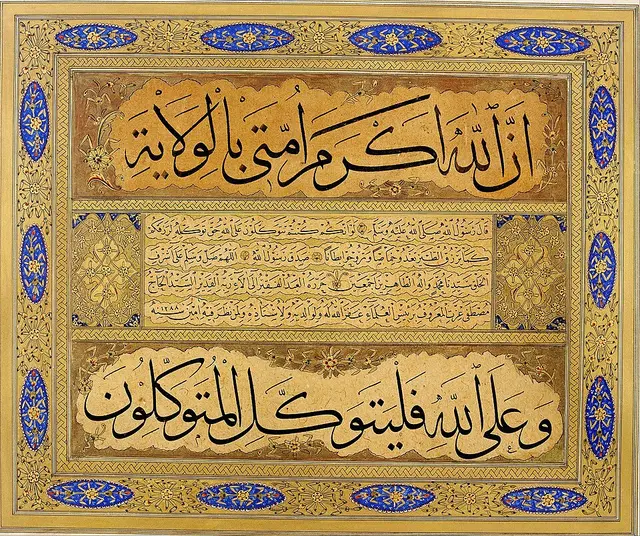
1871 · Sakıp Sabancı Museum, Istanbul
Photo: Wikimedia Commons, public domain
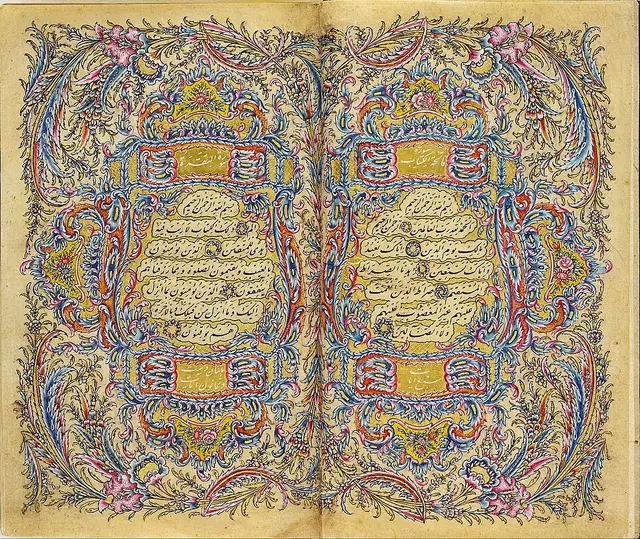
1837 · Sakıp Sabancı Museum, Istanbul
Photo: Wikimedia Commons, public domain
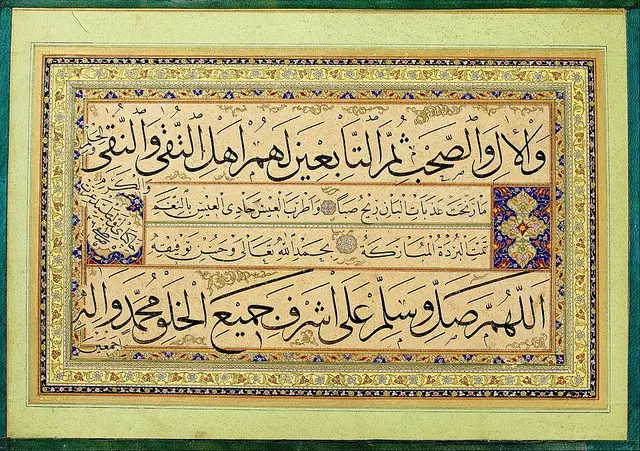
1849 · Sakıp Sabancı Museum, Istanbul
Photo: Wikimedia Commons, public domain
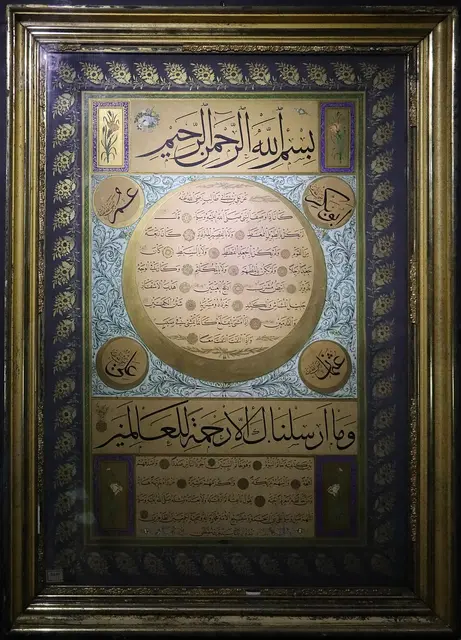
1862–1863 · Turkish and Islamic Arts Museum, Istanbul
Photo: Francesco Bini, Wikimedia Commons (Periodo ottomano, kazasker mustafa izzet efendi calligrafo, hilye-i saadet (descrizione fisica di maometto), 1862-63 (1279 egira).jpg), CC BY-SA 4.0 (creativecommons.org/licenses/by-sa/4.0)
Write in the tradition this hand shaped.
Write in this tradition now →Living calligraphers you can buy from — signed originals on paper, from AED 550: Anwar Alhulwani (Thuluth) · Ahmed Alhawary (Jali Thuluth, Naskh) · Rasha Kasim (Kufi) — or every Thuluth piece the store makes: Thuluth collection.
Sources
- TDV İslâm Ansiklopedisi, 'MUSTAFA İZZET, Kazasker' (hat and mûsiki parts): life, teachers, offices, Qur'ans, Hagia Sophia, inscriptions, students islamansiklopedisi.org.tr
- English Wikipedia: life, death 16 November 1876 en.wikipedia.org
- Turkish Wikipedia: life, music tr.wikipedia.org
- Arabic Wikipedia: Arabic name form, death 1293/1876 ar.wikipedia.org
- Wikidata item wikidata.org
Written by the MASHQ studio · last updated 2026-10-05. Further reading, the standard references in English: Sheila S. Blair, Islamic Calligraphy (Edinburgh University Press, 2006) · Annemarie Schimmel, Calligraphy and Islamic Culture (New York University Press, 1984) · Yasin Hamid Safadi, Islamic Calligraphy (Thames and Hudson, 1978).