Hacı Hasan Rıza Efendi
1849–1920 · Istanbul
Hasan Rıza was born in Üsküdar in 1849, the son of Ahmed Nazif Efendi, a former postmaster of Tırnova. He took his first lessons from several teachers, Yahya Hilmi Efendi among them, then spent some years with his family in Tırnova. Back in Istanbul he joined the imperial band, where the writing master Mehmed Şefik Bey gave him his ijaza; he also learned from Kazasker Mustafa İzzet Efendi and studied ta'liq with Sami Efendi. He became imam of the band in 1871, made the pilgrimage in 1876, and in 1879 succeeded Şefik Bey as its writing master. In 1914 he taught thuluth and naskh at the new Medresetü'l-Hattatin until failing eyesight forced him to stop. Naskh was his greatest strength: TDV praises his Qur'ans for clear letters and well-placed vowels. His fame rests on the ayet-berkenar Qur'an, printed many times from 1884. He also wrote large hilyes, an eight-volume Bukhari for Sultan Mehmed V, and inscriptions in jali thuluth and ta'liq. He died at Rumelihisarı on 1 March 1920.
Achievements
- Wrote the 'ayet-berkenar' Qur'an, each page of fifteen lines ending on a verse, printed by the Matbaa-i Amire many times from 1301 AH (1884) (TDV).
- Copied nineteen Qur'ans in all, among them a large copy of 1330 AH (1912) for the tomb of Sultan Mehmed V, now in the Topkapı Palace Library (TDV).
- Wrote an eight-volume Sahih al-Bukhari (1,067 folios) at the request of Sultan Mehmed V Reşad, now in the Topkapı Palace (TDV).
- Taught calligraphy to the imperial band (Muzıka-yi Hümayun) from 1879, and thuluth-naskh at the Medresetü'l-Hattatin from its opening on 31 May 1914 (TDV).
- Gave the calligrapher's ijaza to seventeen pupils (TDV).
Taught by: Yahya Hilmi Efendi, Mehmed Şefik Bey, Kazasker Mustafa İzzet Efendi, Sami Efendi
Taught: Mustafa Halim Efendi, Hüseyin Hüsnü Efendi, Şükrizade Hüseyin Hamid Efendi
His work
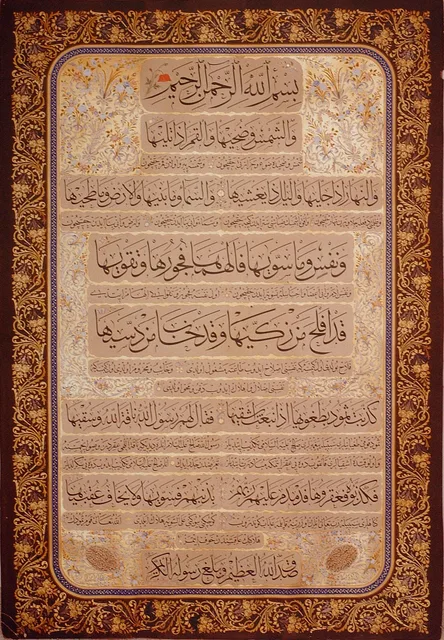
1301 AH (1883–84) · Sakıp Sabancı Museum, Istanbul
Photo: Wikimedia Commons, public domain
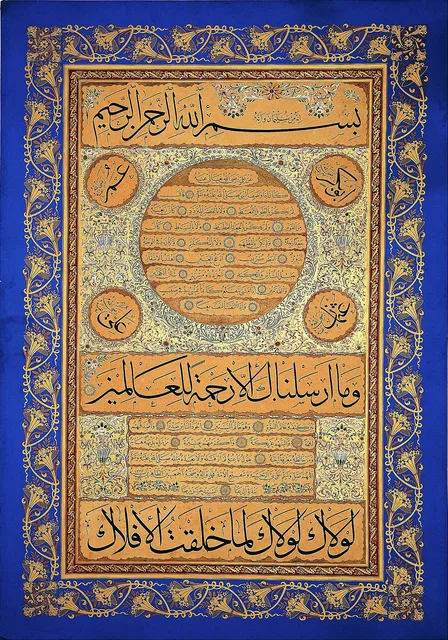
1905 · Sakıp Sabancı Museum, Istanbul
Photo: Wikimedia Commons, public domain
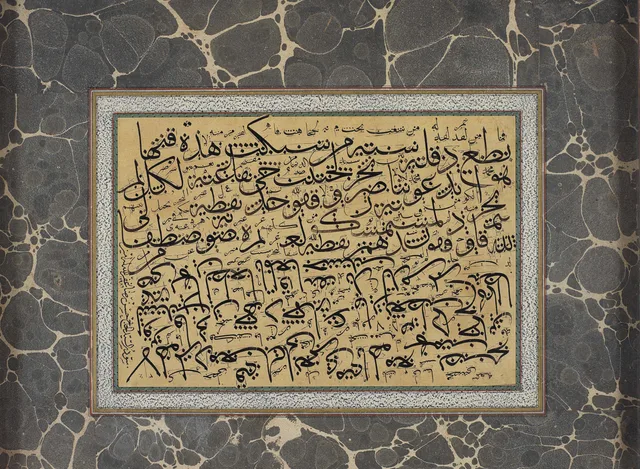
1298 AH (1880–81) · Sakıp Sabancı Museum, Istanbul
Photo: Wikimedia Commons, public domain
These are the works in open collections that can be attributed with certainty.
Write in the tradition this hand shaped.
Write in this tradition now →Living calligraphers you can buy from — signed originals on paper, from AED 550: Anwar Alhulwani (Thuluth) · Ahmed Alhawary (Jali Thuluth, Naskh) · Rasha Kasim (Kufi) — or every Naskh piece the store makes: Naskh collection.
Sources
- TDV İslâm Ansiklopedisi (M. Uğur Derman, 1997): full life, teachers, Qur'ans, Bukhari, hilyes, 17 ijazas, death 1 March 1920 islamansiklopedisi.org.tr
- Arabic Wikipedia: teachers, names of three pupils, death 2 March 1920 ar.wikipedia.org
- Commons: Sakıp Sabancı Museum works commons.wikimedia.org
Written by the MASHQ studio · last updated 2026-10-05. Further reading, the standard references in English: Sheila S. Blair, Islamic Calligraphy (Edinburgh University Press, 2006) · Annemarie Schimmel, Calligraphy and Islamic Culture (New York University Press, 1984) · Yasin Hamid Safadi, Islamic Calligraphy (Thames and Hudson, 1978).