Eğrikapılı Mehmed Rasim
1688–1756 · Istanbul
Mehmed Rasim was born in 1099/1688 in the Eğrikapı quarter of Istanbul, which gave him his name. His father Yusuf Efendi, imam of the Molla Aşkî mosque and a calligrapher, taught him thuluth and naskh, then sent him to the court master Yedikuleli Seyyid Abdullah Efendi, who gave him the ijaza in all six scripts when he was eighteen. When the Galata Palace school opened in 1714 the grand vizier Şehid Ali Pasha made him its calligraphy teacher, and in 1737 he also became teacher at Topkapı Palace. He followed the style of Hafız Osman and wrote about sixty Qur'ans, some thousand prayer books and many album pieces; his jali inscriptions survive on the Saliha Sultan sebil at Azapkapı. At fifty-two he took a ta'liq ijaza from Katibzade Mehmed Refi and gave Refi one in thuluth and naskh, a rare exchange. He was also a poet. He trained a great many pupils, among them Müstakimzade, and died of tuberculosis on 14 May 1756.
Achievements
- Received his ijaza in the six scripts at eighteen from Yedikuleli Seyyid Abdullah.
- Calligraphy teacher at the Galata Palace school from its opening in 1714, and at Topkapı Palace from 1737; this began the custom of moving palace masters from Galata to Topkapı.
- Wrote about sixty Qur'ans and around a thousand prayer books (en'am), besides hilyes, album pieces and waqf deeds.
- Wrote the jali thuluth inscriptions of the Saliha Sultan sebil and fountains at Azapkapı (1732-33) and the verse over the main door of the Nuruosmaniye Mosque.
- Reckoned the chief calligrapher of his day; Müstakimzade's Tuhfe-i hattatin records 94 of his pupils.
Taught by: Yusuf Efendi, Yedikuleli Seyyid Abdullah Efendi (Haşimizade Abdullah Efendi), Katibzade Mehmed Refi
Taught: Mestçizade Ahmed, Fethiyeli Ahmed Hıfzı, Müstakimzade Süleyman Sadeddin, Katibzade Mehmed Refi
His work
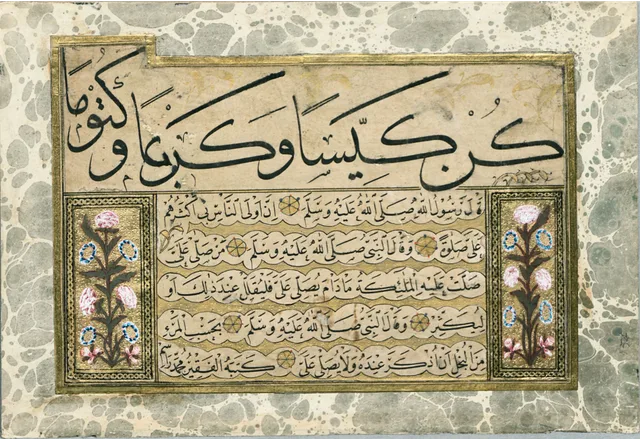
first half of the 18th century · Sakıp Sabancı Museum, Istanbul (110-0154)
Photo: Wikimedia Commons, public domain
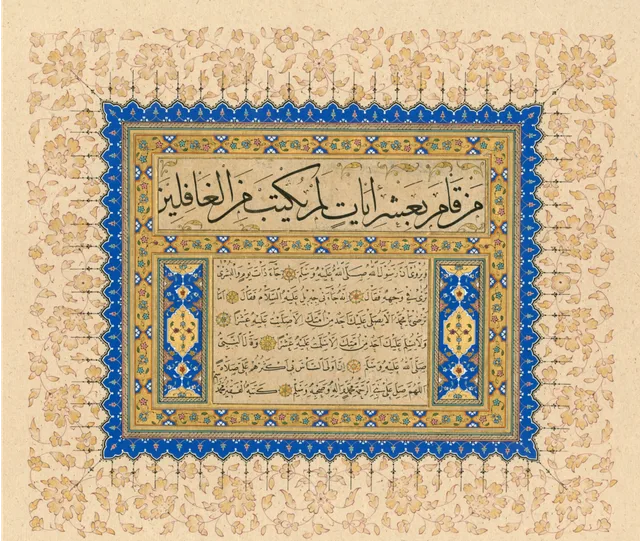
mid-18th century · Albayrak calligraphy collection (published by Ketebe)
Photo: Wikimedia Commons, public domain
Only two open-licence photographs of his own pieces were found; a Khalili album page in his Commons category combines several masters and was left out.
Write in the tradition this hand shaped.
Write in this tradition now →Living calligraphers you can buy from — signed originals on paper, from AED 550: Anwar Alhulwani (Thuluth) · Ahmed Alhawary (Jali Thuluth, Naskh) · Rasha Kasim (Kufi) — or every Thuluth piece the store makes: Thuluth collection.
Sources
- TDV (M. Uğur Derman, 2003): born 1099/1688, father Yusuf, ijaza at 18 from Yedikuleli Seyyid Abdullah, Galata 1714, Topkapı 1737, d. 14 Shaban 1169/14 May 1756, 60 mushafs, ~1000 en'am, Saliha Sultan sebil 1145, Nuruosmaniye, ta'liq ijaza exchange with Katibzade Refi, 94 pupils in Tuhfe, collections islamansiklopedisi.org.tr
- English Wikipedia: 1687-1756, teachers, Galata 1714, Topkapı 1737, 60 Qur'ans, poetry en.wikipedia.org
- Turkish Wikipedia: 1688, ijaza at 18, Galata, Topkapı tr.wikipedia.org
- Arabic Wikipedia (translation of the English article) ar.wikipedia.org
Written by the MASHQ studio · last updated 2026-10-05. Further reading, the standard references in English: Sheila S. Blair, Islamic Calligraphy (Edinburgh University Press, 2006) · Annemarie Schimmel, Calligraphy and Islamic Culture (New York University Press, 1984) · Yasin Hamid Safadi, Islamic Calligraphy (Thames and Hudson, 1978).