Darvish Abd al-Majid Taleqani
1737–1771 · Taleqan & Isfahan
Abd al-Majid Taleqani, known as Darvish for his ascetic way of life, was born about 1150 AH (1737-38) in the Taleqan district of Qazvin and went to Isfahan as a young man. His teacher is not recorded; Reed College says he began by copying the work of Mirza Hasan Kermani and Muhammad Shafi'. Shikasta, a script that joins features of ta'liq and nastaliq, had grown up in Safavid court circles in the 17th century as a hand for letters. Taleqani gave it the form that later calligraphers treated as standard. His dated album pages, in shikasta and nastaliq, run from 1170 to 1185 AH (1756-1771), and from about 1765 his style became his own. Mirza Kuchek Esfahani and others followed his model. He also wrote poems under the names Majid and Khamush. He died young in Isfahan in 1185 AH (1771-72) and was buried in the Takht-e Fulad cemetery.
Achievements
- Regarded as the calligrapher who gave shikasta its definitive form (Iranica).
- His dated album pages run from 1170 to 1185 AH (1756-1771), in shikasta and nastaliq.
- From about 1765 he wrote in an independent style of shikasta named after him (Reed).
- His model was followed by Mirza Kuchek Esfahani and the court poet-calligrapher Neshat.
- Also a poet, under the pen names Majid and Khamush.
Taught by: Not recorded . He began by copying the work of Mirza Hasan Kermani and Muhammad Shafi' .
Taught: Mirza Kuchek Esfahani, Muhammad Reza Esfahani
His work
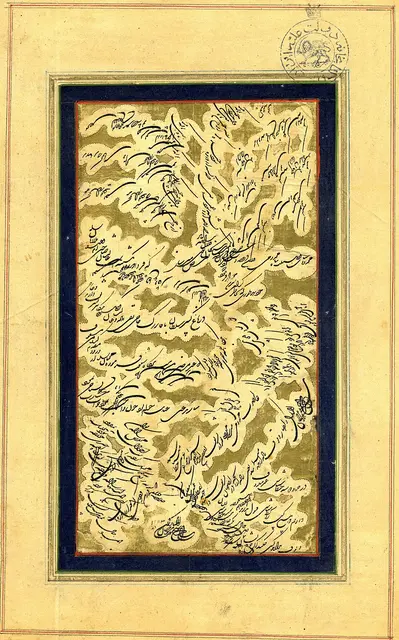
1770 · Golestan Palace Library, Tehran
Photo: Wikimedia Commons, public domain
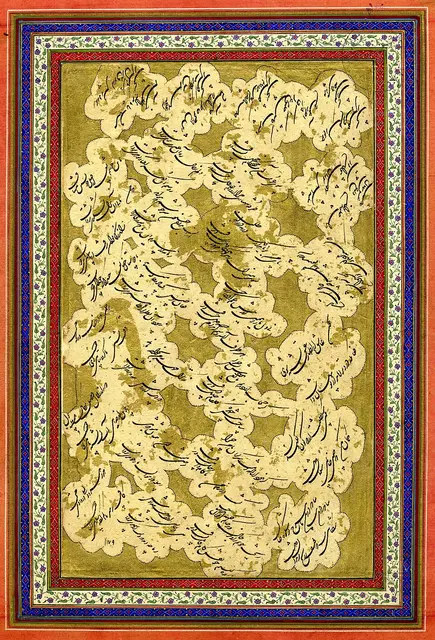
1766 · Golestan Palace Library, Tehran
Photo: Wikimedia Commons, public domain
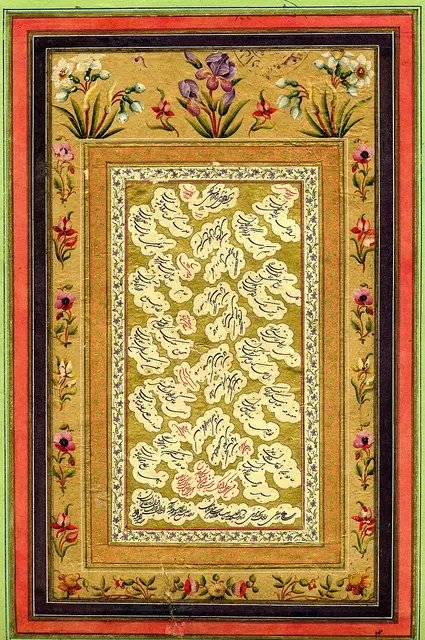
1756–1771 · Golestan Palace Library, Tehran
Photo: Wikimedia Commons, public domain
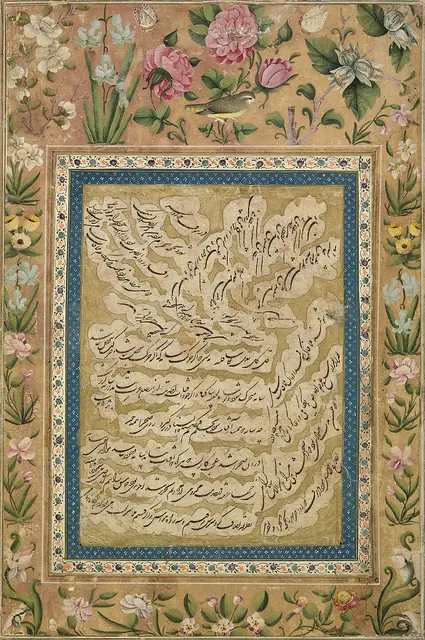
1767 · Art Institute of Chicago
Photo: Wikimedia Commons, CC0
Write in the tradition this hand shaped.
Write in this tradition now →Living calligraphers you can buy from — signed originals on paper, from AED 550: Anwar Alhulwani (Thuluth) · Ahmed Alhawary (Jali Thuluth, Naskh) · Rasha Kasim (Kufi) — or every Nastaliq piece the store makes: Nastaliq collection.
Sources
- Encyclopaedia Iranica, P. P. Soucek, "ʿABD-AL-MAJĪD ṬĀLAQĀNĪ" (archived copy): dates, shikasta history, followers web.archive.org
- Reed College anthology: village, models, own style from 1765, students, malaria, burial reed.edu
- en.wikipedia (follows Iranica) en.wikipedia.org
- fa.wikipedia: life, works, pen names, followers fa.wikipedia.org
- ar.wikipedia: Arabic name form, death 15 Muharram 1185, tuberculosis ar.wikipedia.org
- Wikidata wikidata.org
Written by the MASHQ studio · last updated 2026-10-05. Further reading, the standard references in English: Sheila S. Blair, Islamic Calligraphy (Edinburgh University Press, 2006) · Annemarie Schimmel, Calligraphy and Islamic Culture (New York University Press, 1984) · Yasin Hamid Safadi, Islamic Calligraphy (Thames and Hudson, 1978).