
Sheikh Hamdullah
1436–1520 · Amasya & Istanbul
Father of the Ottoman school. Sultan Bayezid II held his inkwell as he wrote — the most famous image of patronage in calligraphy's history. Working from Yaqut's models, he rebalanced Naskh and Thuluth so thoroughly that Ottomans said 'he took the scripts to their qibla'. Forty-seven Qur'ans, and a chain of students that runs unbroken to the last masters of the twentieth century: every Ottoman calligrapher's silsila begins with his name.
Key works: 47 Qur'ans; foundational Naskh/Thuluth models (Topkapı collections).
Achievements
- Founded the Ottoman school of the six scripts, reworking the proportions of Yaqut al-Musta'simi's thuluth and naskh at Bayezid II's request.
- His naskh became the usual hand for whole Qur'an copies, replacing mixed-script Yaqut-style layouts.
- Set the shape and size of the Ottoman kıta (thuluth line over naskh lines) that later calligraphers copied.
- Reported to have written 47 Qur'ans; about 30 survive with his signature or attribution.
- Later Ottoman calligraphers traced their chains of teachers back to him; he was called 'qiblat al-kuttab' (the scribes' qibla).
- Was a noted archer: a stone in Okmeydanı dated 911 AH records his long-distance shot.
Taught by: Hayreddin Mar'aşi (Khayr al-Din al-Mar'ashi)
Taught: Bayezid II, Mustafa Dede, Şükrullah Halife, Şehzade Korkut, Hüsameddin Hüseyin Şah, Mehmed Handan, Câfer Çelebi, Mahmud Defterî
His work
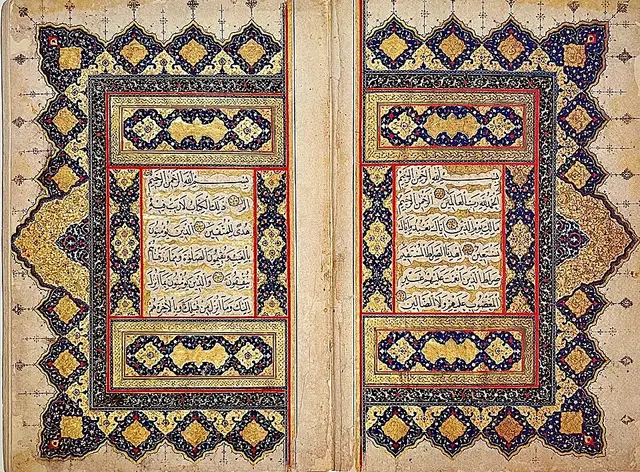
about 1500 · Aga Khan Museum, Toronto (AKM 262)
Photo: Wikimedia Commons, public domain
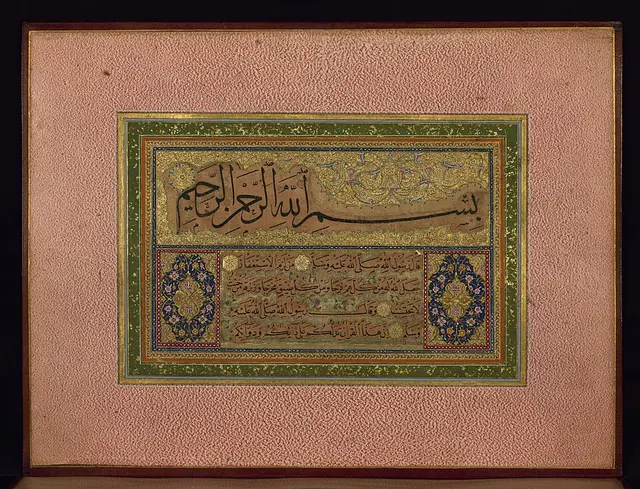
album bearing his name · Walters Art Museum, Baltimore (W.672)
Photo: Wikimedia Commons, public domain
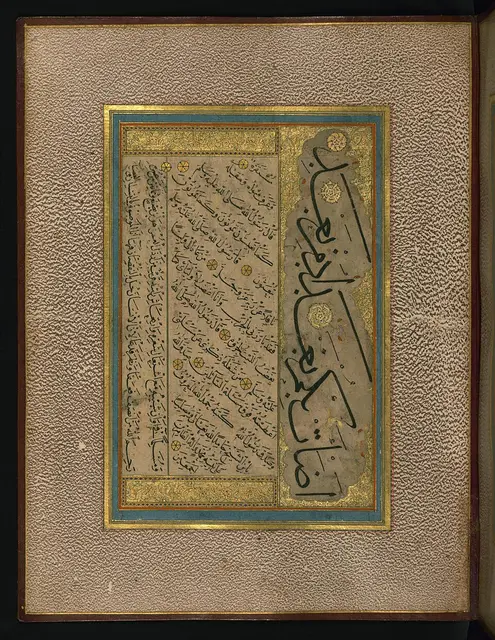
album bearing his name · Walters Art Museum, Baltimore (W.672)
Photo: Wikimedia Commons, public domain
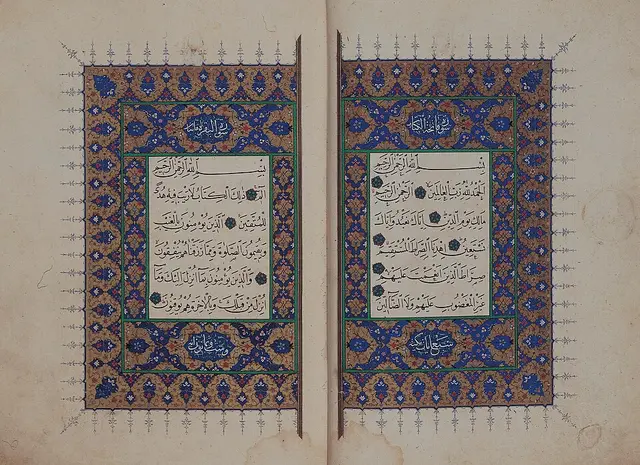
Istanbul, 1503–1504 · Topkapı Palace Library, Istanbul (A. 5)
Photo: Wikimedia Commons, public domain
Write in the tradition this hand shaped.
Write in this tradition now →Write in Thuluth yourself, free: the Thuluth calligraphy generator · your name in Arabic calligraphy
Living calligraphers you can buy from — signed originals on paper, from AED 550: Anwar Alhulwani (Thuluth) · Ahmed Alhawary (Jali Thuluth, Naskh) · Rasha Kasim (Kufi) — or every Thuluth piece the store makes: Thuluth collection.
Sources
- TDV İslâm Ansiklopedisi, 'HAMDULLAH EFENDİ, Şeyh' (M. Serin, 1997): life, dates, teachers, students, works, archery islamansiklopedisi.org.tr
- English Wikipedia: life, Bayezid II and Yaqut's works, inscriptions en.wikipedia.org
- Turkish Wikipedia: works, archery, 1526 death date (conflicting) tr.wikipedia.org
- Arabic Wikipedia: Arabic name, 833-927 AH dates, 47 mushafs (burial at Eyüp, conflicting) ar.wikipedia.org
- Wikidata item wikidata.org
Written by the MASHQ studio · last updated 2026-10-05. Further reading, the standard references in English: Sheila S. Blair, Islamic Calligraphy (Edinburgh University Press, 2006) · Annemarie Schimmel, Calligraphy and Islamic Culture (New York University Press, 1984) · Yasin Hamid Safadi, Islamic Calligraphy (Thames and Hudson, 1978).