Sultan Ali Mashhadi
1437–1520 · Mashhad
Sultan Ali Mashhadi was born in Mashhad around 1437 (841 AH) and lost his father at the age of seven. In his own account he first trained himself; his contemporaries counted him a pupil of Azhar Tabrizi. He moved to Herat before 1468 and worked there for some forty years for the Timurid ruler Sultan Husayn Bayqara and his companion Ali-Shir Nava'i, copying Persian and Turkish manuscripts and designing architectural inscriptions. After Sultan Husayn died in 1506 he went back to Mashhad, where in 1514 he wrote a verse treatise on writing and teaching calligraphy, later given the title Sirat al-sutur. He died in 926 AH (1520) and was buried at the shrine of Imam Reza. His pupils included Sultan Muhammad Khandan and Sultan Muhammad Nur, and his nastaliq remained the reference for Khorasani scribes after him.
Achievements
- Worked about forty years in Herat for Sultan Husayn Bayqara and Ali-Shir Nava'i.
- Designed architectural inscriptions, including one dated 1477-78 at the shrine of Khwaja Abd Allah in Herat.
- Copied court manuscripts in Persian and Turkish, among them Attar's Mantiq al-tayr of 1487 (Metropolitan Museum).
- In 1514 wrote a verse treatise on calligraphy, known as Adab-e khatt or Sirat al-sutur.
- His Khorasani nastaliq became the model that later Iranian nastaliq followed.
- Thirty-four signed works are known, twenty of them dated (Reed College).
Taught by: Azhar Tabrizi . en.wikipedia: Azhar or one of his students. He presents himself as self-taught.
Taught: Sultan Muhammad Khandan, Sultan Muhammad Nur, Zayn al-Din Mahmud, Abdi Nishapuri, Muhammad Abrishami, Rostam Ali, Muhammad Qasem Shadishah, Ala al-Din Muhammad Heravi
His work
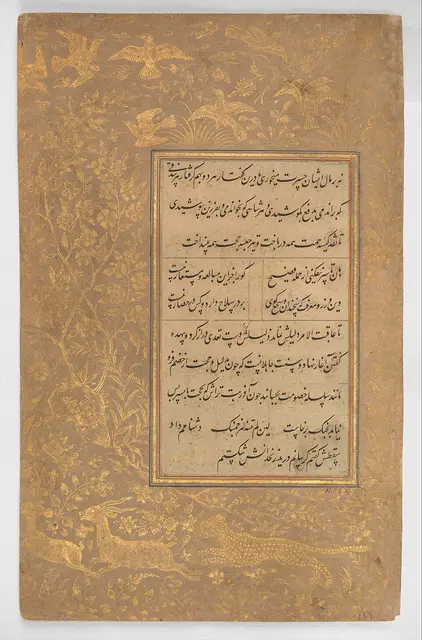
late 15th century · Metropolitan Museum of Art, New York
Photo: Wikimedia Commons, CC0
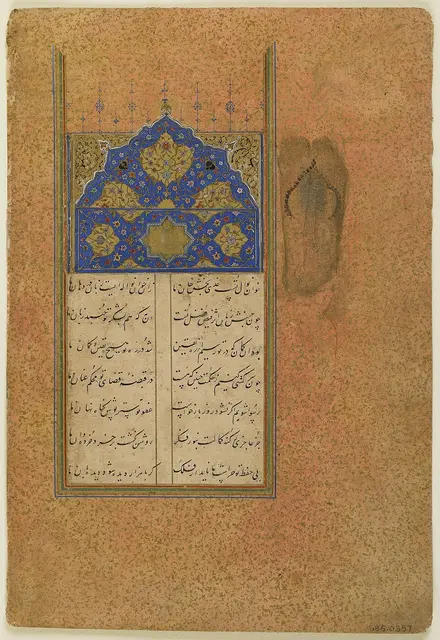
Herat, early 16th century · Arthur M. Sackler Gallery, Washington
Photo: Wikimedia Commons, public domain
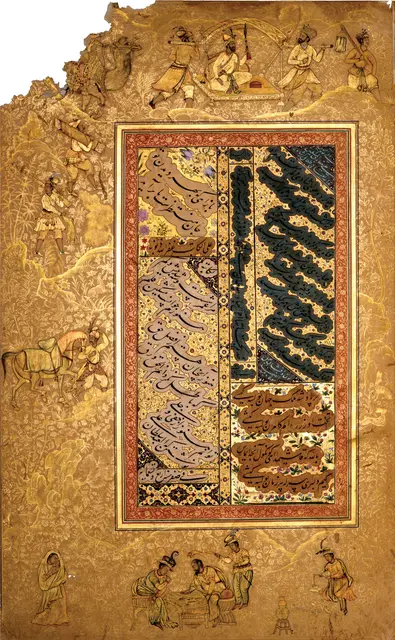
1499 · Golestan Palace Library, Tehran
Photo: Wikimedia Commons, public domain
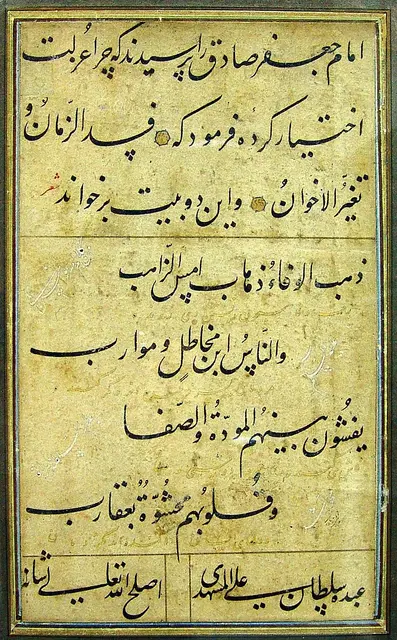
Herat, 15th–16th century · Mostazafan Foundation archive, Tehran
Photo: Wikimedia Commons, public domain
Write in the tradition this hand shaped.
Write in this tradition now →Living calligraphers you can buy from — signed originals on paper, from AED 550: Anwar Alhulwani (Thuluth) · Ahmed Alhawary (Jali Thuluth, Naskh) · Rasha Kasim (Kufi) — or every Nastaliq piece the store makes: Nastaliq collection.
Sources
- en.wikipedia (cites Blair, Islamic Calligraphy; Thackston, Grove Art): career, works and locations en.wikipedia.org
- Reed College, Anthology of Iranian Masters of Calligraphy: birth 1437, students, treatise, burial reed.edu
- fa.wikipedia: 841-926 AH, teacher Azhar, students, burial at the Imam Reza shrine fa.wikipedia.org
- ar.wikipedia: Arabic name form, 841-926 AH, Herat in 865 AH ar.wikipedia.org
- Iranica (Ali Tabrizi entry): his didactic poem credits Mir Ali Tabrizi with nastaliq web.archive.org
- Wikidata wikidata.org
Written by the MASHQ studio · last updated 2026-10-05. Further reading, the standard references in English: Sheila S. Blair, Islamic Calligraphy (Edinburgh University Press, 2006) · Annemarie Schimmel, Calligraphy and Islamic Culture (New York University Press, 1984) · Yasin Hamid Safadi, Islamic Calligraphy (Thames and Hudson, 1978).