Ala al-Din Tabrizi
1523–1601 · Tabriz
Ala al-Din Muhammad, son of Shams al-Din Muhammad, was a Safavid master of the six scripts, called Mulla Ala Beg in Persian sources. Reed College's anthology of Iranian masters places his birth in Tabriz around 1523 and his death around 1601; Persian Wikipedia, following Fazaili's Atlas-e khatt, gives about 930 to 1010 AH. He learned from his father, a hafiz who wrote decrees for Shah Tahmasp, and from about 1565 he too served that court, writing royal firmans. He worked mainly in Tabriz and spent some years in Qazvin. He was strongest in thuluth, naskh and riqa', and also wrote muhaqqaq and rayhan. His inscriptions stood on buildings in Tabriz, Qazvin and Karbala, but those in Tabriz have mostly gone. His surviving dated works run from 957/1550 to 1008/1599, among them Qur'ans in the Malek National Library and album pages in the Golestan Palace. His pupils Ali Reza Abbasi and Abd al-Baqi Tabrizi carried his thuluth into the age of Shah Abbas.
Achievements
- Master of the six scripts, above all thuluth, naskh and riqa'; his dated works run from 957/1550 to about 1008/1599.
- Wrote royal decrees (firmans) for Shah Tahmasp and was attached to his court from about 1565.
- Wrote building inscriptions in Tabriz, Qazvin and Karbala; most of those in Tabriz are lost.
- Trained Ali Reza Abbasi and Abd al-Baqi Tabrizi, the leading thuluth masters of the next generation.
Taught by: Shams al-Din Muhammad Tabrizi
Taught: Ali Reza Abbasi (Ali Reza Tabrizi), Abd al-Baqi Tabrizi
His work
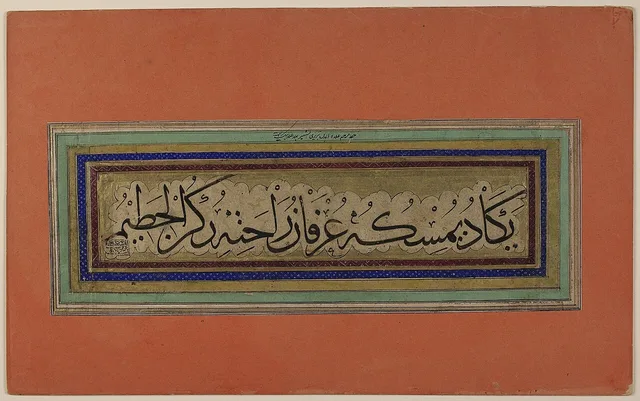
16th century · Library of Congress, Washington
Photo: Wikimedia Commons, public domain
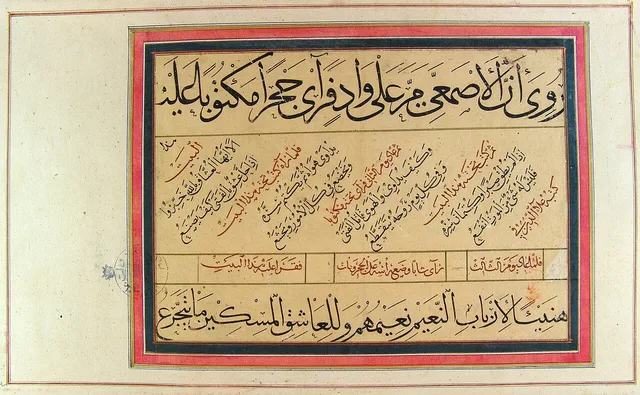
1580 (988 AH) · Golestan Palace Library, Tehran (No. 1558)
Photo: Wikimedia Commons, public domain
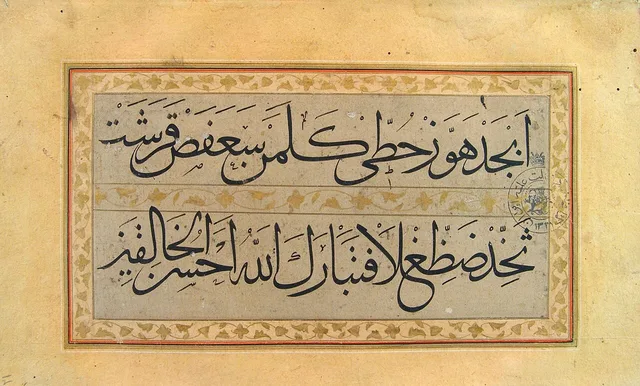
1593 (1001 AH) · Golestan Palace Library, Tehran
Photo: Wikimedia Commons, public domain
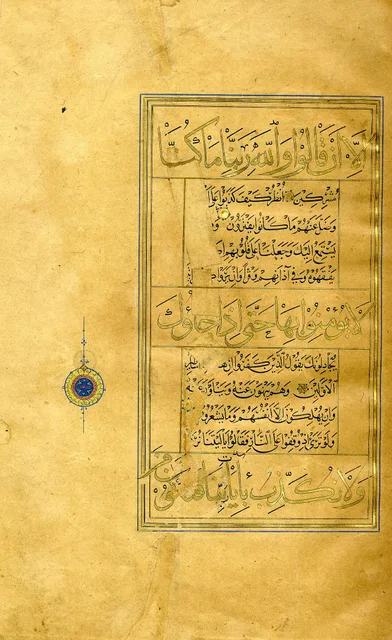
1554 (961 AH) · Malek National Library, Tehran (No. 166)
Photo: Wikimedia Commons, public domain
Write in the tradition this hand shaped.
Write in this tradition now →Living calligraphers you can buy from — signed originals on paper, from AED 550: Anwar Alhulwani (Thuluth) · Ahmed Alhawary (Jali Thuluth, Naskh) · Rasha Kasim (Kufi) — or every Thuluth piece the store makes: Thuluth collection.
Sources
- Reed College, Anthology of Iranian Masters of Calligraphy: born c. 1523 Tabriz, father Shams al-Din Muhammad, court of Tahmasp from 1565, scripts, students, works 957/1550 to 1008/1599, death c. 1601 reed.edu
- Persian Wikipedia (after Fazaili, Atlas-e khatt; Yasavoli): c. 930-1010 AH, Mulla Ala Beg, thuluth/naskh/riqa', students, lost Tabriz inscriptions, dated works 963-1008 AH fa.wikipedia.org
- English Wikipedia: firmans for Shah Tahmasp, inscriptions in Tabriz, Qazvin, Karbala en.wikipedia.org
- Wikidata: 1523-1601 wikidata.org
- Commons category of his works commons.wikimedia.org
Written by the MASHQ studio · last updated 2026-10-05. Further reading, the standard references in English: Sheila S. Blair, Islamic Calligraphy (Edinburgh University Press, 2006) · Annemarie Schimmel, Calligraphy and Islamic Culture (New York University Press, 1984) · Yasin Hamid Safadi, Islamic Calligraphy (Thames and Hudson, 1978).