Mishkin-Qalam (Mirza Husayn Isfahani)
1826–1912 · Shiraz & Acre
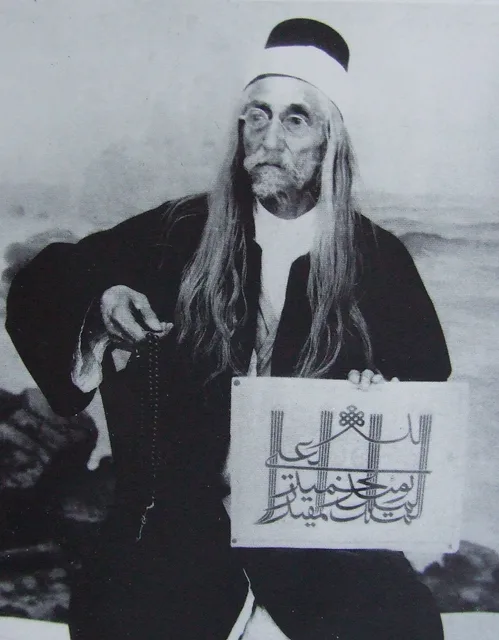
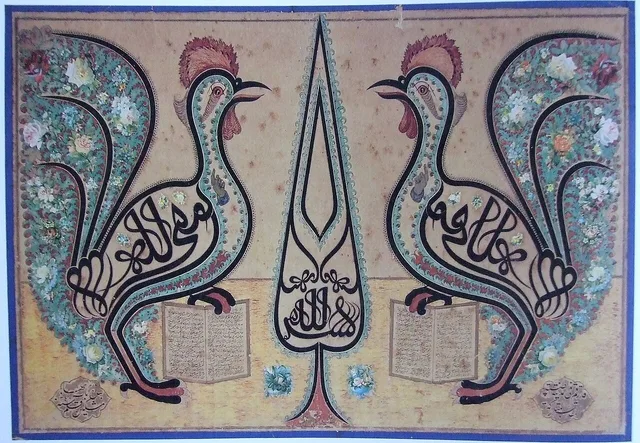
Mirza Husayn Isfahani was born in Shiraz; Persian Wikipedia gives 31 July 1826, English Wikipedia 1824. He grew up in Isfahan and showed an early gift for calligraphy and drawing. In Tehran his skill brought him to court: Naser al-Din Shah named him Mishkin-Qalam, 'musk-black pen', and sent him to Tabriz as tutor to the crown prince Mozaffar al-Din. A Sufi of the Ni'matullahi order, he became a follower of Baha'u'llah after meeting him in Edirne. Sent to Istanbul, he was arrested, and from 1868 to 1877 he was held at Famagusta in Cyprus. He then lived in Acre, travelled to Egypt, Damascus and India, and returned to the Holy Land, where he died in 1912. Mehdi Bayani and Annemarie Schimmel both rank him among the leading masters of his time in nastaliq and shikasta. He also wrote mirror compositions, shaped words into birds, and pressed letters into paper with his fingernail. His rendering of Ya Baha' al-Abha became the Baha'i symbol known as the Greatest Name, and Abdu'l-Baha called him a second Mir Emad.
Achievements
- Given the name Mishkin-Qalam, 'musk-black pen', by Naser al-Din Shah, who made him tutor to the crown prince in Tabriz (Persian Wikipedia).
- Designed the calligraphic 'Greatest Name' (Ya Baha' al-Abha) used by Baha'is worldwide (English and Persian Wikipedia).
- Called 'a second Mir Emad' by Abdu'l-Baha (English Wikipedia).
- Mastered nastaliq, shikasta and naskh, mirror writing, bird-shaped calligrams and fingernail-pressed writing (Persian Wikipedia, citing Bayani and Schimmel).
- Exiled to Famagusta, Cyprus, 1868–1877; later lived in Acre, Egypt, Damascus and India (English Wikipedia).
Taught: Mozaffar al-Din Mirza
His work
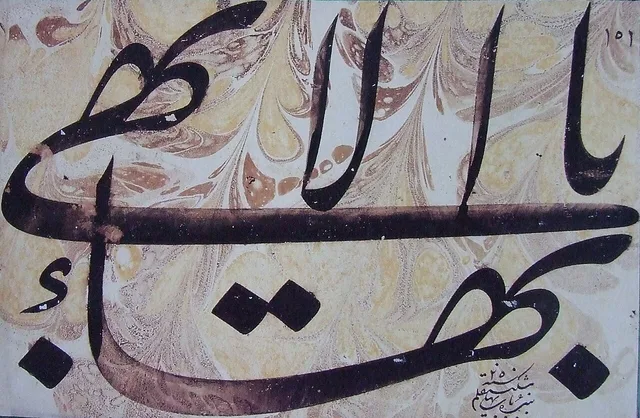
19th century · reproduced in Mishkín Qalam: XIX Century Artist & Calligrapher (1992)
Photo: Wikimedia Commons, public domain
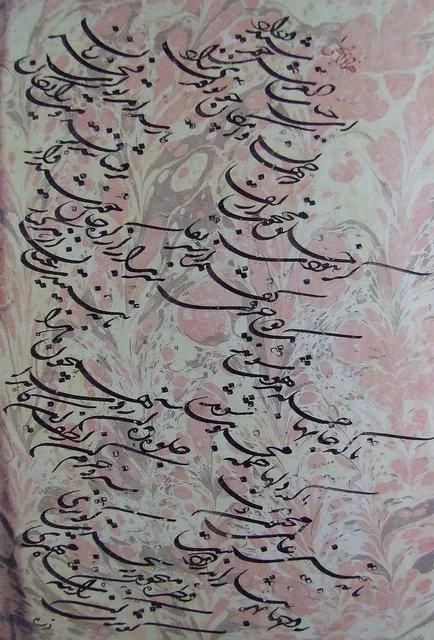
19th century · reproduced in Mishkín Qalam: XIX Century Artist & Calligrapher (1992)
Photo: Wikimedia Commons, public domain
19th century · reproduced in Mishkín Qalam: XIX Century Artist & Calligrapher (1992)
Photo: Wikimedia Commons, public domain
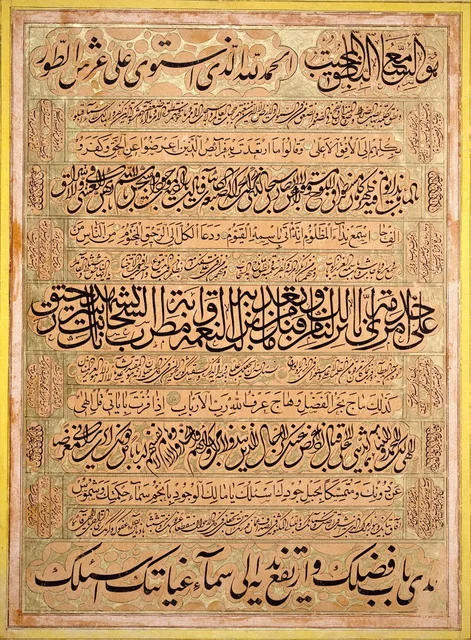
1897 · House of Abbud, Acre
Photo: Wikimedia Commons, public domain
Write in the tradition this hand shaped.
Write in this tradition now →Living calligraphers you can buy from — signed originals on paper, from AED 550: Anwar Alhulwani (Thuluth) · Ahmed Alhawary (Jali Thuluth, Naskh) · Rasha Kasim (Kufi) — or every Nastaliq piece the store makes: Nastaliq collection.
Sources
- English Wikipedia: life, exile, Greatest Name, "second Mir Emad" en.wikipedia.org
- Persian Wikipedia: exact dates, court title, tutor of the crown prince, scripts and techniques, Bayani and Schimmel fa.wikipedia.org
- Arabic Wikipedia: court post, death in Acre ar.wikipedia.org
- Commons: works reproduced from Mishkín Qalam: XIX Century Artist & Calligrapher (Landegg Academy, 1992) commons.wikimedia.org
Written by the MASHQ studio · last updated 2026-10-05. Further reading, the standard references in English: Sheila S. Blair, Islamic Calligraphy (Edinburgh University Press, 2006) · Annemarie Schimmel, Calligraphy and Islamic Culture (New York University Press, 1984) · Yasin Hamid Safadi, Islamic Calligraphy (Thames and Hudson, 1978).