Mirza Mohammad Davari Shirazi
1822–1866 · Shiraz
Mirza Mohammad, who wrote under the pen name Davari, was born in Shiraz in 1238 AH (1822–23). He was the third son of the poet and calligrapher Vesal Shirazi and one of six brothers who were all known as poets and calligraphers. He studied Arabic and theology with his father and also learned from his elder brother Ahmad Vaqar. Encyclopaedia Iranica calls him a master of nastaliq as well as a painter; Persian Wikipedia adds shikasta. His best-known work is a full copy of Ferdowsi's Shahnameh that took him five years. It holds drawings by himself and by the painter Lotf-Ali, with one by his brother Farhang, and ends with a poem in which Davari describes the labour; it is now in the Reza Abbasi Museum in Tehran. He was also a poet of odes in Persian, Arabic and Turkish, and wrote on prosody and rhetoric. Naser al-Din Shah received him at court and gave him a pension for life. He died in Shiraz in 1283 AH (1866); Arabic Wikipedia also records 1282 and 1284. He is buried at the shrine of Shah Cheragh.
Achievements
- Copied a complete Shahnameh in nastaliq over five years; it is in the Reza Abbasi Museum, Tehran (Iranica).
- Added drawings of his own to that Shahnameh, beside paintings by Lotf-Ali and one by his brother Farhang (Iranica).
- Ranked as a master of nastaliq and shikasta (Persian Wikipedia, after Fazaeli's Atlas-e khatt).
- Received a lifetime pension from Naser al-Din Shah (Iranica).
Taught by: Vesal Shirazi, Ahmad Vaqar
His work
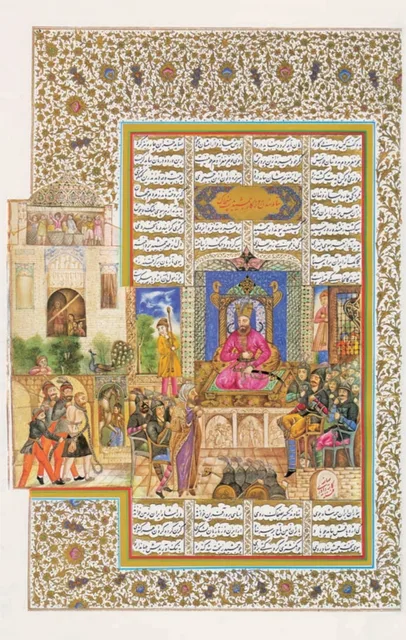
between 1852 and 1863 · Reza Abbasi Museum, Tehran
Photo: Wikimedia Commons, public domain
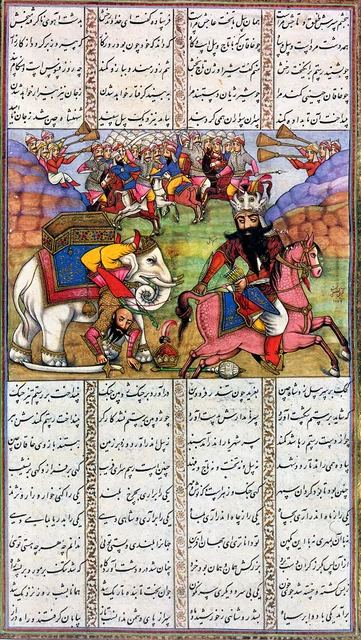
1279 AH (1862–63) · Reza Abbasi Museum, Tehran
Photo: Wikimedia Commons, public domain
Only two pages of his Shahnameh are on Wikimedia Commons, and no single sheet of his calligraphy is in an open collection.
Write in the tradition this hand shaped.
Write in this tradition now →Living calligraphers you can buy from — signed originals on paper, from AED 550: Anwar Alhulwani (Thuluth) · Ahmed Alhawary (Jali Thuluth, Naskh) · Rasha Kasim (Kufi) — or every Nastaliq piece the store makes: Nastaliq collection.
Sources
- Encyclopaedia Iranica, DĀVARĪ ŠĪRĀZĪ: dates, teachers, nastaliq, Shahnameh in the Reza Abbasi Museum, pension, burial web.archive.org
- Persian Wikipedia: nastaliq and shikasta; burial at Shah Cheragh fa.wikipedia.org
- Arabic Wikipedia: variant death years ar.wikipedia.org
- English Wikipedia: summary en.wikipedia.org
Written by the MASHQ studio · last updated 2026-10-05. Further reading, the standard references in English: Sheila S. Blair, Islamic Calligraphy (Edinburgh University Press, 2006) · Annemarie Schimmel, Calligraphy and Islamic Culture (New York University Press, 1984) · Yasin Hamid Safadi, Islamic Calligraphy (Thames and Hudson, 1978).