
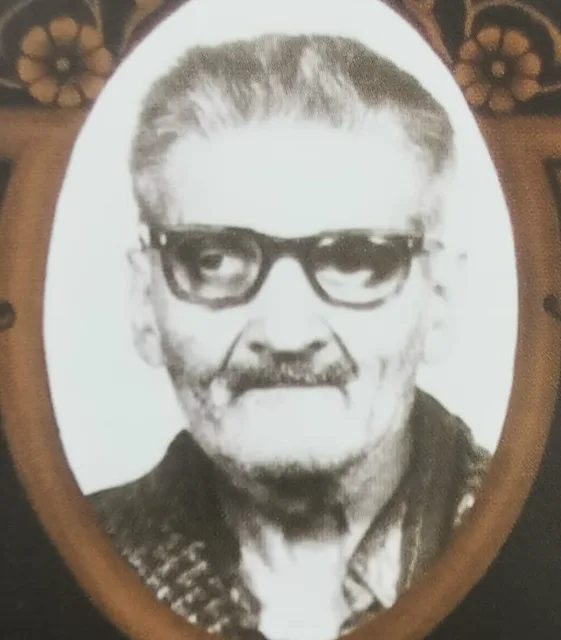
Ibrahim al-Rifai
1904–1983 · Aleppo
Ibrahim al-Rifai was born in Aleppo in 1904. He went to Damascus to learn the principles of calligraphy from Muhammad Badawi al-Dirani, and is counted among al-Dirani's best-known pupils. In 1928 he gave up a government post to devote himself to calligraphy. Back in Aleppo he taught writing in the city's schools and institutes for decades, and in the 1970s was a teacher at the Institute of Applied Arts. He was strongest in thuluth and naskh. His inscriptions and panels decorate many religious buildings in Aleppo, among them the mosque of Umar ibn Abd al-Aziz. The courts used him as a technical expert on handwriting, and he wrote on the rules of Arabic calligraphy. His pupils included Muhammad Kamil Faris, later known for Kufic, and Bakri Shakir. He died in 1983.
Achievements
- Left a government post in 1928 to work only as a calligrapher.
- Taught calligraphy in the schools and institutes of Aleppo, and from the 1970s at the Institute of Applied Arts.
- Inscriptions in Aleppo mosques, among them the Umar ibn Abd al-Aziz mosque.
- Technical expert for the courts; wrote texts on the principles of Arabic calligraphy.
Taught by: Muhammad Badawi al-Dirani
Taught: Muhammad Bashir al-Idlibi al-Rifai, Muhammad Kamil Faris, Bakri Shakir, Muhyi al-Din Badhinjki
His work
He died in 1983, so his calligraphy is still under copyright (life + 50 years); no works are shown.
Write in the tradition this hand shaped.
Write in this tradition now →Living calligraphers you can buy from — signed originals on paper, from AED 550: Anwar Alhulwani (Thuluth) · Ahmed Alhawary (Jali Thuluth, Naskh) · Rasha Kasim (Kufi) — or every Thuluth piece the store makes: Thuluth collection.
Sources
- Arabic Wikipedia (citing eSyria, syria-in.com, Habash, Jawahir al-khattatin): 1904-1983, al-Dirani, teaching, Umar ibn Abd al-Aziz mosque ar.wikipedia.org
- Arabic Wikipedia, Zarzur article: lists Ibrahim al-Rifai of Aleppo among al-Dirani's best-known pupils ar.wikipedia.org
Written by the MASHQ studio · last updated 2026-10-05. Further reading, the standard references in English: Sheila S. Blair, Islamic Calligraphy (Edinburgh University Press, 2006) · Annemarie Schimmel, Calligraphy and Islamic Culture (New York University Press, 1984) · Yasin Hamid Safadi, Islamic Calligraphy (Thames and Hudson, 1978).