Ahmad Neyrizi
Neyriz & Isfahan
Mirza Ahmad, son of Shams al-Din Muhammad, came from Neyriz in Fars and is the master who gave Iranian naskh its own form. His birth year is unclear: Persian Wikipedia takes 1087 AH from his earliest known work, Reed College suggests about 1694, yet both list dated works from the 1680s. He settled in Isfahan, the Safavid capital, around 1100 AH. He learned from Muhammad Ibrahim Qomi, and Reed adds Muhammad Sadeq Tabrizi; he also copied the models of Ala al-Din Tabrizi. Under Shah Sultan Husayn he copied Qur'ans, prayer books and the Sahifa Sajjadiyya, often signing 'al-Soltani'. He also wrote thuluth, riqa', nastaliq and shikasta, but naskh made his name, and Iranian writers call him simply 'the Mirza'. After the Afghan conquest of Isfahan in 1722 his output fell sharply. His dated works run to about 1160/1747; Persian Wikipedia gives his death as 1155 AH, and he probably died in Isfahan. His fame invited forgeries, so authentic pages are rare.
Achievements
- Shaped the Persian style of naskh, which later Iranian copyists took as their model.
- Signed many works 'al-Soltani' as calligrapher to Shah Sultan Husayn Safavi.
- Dated works span roughly 1094/1683 to 1160/1747; Bayani lists 110 works, and Persian sources count dozens of Qur'ans and prayer books in his hand.
- Was so prized that later dealers forged his signature on other men's work.
Taught by: Muhammad Ibrahim Qomi, Muhammad Sadeq Tabrizi, Ala al-Din Tabrizi
His work
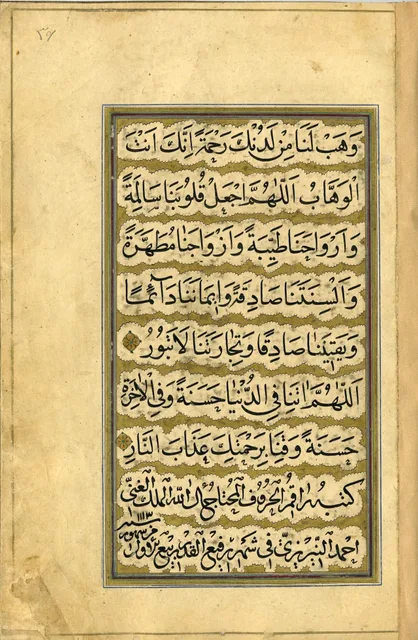
August 1701 (Rabi' I 1113 AH) · Malek National Library, Tehran (No. 130)
Photo: Wikimedia Commons, public domain
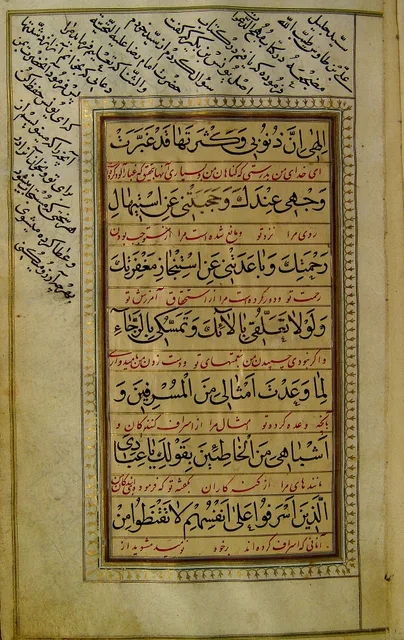
1699 · Golestan Palace Library, Tehran (No. 1077)
Photo: Wikimedia Commons, public domain
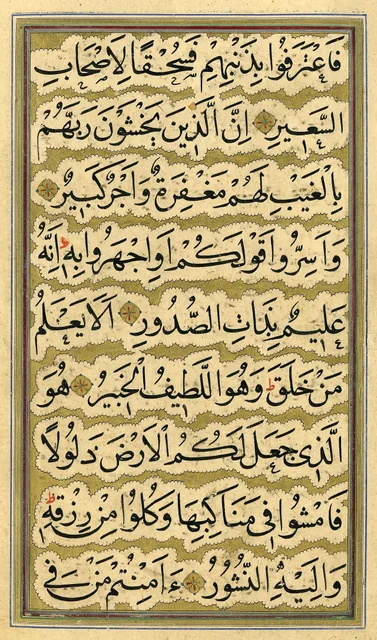
1702 · Malek National Library, Tehran (No. 130)
Photo: Wikimedia Commons, public domain
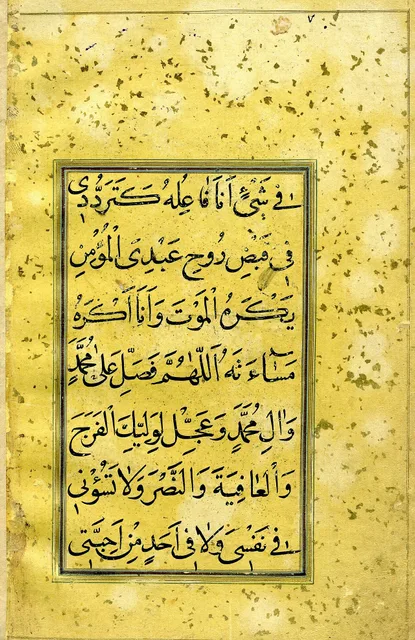
1709 · Central Library of the University of Tehran (No. 793)
Photo: Wikimedia Commons, public domain
Write in the tradition this hand shaped.
Write in this tradition now →Living calligraphers you can buy from — signed originals on paper, from AED 550: Anwar Alhulwani (Thuluth) · Ahmed Alhawary (Jali Thuluth, Naskh) · Rasha Kasim (Kufi) — or every Naskh piece the store makes: Naskh collection.
Sources
- Persian Wikipedia (after Bayani, Fazaili, Yasavoli): 1087-1155 AH, 'Soltani', Isfahan c. 1100 AH, teacher Ibrahim Qomi, models of Ala al-Din Tabrizi, works 1096-1152 (Bayani 1094-1177), 99 Qur'ans, forgeries, list of works fa.wikipedia.org
- Reed College anthology: born c. 1694 Neyriz, teachers Muhammad Sadeq Tabrizi and Muhammad Ebrahim Qomi, own style of naskh, other scripts, about thirty Qur'ans, forgeries, works 1094/1683 to 1160/1747 reed.edu
- Wikidata: 1650-1747 wikidata.org
- Commons category of his works commons.wikimedia.org
Written by the MASHQ studio · last updated 2026-10-05. Further reading, the standard references in English: Sheila S. Blair, Islamic Calligraphy (Edinburgh University Press, 2006) · Annemarie Schimmel, Calligraphy and Islamic Culture (New York University Press, 1984) · Yasin Hamid Safadi, Islamic Calligraphy (Thames and Hudson, 1978).