Ibn Muqla — the dot that measured beauty
In 10th-century Baghdad, tradition holds, the vizier Ibn Muqla did for calligraphy what the grammarians had done for language: he gave it law. The proportioned script (al-khatt al-mansub) credited to him ties every letter to the alif, and to the circle whose diameter is that alif. Later masters, from Ibn al-Bawwab on, counted these lengths in rhombic dots, each the width of the pen. With that measure beauty could be taught: a master could correct a student by measure, not by taste alone — this bowl is a dot too shallow, this alif a dot too tall. No page in Ibn Muqla's own hand survives, yet Naskh, Thuluth and the scripts that grew from them still follow his system.
A vizier's life
Abu Ali Muhammad ibn Ali ibn Muqla was born in Baghdad on 21 Shawwal 272 (31 March 886), into a family of calligraphers. His hand took him into the government offices while still a boy. He served the powerful Ibn al-Furat, ran several departments of state, and in 928, by a payment of 500,000 dinars, won the vizierate of Caliph al-Muqtadir.
He was vizier three times, in 928–930, 932–933 and 934–936, under al-Muqtadir, al-Qahir and al-Radi, in years of empty treasuries and army coups. Each fall brought exile, confiscation or prison. In 938, after he schemed against the commander Ibn Ra'iq, his right hand was cut off, and later his tongue. He died in prison in Shawwal 328 (July 940).
Ibn Khallikan reports his lament: the hand with which he had served three caliphs and twice copied the Qur'an had been cut off like a thief's. His brother Abu Abd Allah al-Hasan (d. 338/949–50) was a calligrapher too, and the sources often name the two together.
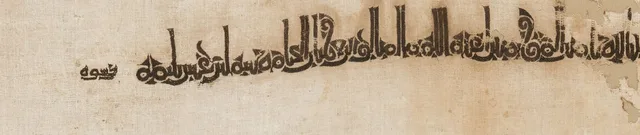
dated 328 AH (939–40); it also carries an inscription of 312 AH (924–25) in al-Muqtadir's name · The Metropolitan Museum of Art, New York (29.179.13); woven in Damietta, Egypt
Photo: Wikimedia Commons, CC0
The dot as a ruler
The dot is made by setting the whole width of the nib on the paper. It is a rhombus standing on its corner, two corners up and down, two left and right, and it is measured from corner to corner. Because it comes from the pen, the unit changes with the pen: a broad nib makes a large script, a fine nib a small one, and the proportions stay the same.
The number of dots in the alif depends on the script, and the alif sets every other measure. Iranica lists what tells one script from another: the alif in dots, each letter alone and joined, the share of straight and round strokes, and elongations up to three alifs long. The circle drawn on the alif governs the curves, such as the bowls of nun, qaf and final lam.
Teachers still write the measure into their models. In Mehmed Şevki's album of letter exercises, dated 1283 (1866–67) and now in the Khalili Collections (MSS 239), red dots outline the letters. Iranica adds that teachers today often draw these dots hollow, so that they are not confused with the dots of the letters.
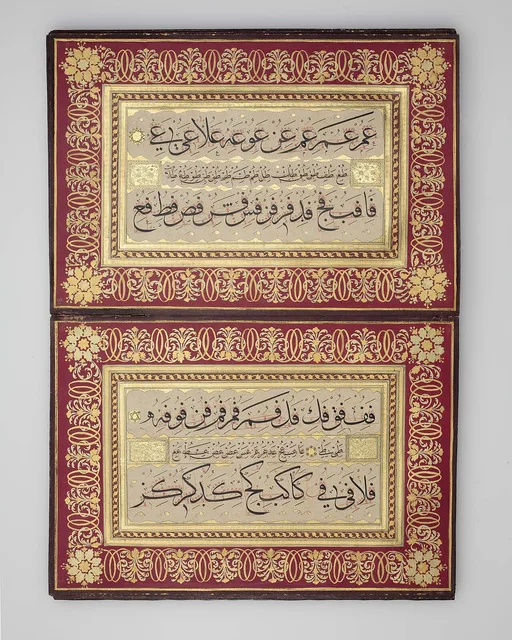
1866–1867 (1283 AH) · Khalili Collections, London
Photo: Khalili Collections, Wikimedia Commons (Khalili Collection Islamic Art mss 0239.15.jpg), CC BY-SA 3.0 igo (creativecommons.org/licenses/by-sa/3.0/igo)
Rules for a good line
Proportion is only half of the system. Iranica, following Ibn Muqla's Risalat al-khatt wa-l-qalam (Treatise on Writing and the Pen), divides his rules into two groups. Good shaping (husn al-tashkil) governs each letter: its size, its straight and round parts, its thick and thin strokes. Good placing (husn al-wad') governs the page: the joins, the gaps between words, the spaces between lines, and the stretched letters that even the margins.
The second group rests on two ideas: tarkib, the composition of letters and lines, and kursi, the seat of each letter on the line. Iranica counts five levels on which letters sit, from the head of the alif to the tail of the jim; other writers count three or four. The treatise survives in a manuscript in Cairo's Dar al-Kutub and in al-Qalqashandi's encyclopaedia; Hilal Naji published a text attributed to Ibn Muqla in Baghdad in 1989.
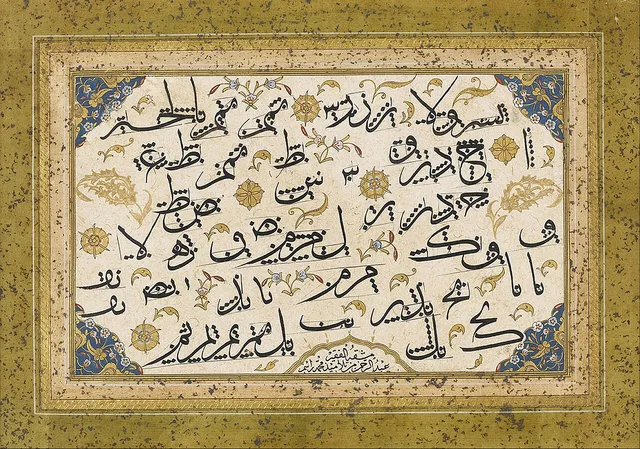
about 1800–1805 · Sakıp Sabancı Museum, Istanbul
Photo: Wikimedia Commons, public domain
What survives, and what is disputed
No writing in Ibn Muqla's own hand is known to survive. Ibn al-Nadim saw a Qur'an copied by his father, and Yaqut al-Hamawi says Ibn Muqla copied books for the Hamdanid prince Sayf al-Dawla, but none has been found. Every picture of 'Ibn Muqla's script' is a later work in his tradition.
The sources also differ on what he did. Many modern books credit him with inventing the six pens, thuluth and naskh among them. Iranica says that he and his brother chose fourteen existing styles and gave them rules, and that Yaqut later fixed the six. TDV gives the brothers the main role in forming the six pens, and names tawqi' and riqa' as Ibn Muqla's own fields, naskhi as his brother's. Iranica even credits Ibn al-Bawwab, not Ibn Muqla, with measuring letter heights in dots. On one point they agree: after Ibn Muqla, proportion became the rule.
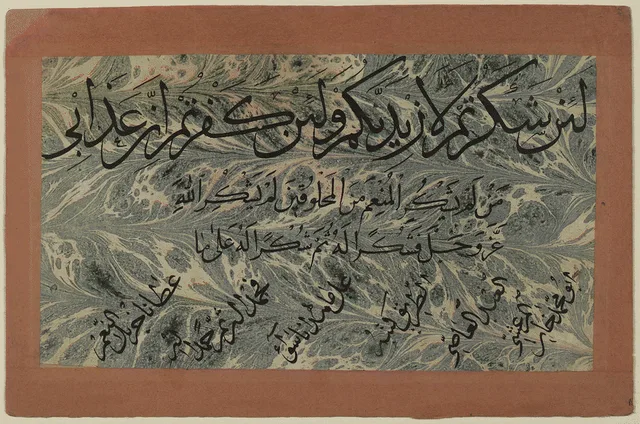
18th century · Library of Congress, Washington
Photo: Wikimedia Commons, public domain
The heirs
Ibn al-Bawwab (d. 413/1022) took up the method in Baghdad and refined it. His Qur'an of 391 (1000–1001), now in the Chester Beatty in Dublin, is the earliest dated Qur'an in a round script on paper. Ibn al-Khazin (d. 518/1124) shaped tawqi' and riqa' along the same path.
Yaqut al-Musta'simi, secretary to the last Abbasid caliph, cut the nib at a slant and gave the six pens their classic form. TDV dates his death to 698 (1299); Iranica gives 696 or 698. His pupils carried the six pens to Anatolia, Egypt, Syria, Iran and Central Asia.
In Istanbul Şeyh Hamdullah (d. 926/1520) reworked Yaqut's models at the urging of Sultan Bayezid II, and Hafız Osman (d. 1110/1698) refined them again.
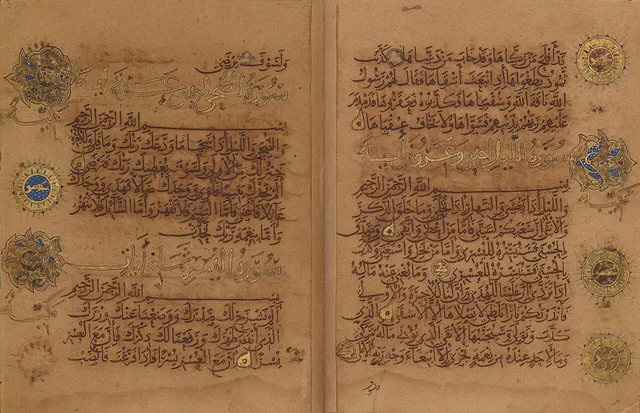
1000–1001 (391 AH) · Chester Beatty, Dublin
Photo: Wikimedia Commons, public domain
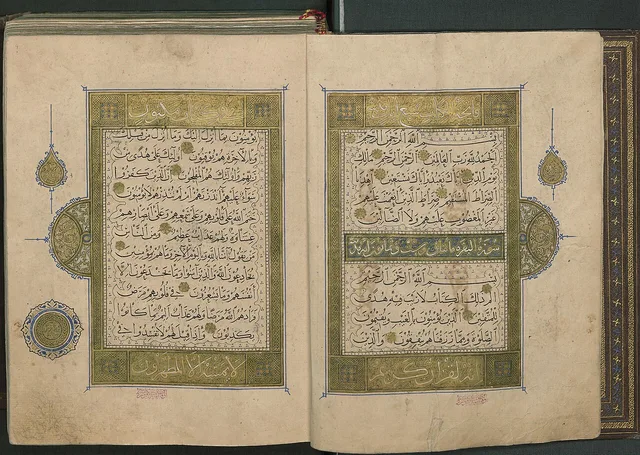
1286–1287 (685 AH) · Turkish and Islamic Arts Museum, Istanbul
Photo: Wikimedia Commons, public domain
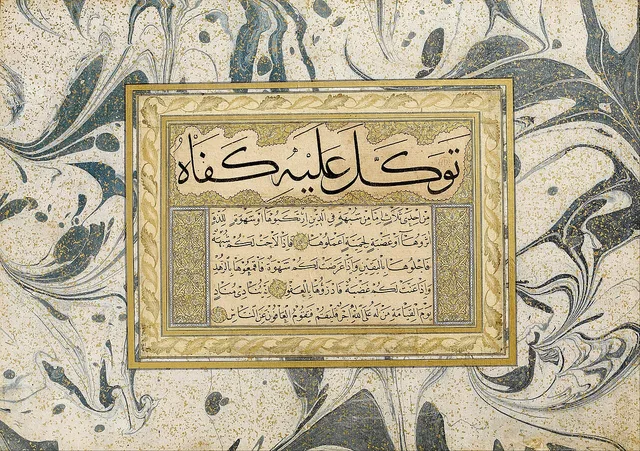
early 16th century or before · Sakıp Sabancı Museum, Istanbul
Photo: Wikimedia Commons, public domain
Measuring your own letters
Take a pen and make one dot: set the whole nib down and draw it its own width. Stack such dots corner on corner beside an alif. Counts differ between schools; where no historical source is named, the figures here are this studio's measure, after the modern teaching plates it follows: the naskh alif is five dots tall and the thuluth alif seven.
Then draw a circle whose diameter is that alif, and test your curves against it: the bowl of a nun, the tail of a final lam. Write the same letter ten times, as on an Ottoman exercise sheet, and measure each one. Change one thing at a time. When a letter fails, find the dot it is missing before you try again.
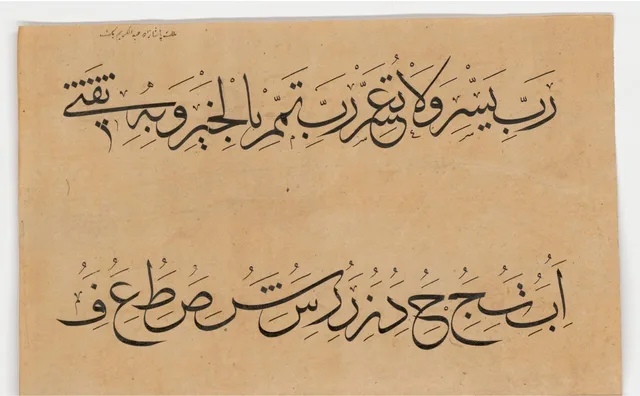
about 1750 · McGill University Library, Montreal
Photo: Wikimedia Commons, public domain
Sources
- Abdülkerim Özaydın, "İbn Mukle", TDV İslâm Ansiklopedisi, vol. 20, 1999
- Gholam-Hosayn Yusofi, "Calligraphy", Encyclopaedia Iranica, vol. IV, fasc. 7, 1990
- M. Uğur Derman, "Hat", TDV İslâm Ansiklopedisi, vol. 16, 1997
- McGill University Library, "Strokes and Hairlines", online exhibition on Islamic calligraphy
- Khalili Collections, "Album of alphabetical exercises by Mehmed Shevki" (MSS 239), catalogue record
- The Metropolitan Museum of Art, "Proportional Scripts", educator resource; "Textile Fragment" (29.179.13), collection record
- Chester Beatty, "The Silent Margins in Ibn al-Bawwab's Qur'an", 2025
- Wikipedia (English): "Ibn Muqla"
Try it now in this very script — ميزان
Open in the Studio →Written by the MASHQ studio · last updated 2026-10-05. Further reading, the standard references in English: Sheila S. Blair, Islamic Calligraphy (Edinburgh University Press, 2006) · Annemarie Schimmel, Calligraphy and Islamic Culture (New York University Press, 1984) · Yasin Hamid Safadi, Islamic Calligraphy (Thames and Hudson, 1978).
Keep exploring
From the store's journal: Styles guide: Kufic, Thuluth & Diwani