
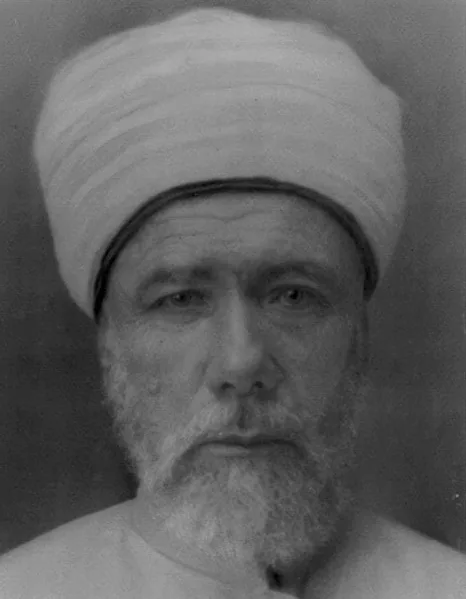
Muhammad Tahir al-Atassi
1860–1940 · Homs
Muhammad Tahir ibn Khalid al-Atassi was born in Homs in 1276 AH (1860) into a family of jurists, and studied at the school for sharia judges in Istanbul; among his teachers in the religious sciences were Mahmud Hamza and Badr al-Din al-Hasani. From 1306 AH he served as a judge across the Ottoman provinces, from Hauran, Nablus and Karak to Denizli, Adana, Jerusalem and Basra, and in 1333 AH (1915) he succeeded his father as mufti of Homs, a post he held until he died. He taught a Friday lesson in the Khalid ibn al-Walid Mosque, wrote fatwas, books and poetry, and in 1938 chaired the first congress of the ulama of Syria. Calligraphy was a serious second craft for him: he copied the entire Qur'an by hand, and one copy, written in the ijaza script (a blend of thuluth and naskh), was kept in the Khalid ibn al-Walid Mosque before it moved to the museum of the Awqaf directorate in Homs. He died in Homs on 18 April 1940 and was buried in the family tomb there.
Achievements
- Copied the whole Qur'an by hand; a copy in ijaza script, once kept in the Khalid ibn al-Walid Mosque, is now in the Awqaf museum in Homs.
- Mufti of Homs from 1333 AH / 1915 until his death.
- Served as a sharia judge in Hauran, Nablus, Karak, Denizli, Adana, Jerusalem and Basra.
- Chaired the first congress of the ulama of Syria in 1938.
His work
No photograph of his Qur'an or any other work by his hand is on Wikimedia Commons.
Write in the tradition this hand shaped.
Write in this tradition now →Living calligraphers you can buy from — signed originals on paper, from AED 550: Anwar Alhulwani (Thuluth) · Ahmed Alhawary (Jali Thuluth, Naskh) · Rasha Kasim (Kufi) — or every Naskh piece the store makes: Naskh collection.
Sources
- dates 1276–1359 AH / 1860–1940, Istanbul judges' school, posts, mufti 1333/1915, 1938 congress, Qur'an copy in ijaza script now in Homs Awqaf museum ar.wikipedia.org
- biography (Syrian Ulama League), source of the portrait islamsyria.com
- portrait, public domain commons.wikimedia.org
Written by the MASHQ studio · last updated 2026-10-05. Further reading, the standard references in English: Sheila S. Blair, Islamic Calligraphy (Edinburgh University Press, 2006) · Annemarie Schimmel, Calligraphy and Islamic Culture (New York University Press, 1984) · Yasin Hamid Safadi, Islamic Calligraphy (Thames and Hudson, 1978).