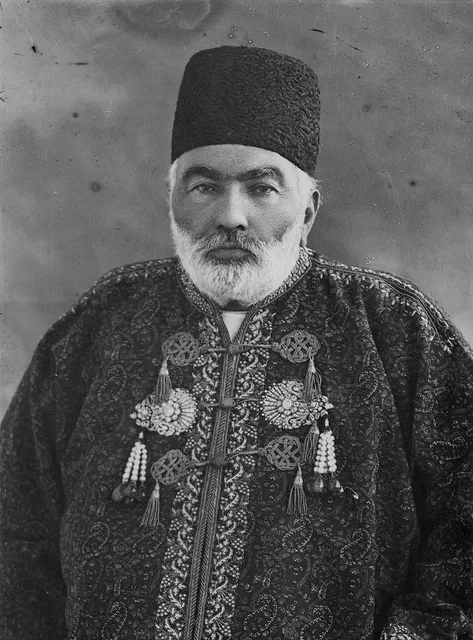
Mirza Ahmad Khan Moshir al-Saltaneh
1844–1918 · Amol & Tehran
Mirza Ahmad Khan was born in Amol on 6 July 1844 (1260 AH). Besides the usual schooling of his day and some law, he gave time to learning calligraphy and the craft of writing. In 1280 AH his brother invited him to the Tabriz court of the crown prince Mozaffar al-Din. His hand and style were liked, he was given the court's writing, and he soon became head of the prince's secretariat with the title monshi-bashi. He went on to high office: he was twice prime minister of Iran, minister of the interior and minister of justice, and also served at the Ottoman embassy. Mehdi Bayani, in his biographical dictionary of calligraphers, describes him as a skilled scribe who wrote nastaliq and a fine shikasta, and notes pieces of his shikasta in the Royal Library and in the Astan Quds Razavi library in Mashhad. He was wounded by gunmen in 1328 AH and died in Tehran on 20 April 1918, having given away his property to charity.
Achievements
- His handwriting won him the post of head secretary (monshi-bashi) to the crown prince Mozaffar al-Din in Tabriz, from 1280 AH (English and Persian Wikipedia).
- Wrote nastaliq and also a fine shikasta; pieces of his shikasta are in the Royal (Golestan) Library and the Astan Quds Razavi library (Mehdi Bayani, quoted in Persian Wikipedia).
- Served twice as prime minister of Iran, and as minister of the interior and of justice (English Wikipedia).
His work
His shikasta pieces are in the Golestan Palace and Astan Quds libraries, but no photograph of them is on Wikimedia Commons or another open collection.
Write in the tradition this hand shaped.
Write in this tradition now →Living calligraphers you can buy from — signed originals on paper, from AED 550: Anwar Alhulwani (Thuluth) · Ahmed Alhawary (Jali Thuluth, Naskh) · Rasha Kasim (Kufi) — or every Nastaliq piece the store makes: Nastaliq collection.
Sources
- English Wikipedia: dates, early career, offices, death en.wikipedia.org
- Persian Wikipedia: quotes Mehdi Bayani's Ahval va asar-e khoshnevisan on his nastaliq and shikasta fa.wikipedia.org
- Arabic Wikipedia: burial at the Fatimid shrine (Qom) ar.wikipedia.org
Written by the MASHQ studio · last updated 2026-10-05. Further reading, the standard references in English: Sheila S. Blair, Islamic Calligraphy (Edinburgh University Press, 2006) · Annemarie Schimmel, Calligraphy and Islamic Culture (New York University Press, 1984) · Yasin Hamid Safadi, Islamic Calligraphy (Thames and Hudson, 1978).