
Muhammad ibn al-Qasim al-Qandusi
1790–1861 · Kenadsa & Fes
Muhammad ibn al-Qasim al-Qandusi was a Sufi scholar and calligrapher of the Maghrib. He was chosen for this Maghribi-script entry because his life and works are documented and photographs of his own pieces can be shown. Born around 1790 in Kenadsa in south-western Algeria, he studied at the local Ziyaniyya zawiya and moved to Fes in 1828, where he kept a shop in the herb market. He developed a bold personal form of Maghribi script, now called the Qandusi script. He copied a Quran in 12 volumes, finished in 1266 AH (1850) and kept in the royal library, al-Khizana al-Hassaniyya in Rabat, and he wrote the large name of God shown in the zawiya of Moulay Idris II in Fes. He also wrote books on Sufism, most of them now in the national library in Rabat. He died in Fes in 1861 and was buried outside Bab al-Futuh.
Achievements
- Developed a bold personal form of Maghribi script, now called the Qandusi script.
- Completed a 12-volume Quran in 1266 AH (1850), kept in al-Khizana al-Hassaniyya, Rabat.
- Wrote the large name of God (Allah) displayed in the zawiya of Moulay Idris II in Fes.
- Copied al-Jazuli's Dala'il al-Khayrat; one copy is manuscript 399 K in Rabat.
- Wrote Sufi books, most now in the national library in Rabat.
- His work inspired the Qandus typeface (Kristyan Sarkis with Laura Meseguer), a TDC 2017 award winner.
Taught: Muhammad ibn Abd al-Kabir al-Kattani, Muhammad ibn Ahmad al-Sanhaji al-Fasi
His work
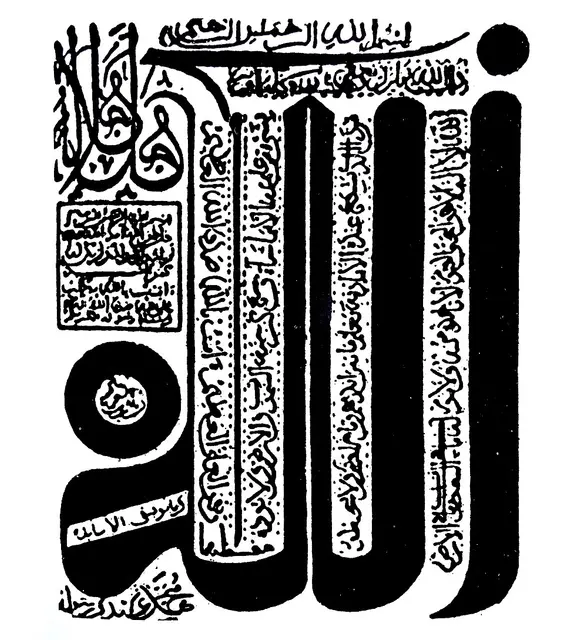
19th century · reproduced in Afa and al-Maghraoui, al-Khatt al-Maghribi
Photo: Wikimedia Commons, public domain
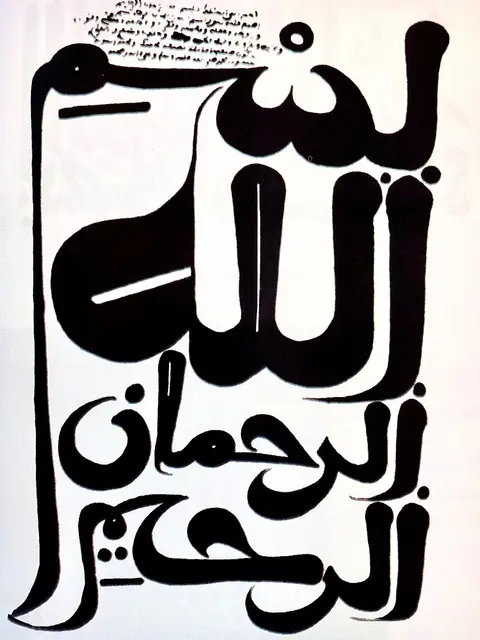
19th century · reproduced in Afa and al-Maghraoui, al-Khatt al-Maghribi
Photo: Wikimedia Commons, public domain
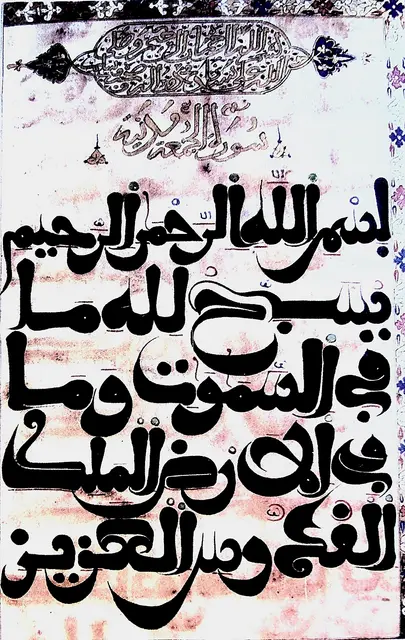
1850 · reproduced in Afa and al-Maghraoui, al-Khatt al-Maghribi
Photo: Wikimedia Commons, public domain
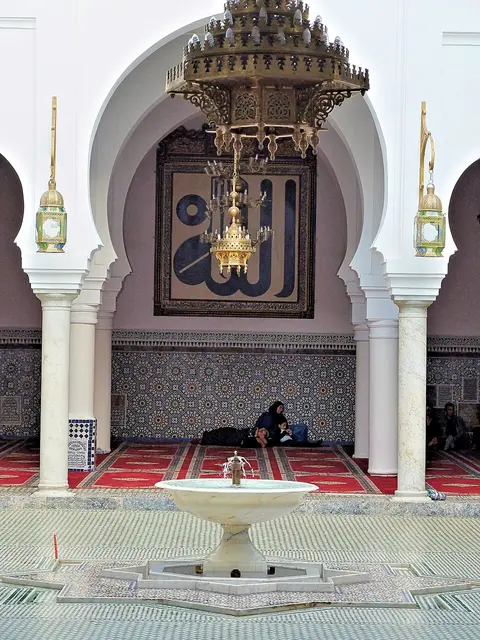
19th century · Zawiya of Moulay Idris II, Fes (photograph 2014)
Photo: Robert Prazeres, Wikimedia Commons (Zawiya moulay idris II and al-Qandusi art DSCF6286.jpg), CC BY-SA 4.0 (creativecommons.org/licenses/by-sa/4.0)
Write in the tradition this hand shaped.
Open Mashq Studio →Living calligraphers you can buy from — signed originals on paper, from AED 550: Anwar Alhulwani (Thuluth) · Ahmed Alhawary (Jali Thuluth, Naskh) · Rasha Kasim (Kufi).
Sources
- en.wikipedia: c.1790 Kenadsa - 1861; Fes 1828, herb shop; Qadiri and Nasiri orders; flamboyant Maghribi style; 12-volume Quran finished 7-8 Sep 1850 in al-Khizana al-Hassaniyya; Allah at the zawiya of Idris II; works mostly in the national library, Rabat; Qandus typeface TDC 2017 en.wikipedia.org
- ar.wikipedia: full Arabic name; Ziyaniyya Shadhiliyya zawiya at Kenadsa; Fes 1828; Quran 1266 AH in al-Khizana al-Hassaniyya, Rabat; Allah in the Idrisi shrine; death 1861 (1278 AH, also 1270 AH reported), buried outside Bab al-Futuh; students al-Kattani and al-Sanhaji; died 1862 in lead ar.wikipedia.org
- Khatt Foundation: Qandus tri-script typeface by Laura Meseguer and Kristyan Sarkis, TDC 2017 Excellence in Type Design khtt.net
- Wikimedia Commons category of works in Qandusi script (file records checked one by one) commons.wikimedia.org
- Wikidata: born 1790, died 1861 wikidata.org
Written by the MASHQ studio · last updated 2026-10-05. Further reading, the standard references in English: Sheila S. Blair, Islamic Calligraphy (Edinburgh University Press, 2006) · Annemarie Schimmel, Calligraphy and Islamic Culture (New York University Press, 1984) · Yasin Hamid Safadi, Islamic Calligraphy (Thames and Hudson, 1978).