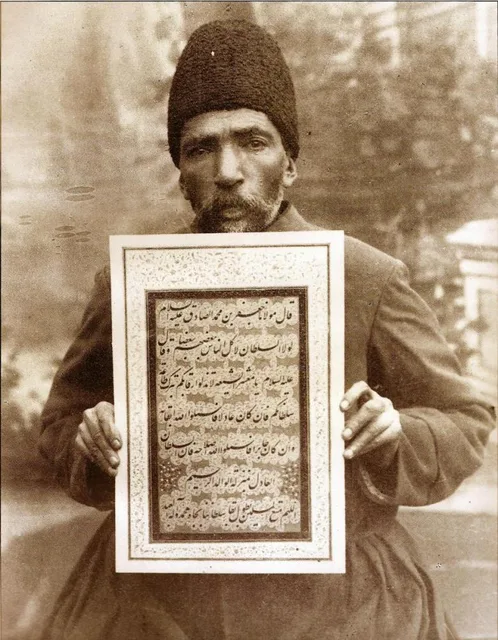
Mirza Muhammad Reza Kalhor
1829–1892 · Kermanshah & Tehran
Mirza Muhammad Reza Kalhor was born in 1245 AH (1829) into the Kurdish Kalhor tribe of Kermanshah, and spent his youth learning horsemanship and shooting. He began calligraphy in Tehran with Mirza Muhammad Khansari, then went to Qazvin and Isfahan to copy original works by Mir Emad, above all the inscription on the tomb of Mir Fendereski. Naser al-Din Shah took lessons from him and offered him a post in the state press bureau; Kalhor declined and lived from teaching and private work. Much of what survives is lithographic: on the shah's 1883 journey to Khorasan he wrote twelve issues of the court journal Ordu-ye homayun. For lithography he made letters smaller, thicker and more compact, changed the cut of the pen and devised a metal pen. He left many unsigned practice sheets. He died of cholera in Tehran on 3 August 1892.
Achievements
- Adapted nastaliq for lithographic printing: smaller, thicker, more compact letters and stacked words.
- Wrote twelve issues of the court journal Ordu-ye homayun during Naser al-Din Shah's 1883 journey to Khorasan.
- Introduced new ways of cutting the reed pen for printing ink, and a metal pen on the French model.
- Wrote lithographed books, including Fayz al-domu' and Makhzan al-insha (1868).
- Taught Naser al-Din Shah, and declined a post in the state press bureau.
- Shortened the years of training needed to reach mastery (Iranica).
Taught by: Mirza Muhammad Khansari, self-study of Mir Emad's works in Qazvin and Isfahan
Taught: Mirza Zayn al-Abedin Qazvini, Aqa Morteza Najmabadi, Morteza Baraghani, Abdollah Mostowfi, Sayyid Mahmud Sadr al-Kottab, Nasrollah Hakkak
His work
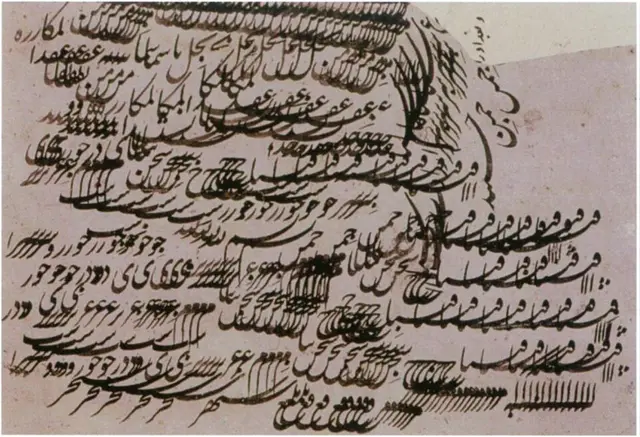
second half of the 19th century · private collection, Tehran
Photo: Wikimedia Commons, public domain
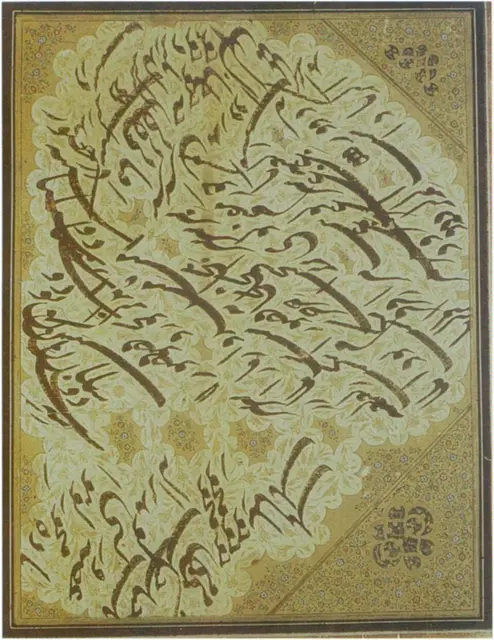
second half of the 19th century · 'Ali Jamasb Collection, Tehran
Photo: Wikimedia Commons, public domain
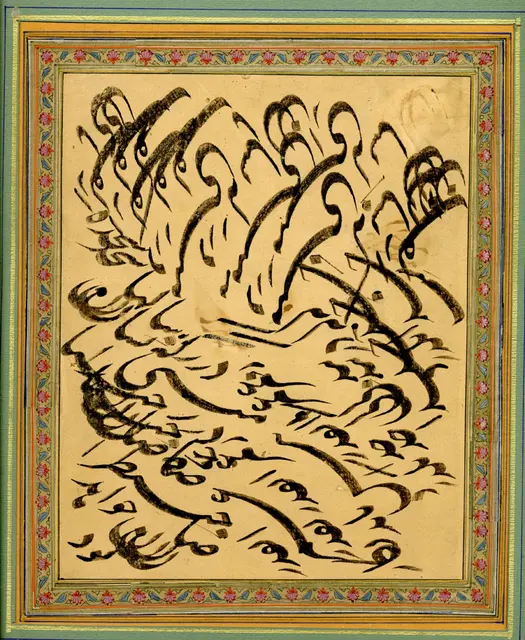
19th century · Iranian Calligraphers Association, Tehran
Photo: Wikimedia Commons, public domain
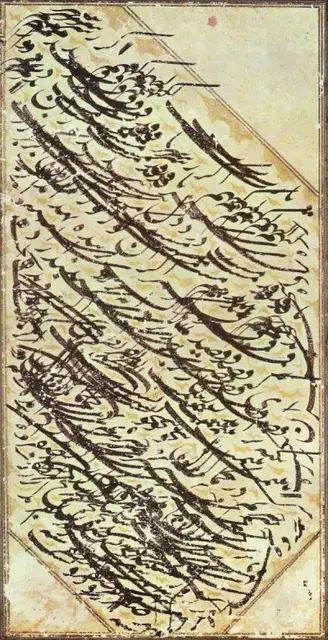
mid-19th century · collection not stated
Photo: Wikimedia Commons, public domain
Write in the tradition this hand shaped.
Write in this tradition now →Living calligraphers you can buy from — signed originals on paper, from AED 550: Anwar Alhulwani (Thuluth) · Ahmed Alhawary (Jali Thuluth, Naskh) · Rasha Kasim (Kufi) — or every Nastaliq piece the store makes: Nastaliq collection.
Sources
- Encyclopaedia Iranica, M. Ekhtiar, "KALHOR, Mirzā Moḥammad-Reżā" (archived copy): life, works, innovations, pupils web.archive.org
- Reed College anthology: birth 1829 Kermanshah, teacher, students, burial reed.edu
- en.wikipedia: summary, cholera, nine children en.wikipedia.org
- fa.wikipedia: birthplace Gilan-e Gharb, teaching method, pupils fa.wikipedia.org
- Wikidata wikidata.org
Written by the MASHQ studio · last updated 2026-10-05. Further reading, the standard references in English: Sheila S. Blair, Islamic Calligraphy (Edinburgh University Press, 2006) · Annemarie Schimmel, Calligraphy and Islamic Culture (New York University Press, 1984) · Yasin Hamid Safadi, Islamic Calligraphy (Thames and Hudson, 1978).