ʿAbd al-Rahim ʿAnbarin-Qalam
d. 1627 · Herat
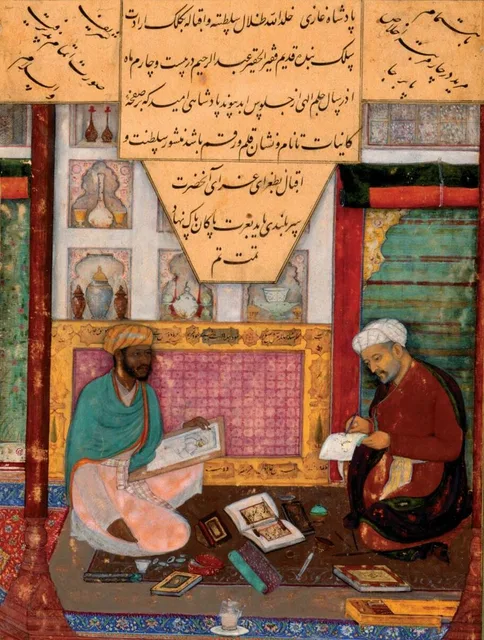
ʿAbd al-Rahim, known as ʿAnbarin-Qalam, 'amber pen', was a nastaliq calligrapher from Herat who went to India as a young man. He first served the statesman and patron ʿAbd al-Rahim Khan-i Khanan, who later brought him to the court of Akbar, where he copied several manuscripts for the imperial library. The best known is the Khamsa of Nizami made for Akbar in 1593–95, now divided between the British Library and the Walters Art Museum; its last page carries his colophon and a painted portrait of him writing beside the painter Daulat. Encyclopaedia Iranica lists dated work by him from 1005 AH (1596–97), an Anvar-i Suhayli copied at Lahore, to 1037 AH (1627–28), and a Jahangirnama of 1034 AH, and thinks that his title was given by Jahangir. His single album pages, with a few verses of Persian poetry in a large, smooth nastaliq, are signed 'faqir ʿAnbarin-Qalam ʿAbd al-Rahim'. The year of his death is not recorded.
Achievements
- Copied the Khamsa of Nizami made for Emperor Akbar in 1593–95 (British Library Or. 12208 and Walters Art Museum W.613); his colophon at the end is shown with a painted portrait of him at work.
- Copied an Anvar-i Suhayli at Lahore in 1005 AH (1596–97) and a Jahangirnama dated 1034 AH (1624–25, State Library, Tehran).
- Received the title ʿAnbarin-Qalam ('amber pen'), probably from Jahangir according to Iranica.
- Signed album pages and manuscripts are in the British Library (India Office), the Museum of Fine Arts Boston, the Freer Gallery, the Cleveland Museum of Art and the Metropolitan Museum; his latest dated work is of 1037 AH (1627–28), at Aligarh.
His work
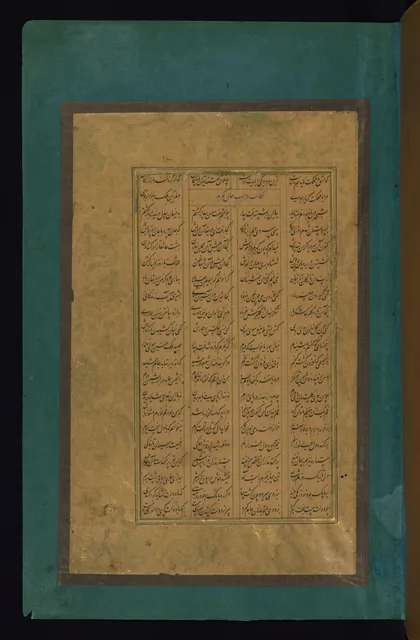
1593–95 (1003 AH) · Walters Art Museum, Baltimore (W.613, f. 1a)
Photo: Wikimedia Commons, public domain
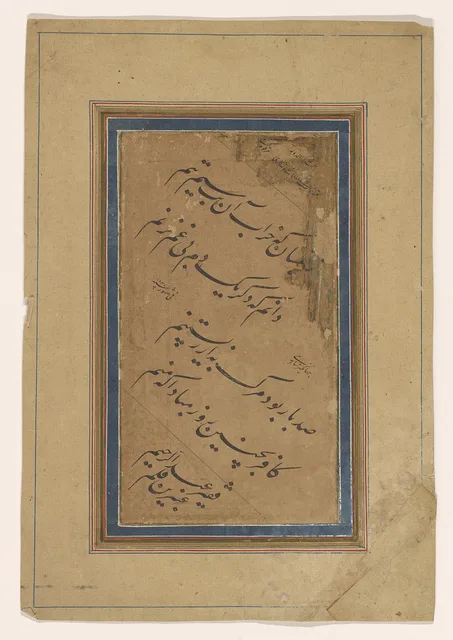
Late 16th or early 17th century · Freer Gallery of Art, Washington (study collection FSC-MS-31)
Photo: Wikimedia Commons, public domain
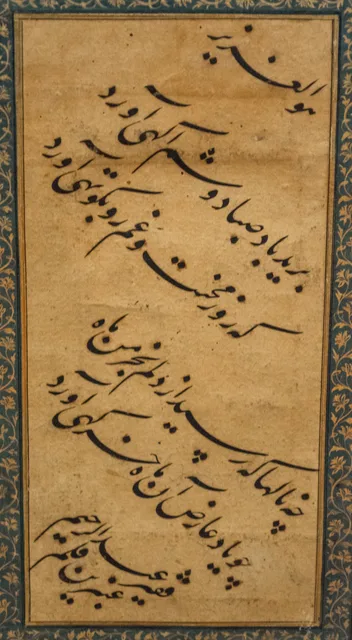
About 1600 · Cleveland Museum of Art, Cleveland
Photo: Tim Evanson, Wikimedia Commons (Calligraphy from 1600 - Cleveland Museum of Art (29621004093).jpg), CC BY-SA 2.0 (creativecommons.org/licenses/by-sa/2.0)
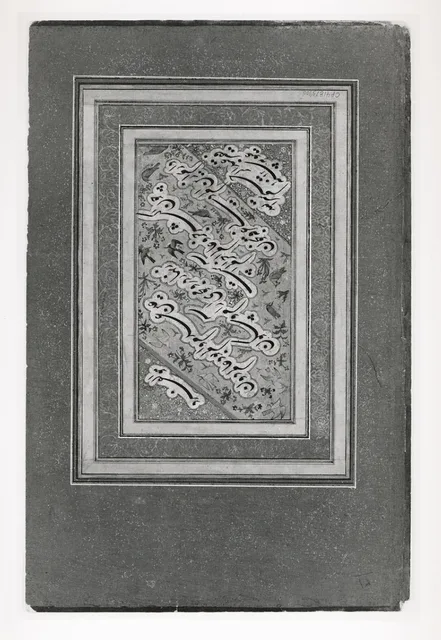
992 AH (1584–85) · The Metropolitan Museum of Art, New York (1994.359)
Photo: Wikimedia Commons, CC0
Write in the tradition this hand shaped.
Write in this tradition now →Living calligraphers you can buy from — signed originals on paper, from AED 550: Anwar Alhulwani (Thuluth) · Ahmed Alhawary (Jali Thuluth, Naskh) · Rasha Kasim (Kufi) — or every Nastaliq piece the store makes: Nastaliq collection.
Sources
- Encyclopaedia Iranica (M. A. Chaghatai): native of Herat, Khan-i Khanan, Akbar, title probably from Jahangir, dated works 1005–1037 AH incl. Anvar-i Suhayli (Lahore 1005), Jahangirnama 1034, Boston, India Office, Aligarh iranicaonline.org
- Arabic Wikipedia: Herat, Khan-i Khanan, Akbar's court, Khamsa BL Or. 12208 ar.wikipedia.org
- Persian Wikipedia: same fa.wikipedia.org
- Walters Art Museum record on Commons: W.613 text page copied by 'Abd al-Rahim 'Ambarin Qalam, 1003 AH/1595 commons.wikimedia.org
- Metropolitan Museum record on Commons: 1994.359, by Abd al-Rahim 'Anbarin-Qalam, dated 992/1584-85 commons.wikimedia.org
- British Library Or. 12208 f. 325v: colophon with portrait of Daulat and 'Abd al-Rahim commons.wikimedia.org
Written by the MASHQ studio · last updated 2026-10-05. Further reading, the standard references in English: Sheila S. Blair, Islamic Calligraphy (Edinburgh University Press, 2006) · Annemarie Schimmel, Calligraphy and Islamic Culture (New York University Press, 1984) · Yasin Hamid Safadi, Islamic Calligraphy (Thames and Hudson, 1978).