Tughra & seals — a name becomes a monogram
The tughra was the Ottoman sultan's signature-as-artwork: his name, his father's name and the prayer 'ever victorious' woven into one inseparable emblem. Three verticals like masts, two nested ovals sweeping left, a dense knot at the base — always the same skeleton, redrawn for each new sultan by the chancery's specialist. Illuminated tughras were counted, kept in the treasury and issued only against a receipt, so the sign could not be used at will. The same instinct lives in seals and signet rings, and in this studio's seal and circle compositions: a name made into a mark that stands for its owner.
Before the Ottomans
The word is Turkic. Mahmud al-Kashgari, compiling his dictionary of the Turkic languages in the eleventh century, explained tughragh as the seal and signature of the king in the Oghuz dialect. Persian chanceries called the sign nishan, and Arabic ones tawqi' or 'alama.
Uğur Derman, in the TDV encyclopaedia, notes that the Great Seljuks had an office called the Divan-i Tughra, but none of their tughras survives. An early one that does is on a Persian decree from northwest Iran, dated 630 (1233): a local Turkic ruler, Abu al-Muzaffar Muhammad b. 'Uthman b. Uzbak, grants two villages near Ardabil, and his name stands at the head in tall upright strokes.
Mamluk decrees in Egypt carried a tughra until the 1370s, but Derman notes that theirs were squarish and unlike the Ottoman form, which grew within one dynasty over six centuries.
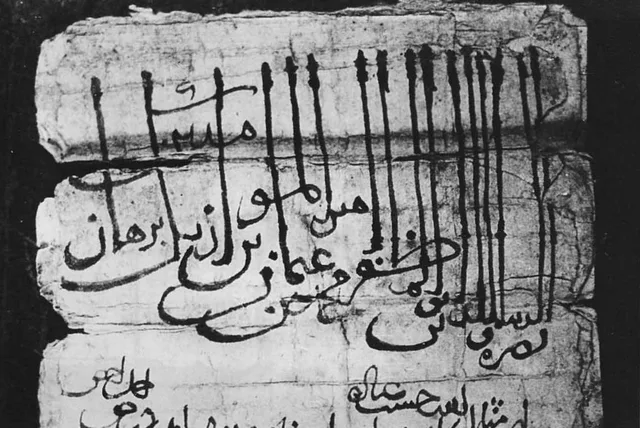
630 AH / 1233 · Northwest Iran; published by Gottfried Herrmann, 1994
Photo: Wikimedia Commons, public domain
The Ottoman tughra and its five parts
No tughra of Osman, the founder of the dynasty, is known. The first is his son Orhan's, on a document of 724/1324 according to the TDV encyclopaedia; English Wikipedia gives 1326. Orhan's already has the skeleton: Derman reads its verticals as three alifs and its sweeps to the left as three nuns.
Ottoman calligraphers named five parts. The sere or kürsi, the seat, holds the words at the base. The beyze are the two egg-shaped loops on the left. The tuğ are the three tall verticals. The zülfe are the curls that cross them. The hançer or kol, dagger or arm, runs out to the right.
The words grew with the empire. The prayer al-muzaffar da'iman, ever victorious, appears from the reign of Murad I, and the title Shah from Selim I. The tughra of Mehmed IV in Cleveland reads, in full: Shah Mehmed, son of Ibrahim Khan, ever victorious.
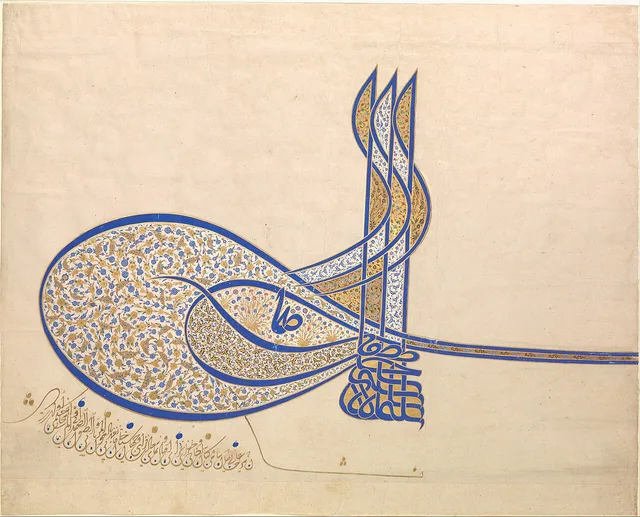
about 1555–60 · The Metropolitan Museum of Art, New York
Photo: Wikimedia Commons, CC0
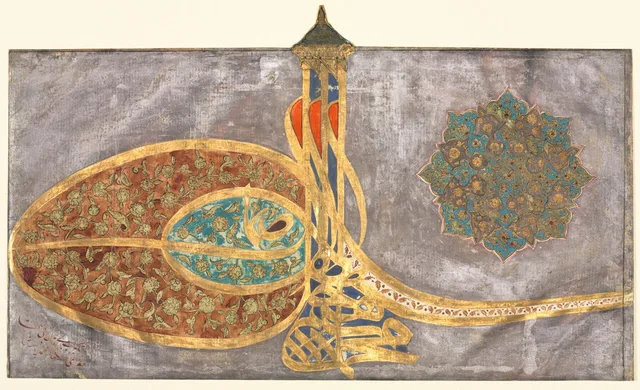
1648–1687 · Cleveland Museum of Art, Cleveland
Photo: Wikimedia Commons, CC0
At the head of every decree
The tughra made a document valid. It was drawn at the top of decrees (fermans), letters of appointment (berats) and official letters. It was drawn by the nişancı, head of the chancery. Later the specialist was called tuğrakeş, the tughra drawer, and learning the form had its own name, meşk-i tuğra, the practice of the tughra.
A decree of Mehmed IV, dated Ramadan 1092 (September–October 1681) and sold at Christie's, shows the order of such a document: the gilded tughra at the top and below it seven lines of diwani in gold, red and black, granting a cavalryman the revenues of villages near Kars.
It also travelled on metal: according to English Wikipedia, the first Ottoman coin with a tughra was struck for Süleyman Çelebi in 1404, and later coins bore it on one face. Turkish still calls a coin's two faces yazı and tura, the writing and the tughra. In stone it became a custom only under Ahmed III, from 1723; Derman knows just two older examples, one dated 1431 at Thessaloniki.
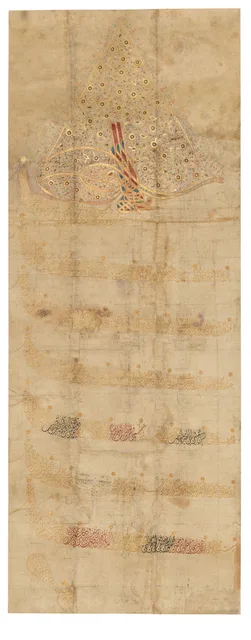
Ramadan 1092 AH / September–October 1681 · Private collection (sold at Christie's)
Photo: Wikimedia Commons, public domain
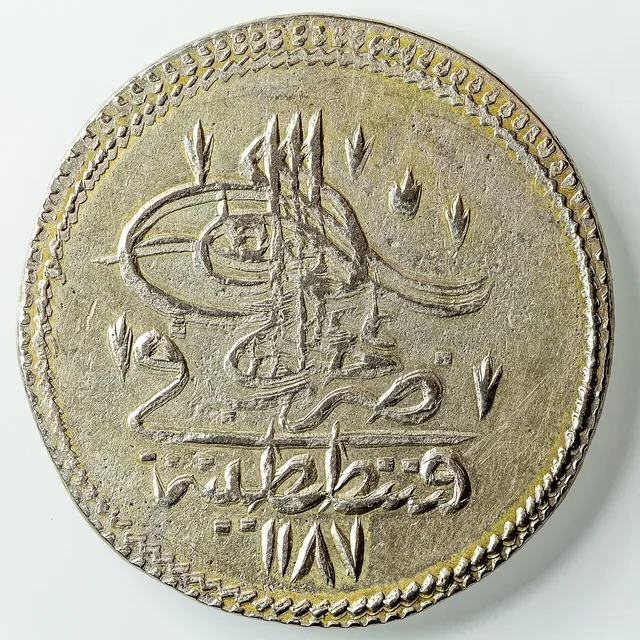
accession year 1187 AH / 1774 · Ottoman mint of Constantinople (Istanbul)
Photo: Raimond Spekking, Wikimedia Commons (1 Piastre 1188 Abdülhamid I (obv)-8481.jpg), CC BY-SA 4.0 (creativecommons.org/licenses/by-sa/4.0)
Mustafa Râkım's reform
The tughra changed most at the start of the nineteenth century. Mustafa Râkım, a master of jali thuluth, reshaped its letters one by one, spaced the words so they could be read, leaned the verticals slightly left and fixed the proportions between the parts. Derman sees the new manner taking shape in Mustafa IV's tughra of 1808 and at its height in Râkım's tughras for Mahmud II from 1815.
Derman's clearest example is Mahmud II's tughra of 1230 (1815) over the entrance of Topkapı Palace. Carved in stone, gilded on a dark ground, such tughras need no ornament: the letters carry the design. After Râkım the form passed to Haşim Efendi, Abdülfettah Efendi, Sami Efendi and İsmail Hakkı (Altunbezer).
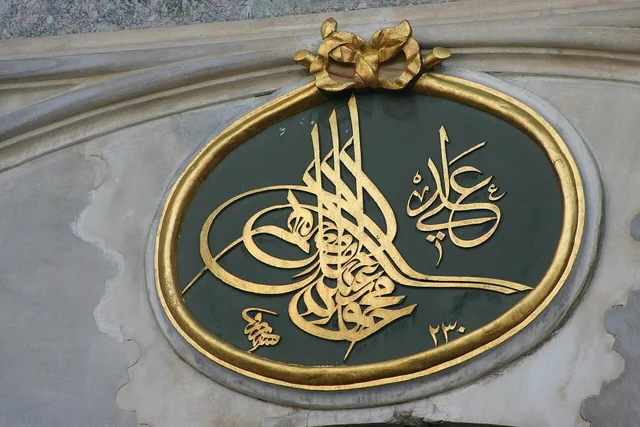
reign of Mahmud II, 1808–1839 · Topkapı Palace, Istanbul
Photo: José Luiz, Wikimedia Commons (Tughra of Mahmud II on the Gate of Salutation, Topkapi Palace.jpg), CC BY-SA 3.0 (creativecommons.org/licenses/by-sa/3.0)
Seals: a name cut in reverse
Beside the drawn tughra stood the pressed seal: mühür in Turkish, khatam in Arabic. The TDV article on seals describes the Prophet's: a silver ring set with a black agate, engraved Muhammad rasul Allah in three lines, with the name of God at the top, rasul in the middle and Muhammad at the bottom. It was lost when the caliph 'Uthman dropped it into the well of Aris in Medina.
A seal is written in mirror image. The engraver, the hakkak, cut the letters backwards into stone, metal or ivory so that the impression in ink, clay or wax would read the right way. Seal writing is the art of fitting a name into a small fixed shape, as on the gold ring with an inscribed nephrite stone in New York.
An Ottoman sultan had at least four seals made bearing his tughra. One of them was held by the grand vizier: to receive it meant appointment, and to hand it back meant dismissal. The Mughals joined both marks: a decree of Dara Shikoh, dated 1059/1649–50, in the Metropolitan Museum, carries two tughras and a seal.
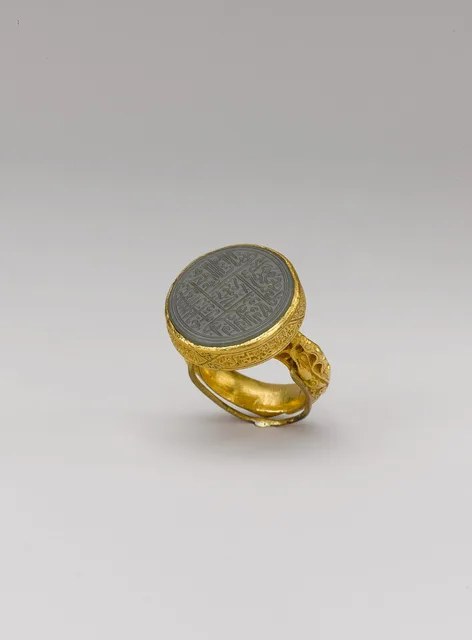
late 15th–early 16th century · The Metropolitan Museum of Art, New York
Photo: Wikimedia Commons, CC0
How to read a tughra
Start at the bottom. The sere holds the sultan's name, then bin, son of, his father's name, and al-muzaffar da'iman; the title Khan follows the father's name in early tughras and the sultan's own from Mahmud I on. Sami Efendi's tughra of Abdülhamid II, of 1880, reads: 'Abd al-Hamid Khan bin 'Abd al-Majid al-muzaffar da'iman.
Then look up. The verticals are letters pulled far above the line; the loops are long tails carried left and closed into ovals. Follow one stroke from start to end, and the knot at the base comes apart into words.
For a learner the tughra is a lesson in balance: a dense base, an open top, long strokes kept parallel. Copy a nineteenth-century tughra before an early one; its letters are thuluth, the forms you already practise.
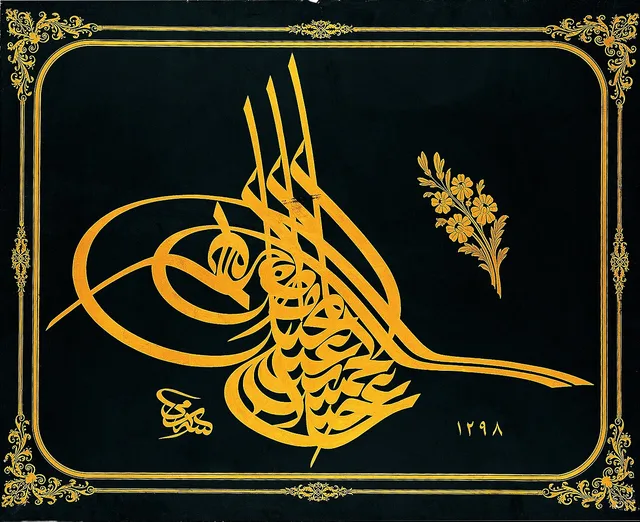
1880 · Sakıp Sabancı Museum, Istanbul
Photo: Wikimedia Commons, public domain
Sources
- M. Uğur Derman, "Tuğra", TDV İslâm Ansiklopedisi, vol. 41, 2012
- Necati Fahri Taş, Nebi Bozkurt and Mübahat S. Kütükoğlu, "Mühür", TDV İslâm Ansiklopedisi, vol. 31
- Wikipedia (English), "Tughra"
- Christie's, "A firman of Sultan Mehmed IV (r. 1648-87 AD), Ottoman Turkey, dated Ramadan AH 1092/September-October 1681 AD", online sale Calligraphy, Art & Writing
- The Metropolitan Museum of Art, "Firman of Dara Shikoh", sf1997-205a
- Gottfried Herrmann, "Ein früher persischer Erlass", Zeitschrift der Deutschen Morgenländischen Gesellschaft 144, 1994
Try it now in this very script — محمد
Open in the Studio →Written by the MASHQ studio · last updated 2026-10-05. Further reading, the standard references in English: Sheila S. Blair, Islamic Calligraphy (Edinburgh University Press, 2006) · Annemarie Schimmel, Calligraphy and Islamic Culture (New York University Press, 1984) · Yasin Hamid Safadi, Islamic Calligraphy (Thames and Hudson, 1978).
Keep exploring
From the store's journal: The meaning behind popular phrases